● China-AI-Chip-Shift,Deflation-Trap,Memory-War
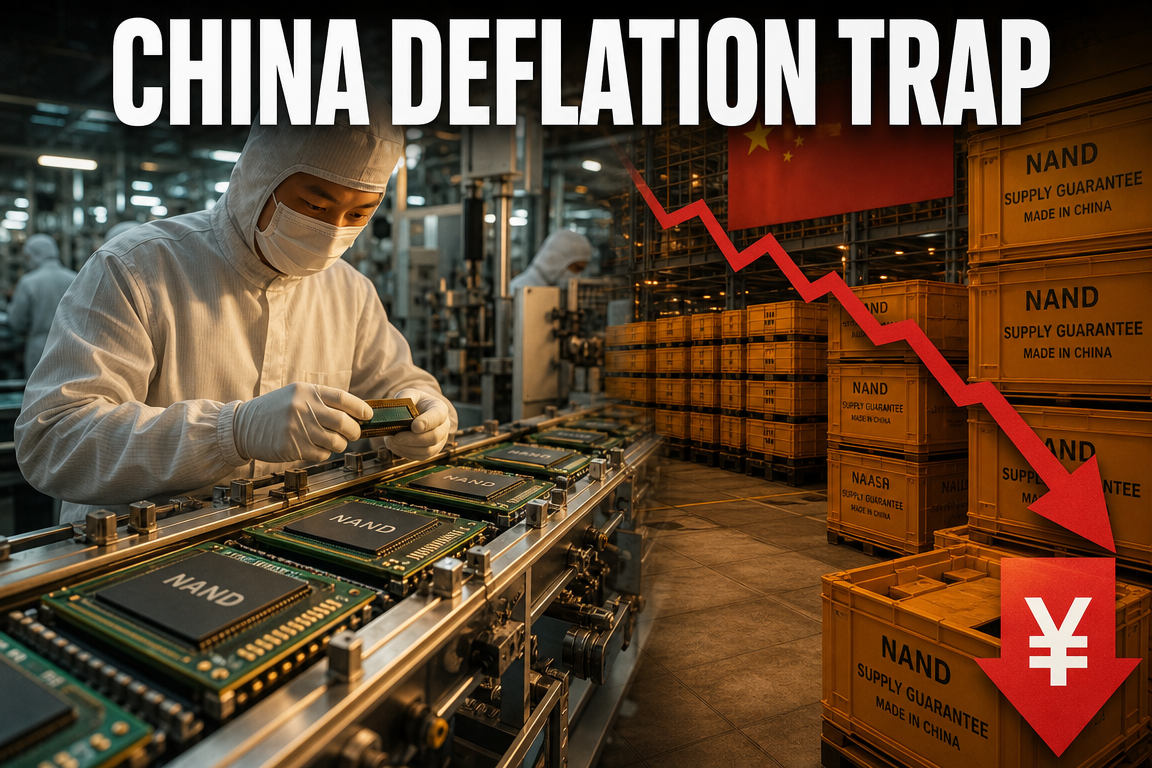
China’s AI Semiconductors Are Advancing: Why Is the Chinese Economy Still Struggling?
The key point of this article is not simply that “Chinese semiconductors are becoming a threat.”
It reviews why the Chinese economy remains trapped in deflation and weak domestic demand even as China expands across the AI infrastructure, AI models, AI services, and physical AI segments of the semiconductor value chain.
For Samsung Electronics, SK Hynix, and KOSPI investors, the issue is no longer just “China has not caught up in HBM yet.”
The market is already positioning for semiconductor value-chain restructuring after 2026, rather than waiting for near-term earnings alone.
This report summarizes the real competitiveness of China’s AI semiconductors, CXMT’s rapid catch-up, risks to US hyperscaler investment, polarization within the Chinese economy, and key response points for Korea’s semiconductor sector.
1. How Far Has China’s AI Semiconductor Industry Advanced?
The core of the global AI competition is who can secure more computing power.
AI performance depends on data centers, GPUs, HBM, network equipment, servers, and power infrastructure.
In other words, AI competition is not just a model-performance race; it is a contest over the entire semiconductor value chain.
In terms of data-center scale, the US remains far ahead.
The US operates more than 4,700 data centers, while China has only around 300, leaving a large gap.
Korea has also expanded beyond 100 data centers, but its scale remains limited relative to the US and China.
However, focusing only on data-center count can be misleading.
China is developing its AI ecosystem through a different model from the US CAPEX-heavy approach.
The key strategy is to advance AI infrastructure, AI models, AI services, and physical AI products simultaneously.
2. China’s Strength Becomes Clearer Through an AI Full-Stack View
The AI value chain can be divided into four layers:
- AI infrastructure: GPUs, HBM, DRAM, servers, PCBs, CCL, packaging, data centers
- AI models: large language models, multimodal models, open-source models
- AI services: messaging, payments, e-commerce, delivery, mobility, finance, public services
- Physical AI: robots, autonomous vehicles, smart appliances, humanoid robots
Korean investors tend to focus mainly on AI infrastructure, especially HBM and memory semiconductors.
Samsung Electronics and SK Hynix remain highly competitive in HBM.
However, China is not targeting HBM alone; it is advancing across multiple points in the value chain.
3. AI Infrastructure: GPUs in the US, HBM in Korea, Packaging in Taiwan, Yet China Has Found Gaps
The US remains the strongest country in AI infrastructure.
NVIDIA GPUs dominate global AI training and inference infrastructure.
Korea leads in HBM.
SK Hynix and Samsung Electronics are key global suppliers in high-bandwidth memory.
HBM is a critical bottleneck technology that determines AI semiconductor performance.
Taiwan remains strong in packaging through TSMC.
Japan continues to play an important role in package substrates and materials.
China also holds strengths in specific areas.
One of the most important is PCB and CCL.
PCBs connect GPUs, HBM, network equipment, and server components.
As AI server performance increases, higher layer counts, lower signal loss, and greater stability are required.
This continues to raise the technical barrier for PCBs.
CCL is a core material used in PCBs.
High-speed data transmission in AI servers creates signal-loss challenges.
High-spec CCL is needed to reduce these losses.
China already has strong competitiveness in this area.
In short, China has not fully captured GPUs or HBM.
However, it has already built substantial influence in selected parts of the AI semiconductor value chain.
4. CXMT’s Rise: China’s DRAM Challenge Is Becoming the Most Realistic Threat
The most important company to watch in China’s semiconductor catch-up is CXMT.
Just a few years ago, CXMT had almost no presence in the global DRAM market.
Its market share has been rising rapidly.
- Samsung Electronics DRAM share: around 38%
- SK Hynix DRAM share: around 29%
- Micron DRAM share: around 22%
- CXMT DRAM share: around 8%
The outlook is more important.
CXMT’s market share could rise to around 11% by 2026.
As China’s DRAM share increases, the relative shares of Samsung Electronics, SK Hynix, and Micron may decline.
Korean firms still lead in HBM.
However, China is increasing investment in HBM production as well.
Even if China does not catch up immediately, it could pressure the market within 2–3 years through price competitiveness and domestic procurement policy.
Semiconductor investing should not be based only on current earnings.
The stock market always prices in the future first.
Even if Samsung Electronics and SK Hynix post strong earnings over the next 1–1.5 years, the market may discount the competitive landscape beyond that horizon.
5. AI Models: Dependence on Chinese Models Is Rising
China is gaining ground not only in AI infrastructure but also in AI models.
Examples include DeepSeek, Kimi, MiniMax, and Xiaomi-related models.
Recent Chinese AI models have narrowed the gap with US models in math, coding, language reasoning, and multimodal tests.
OpenAI, Google, and Anthropic remain at the global top tier.
However, in terms of market share and usage, Chinese models are expanding quickly.
The key point is usage rather than benchmark performance.
AI models ultimately matter most when they are widely used in the market.
Rising usage of Chinese models indicates that China’s AI ecosystem is expanding on its own.
6. AI Services: The Real Strength of China’s Super-App Structure Is Data
China’s advantage in AI services comes from its super-app ecosystem.
WeChat, Alipay, Meituan, and Didi integrate multiple functions within a single app.
- Messaging
- Mobile payments
- E-commerce
- Food delivery
- Ride-hailing
- Financial services
- Public services
- Healthcare services
By comparison, US platforms are more segmented.
Facebook and Instagram focus on social networking.
Amazon is centered on e-commerce.
Uber focuses on mobility.
Chinese platforms, by contrast, manage a broad range of daily functions within one application.
The key advantage of this structure is data.
In the AI era, companies with more data can build more refined services.
Chinese super-apps collect data on payments, mobility, shopping, consumption, and communication at the same time.
This factor is often understated, but it is critical.
China’s AI service strength comes not only from model performance but also from its data-collection structure.
7. Physical AI: The Fastest-Growing Area for China
The most important area after 2026 will be physical AI.
Physical AI refers to the combination of software AI with real-world physical products.
Examples include robots, autonomous vehicles, smart appliances, and humanoid robots.
China is rapidly increasing its share in collaborative robots and service robots.
For example, DoBot’s robot barista can operate 24 hours a day and produce hundreds of cups of coffee daily.
Popcorn-selling robots, food-preparation robots, and mobile service robots are also being commercialized quickly.
Home robots are another important area.
Chinese companies such as Yuan Robotics are targeting products that replace repetitive household tasks such as dishwashing, laundry, and cleaning.
The strategy is to prioritize practical products that consumers can afford, rather than highly complex humanoid robots.
This approach aligns with China’s traditional manufacturing strength.
The emphasis is on rapid commercialization and price competitiveness rather than perfect technological leadership.
8. Why Is the Chinese Economy Still Struggling?
The key question is why China remains under economic pressure despite strength in AI semiconductors, robots, electric vehicles, batteries, and solar power.
The answer is polarization.
China’s new economy is growing rapidly, while the old economy continues to weaken.
The new economy includes AI, semiconductors, EVs, batteries, solar power, robots, displays, and advanced manufacturing.
The old economy includes real estate, construction, traditional infrastructure, domestic consumption, and low value-added manufacturing.
China’s new economy is large enough to influence global markets.
However, the old economy is too large and too deeply stressed.
As a result, overall growth has slowed.
9. China Has Already Moved Into a Mid-Growth Regime
China was once a high-growth economy with double-digit expansion.
At one point, growth reached 14%.
Today, even 5% growth is difficult to sustain.
According to IMF projections, China’s growth rate could fall to the low-4% range after 2026.
A 4% growth rate is high by developed-market standards.
But for an economy facing debt, property stress, local-government financing pressure, and youth unemployment, the slowdown has a much larger impact.
China is no longer in a position to sustain high growth through investment and property-led expansion.
10. China Remains Trapped in Deflation
China’s biggest macroeconomic problem is deflation.
Producer prices have remained negative for an extended period.
Consumer inflation has also hovered around 0%.
At first glance, this may appear stable.
But in a 4–5% growth economy, consumer inflation near 0–1% indicates weak demand.
The more serious issue is that even when producer prices rebound due to raw-material costs, the increase does not pass through to consumer prices.
This indicates that firms cannot transfer costs to consumers.
That is a sign of weak end-demand.
This pattern is similar to Japan’s lost decades.
Lower rates do not revive consumption, and liquidity does not restore property or domestic demand.
11. Rate Cuts Have Not Revived Domestic Demand
China has continued to lower its LPR, its benchmark policy lending rate.
The policy rate is now around 3%.
For a 4–5% growth economy, a 3% rate is highly accommodative.
Even so, domestic demand has not recovered strongly.
Retail sales growth has slowed.
The property market has also failed to show a clear rebound.
In effect, liquidity is being supplied, but the private sector is not responding with stronger consumption or investment.
This is the core of China’s economic weakness.
12. Why Rising AI Exports Are Not Enough to Lift China’s Overall Growth
China’s AI-related exports are clearly increasing.
Exports of integrated circuits, semiconductor components, and AI-server-related goods have risen.
However, an important distinction is needed.
Higher export value may reflect prices rather than volume.
Recent growth in semiconductor exports has been driven in part by price increases.
The same is true for Korea.
Export value has risen, but shipment volume has not necessarily increased at the same pace.
Export growth driven by prices has a limited effect on overall growth.
By contrast, export growth driven by volume has a stronger impact on employment, output, and investment.
Another important point is that China remains a net importer of advanced semiconductors.
China exports some lower-end chips, but it still depends heavily on foreign suppliers for advanced AI semiconductors and high-performance chips.
As a result, even if AI investment rises, the simultaneous increase in high-end semiconductor imports may limit the improvement in the trade balance.
13. The Core of China’s Economy Is the Polarization Between the New and Old Economy
China’s new economy is strong.
Electric vehicles, batteries, solar power, AI models, robots, and certain semiconductor materials and components are pressuring global markets.
But the old economy remains weak.
Real estate, construction, local-government infrastructure investment, and traditional domestic consumption have not recovered.
As a result, overall growth slows.
Even rapid growth in the new economy cannot fully offset weakness in the old economy.
This polarization is also visible in wages.
Average wages in IT continue to rise relatively quickly.
By contrast, wage growth in manufacturing, construction, and wholesale sectors remains limited.
Within China, the income gap between workers in advanced industries and those in traditional sectors is widening.
14. Youth Unemployment Is Another Burden
China’s youth unemployment remains high.
Although changes in statistical methodology can make the figure appear lower at times, the underlying trend remains a concern.
China is pushing industrial policy toward AI, robotics, and advanced manufacturing.
However, these industries do not absorb labor on the same scale as property, construction, or traditional manufacturing.
AI and robotics raise productivity, but they can also limit new job creation.
If the number of quality jobs sought by college graduates does not increase sufficiently, consumer sentiment will remain weak.
15. What Does This Mean for Korea’s Semiconductor Industry?
For Korea, the key is to separate near-term earnings from the medium- and long-term structure.
In the near term, there is little doubt about Samsung Electronics and SK Hynix’s earnings outlook.
AI server investment, HBM demand, and memory-price recovery can support results over the next 1–1.5 years.
However, the stock market discounts future competitive conditions before current results fully materialize.
If China expands its share in DRAM, PCBs, CCL, AI models, and physical AI, Korea’s semiconductor revenue base and pricing power could weaken over time.
US hyperscaler CAPEX durability is also an important variable.
If AI services fail to generate sufficient returns, data-center investment could slow.
That would affect demand for Korean semiconductors as well.
As China raises its domestic semiconductor self-sufficiency, Korea’s export structure to China may also change.
16. The Market’s Real Concern Is Not “Now” but What Comes After
Many investors say, “China has not caught up in HBM yet.”
That is correct.
But the market does not stop there.
The market is looking toward 2026 and beyond.
If China moves from low-end DRAM into higher-end memory, and if it builds a self-sustaining ecosystem across AI models and services, the global semiconductor demand structure could shift.
Similar transitions have occurred before.
Steel shifted from the US and Japan to Korea, then to China.
Shipbuilding also moved from the US and Japan to Korea, then to China.
The same pattern appeared in displays, batteries, and EVs as China accelerated its catch-up.
It is difficult to assume that semiconductors and AI will be exceptions.
Korea must therefore widen its technological lead.
The most important areas are HBM, high-performance DRAM, packaging-linked technologies, the AI chip design ecosystem, and power-efficiency technologies.
17. The Most Important Points That Other Reports Often Miss
First, China’s real strength is not a single technology, but distributed control across the value chain.
China is not the global leader in GPUs or HBM.
But it is building strength in PCBs, CCL, low-end DRAM, super-app data, and physical-AI commercialization.
Together, these strengths can form a powerful industrial ecosystem over time.
Second, the key to China’s AI services is data structure, not just model quality.
Super-apps such as WeChat and Alipay collect extensive behavioral data.
In the AI era, that data becomes a core asset for model improvement and service commercialization.
Third, the statements “China’s economy is weak” and “China’s advanced industries are strong” can both be true.
China’s new economy is strong, while the old economy is weak.
That is why the overall economy slows even as some industries pressure global markets.
Fourth, Korean semiconductor investors should watch value-chain migration rather than only current earnings.
Even if Samsung Electronics and SK Hynix post strong near-term results, share prices can still be volatile.
The market is simultaneously pricing China’s catch-up, slowing price growth, the sustainability of US CAPEX, and questions around AI profitability.
Fifth, Korea’s response should be technological leadership, not protectionism.
Korea must protect its core strengths in HBM, high-performance memory, advanced packaging cooperation, AI chip ecosystems, and power-efficiency technologies.
The appropriate strategy is not to dismiss China, but to recognize its progress and extend Korea’s lead further.
18. USD/KRW and Global Liquidity Also Matter
Semiconductor stocks and the KOSPI are not driven solely by industry fundamentals.
The dollar index, USD/KRW, US liquidity, and changes in the yen carry trade also matter.
A weaker dollar can support a stronger won.
In that case, foreign capital flows may become more favorable for the Korean equity market.
However, whether US liquidity remains strong or turns weaker is a separate issue.
The durability of US hyperscaler AI investment, expectations for rate cuts, and macroeconomic indicators are all linked.
Ultimately, the KOSPI and semiconductor stocks move at the intersection of industrial competitiveness and global liquidity.
< Summary >
China is advancing rapidly across the AI semiconductor value chain.
The US and Korea still lead in GPUs and HBM, but China is strengthening its position in PCBs, CCL, DRAM, AI models, super-app data, and physical AI.
CXMT is rapidly increasing its DRAM share and narrowing the gap with Samsung Electronics, SK Hynix, and Micron.
At the same time, the Chinese economy remains weak overall.
The reason is the widening gap between a strong new economy and a weak old economy centered on property, construction, and domestic demand.
Deflation, weak consumption, youth unemployment, and property-sector stress are weighing on growth.
Korean semiconductor investors should focus less on near-term earnings alone and more on value-chain restructuring after 2026.
The key response is not to underestimate China, but to widen the lead in HBM and high-performance memory.
[Related Articles…]
- AI Semiconductor Value-Chain Restructuring and Korea’s Investment Strategy
- China’s Deflation and Its Impact on Global Equity Markets
*Source: [ 경제 읽어주는 남자(김광석TV) ]
– [LIVE] 중국의 AI-반도체가 온다. 그런데 중국은 왜 어려운가? [즉시분석]
● AI Power Surge, Chip Shock, Oil Bounce
U.S. stocks were mixed as AI power and nuclear names strengthened, while semiconductors weakened on guidance disappointment
Key Points to Watch in Today’s Market
This session in New York should not be reduced to a simple “semiconductor selloff.”
The Nasdaq weakened on disappointing memory semiconductor guidance, while Dow futures held up relatively well on expectations of renewed passage through the Strait of Hormuz and strength in energy and healthcare.
Constellation Energy drew significant attention as AI power demand and the revaluation of nuclear assets became key themes.
Weekly jobless claims declined, labor productivity improved, and unit labor costs slowed, sending important signals for rates and Federal Reserve policy.
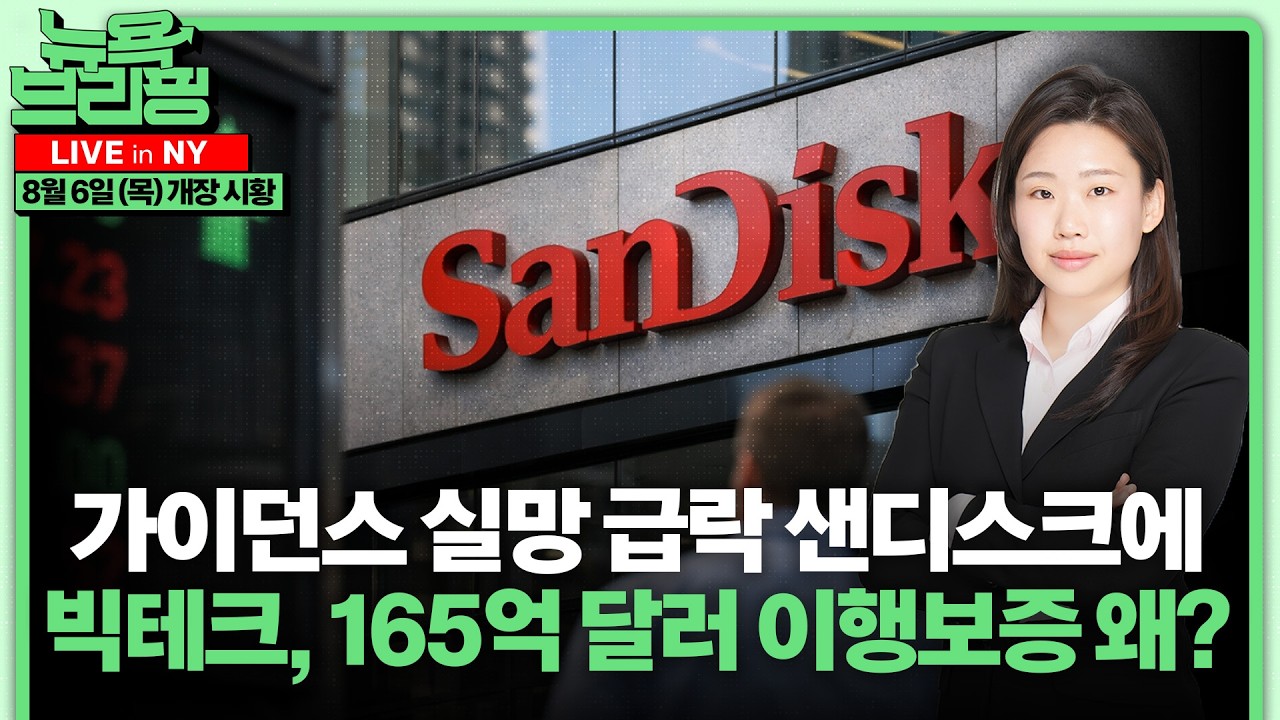
The most important takeaway came from Sandisk’s conference call: a long-term NAND supply race among large technology firms.
The key issue is not simply rising semiconductor demand, but that customers are reportedly providing financial guarantees for supply contracts of up to five years.
Pre-Market U.S. Trading: Dow Held Firm, Nasdaq Weighed by Semiconductors
U.S. futures were broadly mixed before the open.
Dow Jones futures rose about 0.12%, showing relative stability.
S&P 500 futures fell about 0.1%.
Nasdaq 100 futures declined about 0.8%, reflecting pressure on technology and semiconductor shares.
After the open, the Nasdaq remained under pressure, and weakness in semiconductors weighed on overall market sentiment.
The defining feature of the session was clear sector divergence.
AI-related semiconductors and software were weak, while financials, healthcare, and energy held up better.
Semiconductor Shares: Nvidia Held Up, but Memory Names Fell Sharply
The semiconductor sector was broadly weak.
Nvidia rose about 0.85% in pre-market trading and remained relatively resilient.
Broadcom also gained about 0.31%.
However, memory and legacy semiconductor names were notably weaker.
- Micron fell more than 5% at one point before the open.
- AMD extended its post-earnings weakness and fell about 1%.
- Intel declined about 2%.
- Texas Instruments also weakened.
- Applied Materials and Lam Research also moved lower.
The main driver was disappointing guidance from Sandisk and Western Digital after earnings.
Reported results were not weak, but expectations were elevated, and next-quarter guidance fell short of Wall Street estimates, triggering broader selling across the sector.
The impact spread beyond the U.S. market and into Asian semiconductor equities.
- SK Hynix fell about 10%.
- Samsung Electronics declined about 6%.
- Kioxia in Japan fell about 8%.
- China’s YMTC and SMIC also weakened.
- TSMC in Taiwan also moved lower.
This correction was driven less by a collapse in demand and more by stretched valuations and excessive expectations.
Sandisk Earnings: Strong Numbers, but Below Elevated Expectations
Sandisk’s earnings release was strong on the surface.
Revenue increased about 372% year over year.
EPS turned sharply positive from a prior loss.
The company attributed the improvement to higher NAND pricing and stronger volumes.
Data center SSD demand was especially strong.
Data center revenue rose about 103% quarter over quarter.
By contrast, consumer business revenue fell about 32%.
The results therefore reflected AI infrastructure investment demand.
The issue was next-quarter guidance.
The company guided revenue to roughly $10.3 billion to $10.8 billion.
Street expectations were around $11.16 billion.
EPS guidance of 44 to 46 also failed to materially exceed market expectations.
In the end, weaker-than-expected guidance outweighed strong reported results.
The Most Important Point: Big Tech Is Securing NAND Supply with Financial Guarantees
The most important issue from Sandisk’s conference call was not revenue or EPS.
The real takeaway was that contract structure in the AI memory market is changing materially.
CEO David Goeckeler said NAND contracts used to be structured on a quarterly basis.
Today, the company can already see demand extending more than four years out.
More importantly, customers are signing supply agreements as long as five years.
These customers are effectively large cloud and technology companies.
Some key customers are reportedly returning with higher demand than they had forecast just three months earlier.
This suggests that the AI data center investment cycle is not a short-term trend.
Sandisk expects demand to remain strong through the end of 2027 and into 2028.
What Many Reports Missed: The Meaning of the $16.5 Billion Performance Guarantee
The most notable detail was the financial guarantee structure.
Sandisk said customers are providing financial guarantees alongside long-term contracts.
If a customer fails to honor the agreement, up to $16.5 billion in guaranteed payments could be made to Sandisk.
This is highly significant.
In typical semiconductor transactions, the buyer has stronger bargaining power than the supplier.
Here, however, large technology firms are effectively providing guarantees to secure NAND supply for AI infrastructure.
This indicates that memory has shifted from a standard component to a strategic AI data center asset.
In the past, it was a buy-as-needed part. Now it has become critical infrastructure that can constrain AI expansion if not secured in advance.
Another important point is pricing structure.
There had been concern that long-term contracts would eliminate participation in future NAND price increases.
Sandisk said pricing is structured as a mix of fixed and market-linked terms.
In other words, long-term contracting does not fully sacrifice upside from higher pricing.
Constellation Energy: AI Power Demand Repriced the Nuclear Theme
One of the strongest names in the session was Constellation Energy.
Constellation is a leading U.S. nuclear power company.
It is being viewed as a beneficiary of AI power demand and as a leading nuclear stock.
The company raised its full-year earnings outlook.
It lifted adjusted EPS guidance to around $12.50.
Second-quarter adjusted EPS rose from $1.91 a year earlier to $2.55.
GAAP net income declined due to one-time acquisition-related costs.
Even so, the market reacted positively because AI data center power demand appears likely to remain durable.
Constellation said it added 920 MW of long-term power supply contracts with corporate customers.
Contract terms range from 15 to 20 years.
This should be viewed not simply as a power sales agreement, but as a strategic position in AI infrastructure.
The company also advanced regulatory approval for restarting the Crane nuclear plant in Pennsylvania.
It has also begun proceedings to extend the operating lives of two New York nuclear plants through 2049.
In the AI era, semiconductors are not the only critical asset.
Data centers that run GPUs, the power that supports those data centers, and stable baseload generation are becoming equally important.
Within this framework, nuclear assets are being revalued.
Hormuz Negotiations and Oil: The Background for Energy Strength
Crude oil rebounded after several days of declines.
WTI crude rose about 2.5%.
Brent crude gained about 2.45%.
Markets focused on reports that Iran and Oman are nearing talks on reopening the Strait of Hormuz.
However, the key issue is not merely whether an agreement is reached, but the terms of any deal.
One important unresolved question is whether Iran could impose transit fees on ships passing through the strait.
The Strait of Hormuz is a critical corridor in global oil transport.
Uncertainty in the region can affect oil prices, inflation, rates, and energy stocks.
The rebound in oil supported energy shares.
Large integrated names such as Exxon Mobil moved higher.
ConocoPhillips: Higher Oil Prices and Margin Expansion Lifted Results
ConocoPhillips also reported better-than-expected earnings.
Second-quarter adjusted EPS came in at $3.24, above the $2.90 consensus estimate.
Net income rose from about $2.0 billion a year earlier to about $3.9 billion.
Average realized oil and gas prices increased about 36% year over year, significantly improving profitability.
Production was slightly lower than a year earlier, but came in above expectations at about 2.25 million barrels per day.
The company maintained its full-year production outlook.
Management changes were also announced.
After 14 years leading the company, CEO Ryan Lance will step down, and CFO Andy O’Brien will become the new CEO.
Howmet Aerospace: Recovery in Aviation Demand and Production Expansion Expectations
Howmet Aerospace also reported better-than-expected earnings.
The company produces aircraft engine and structural components.
Second-quarter EPS was $1.33, above the $1.23 consensus estimate.
Revenue also exceeded expectations at $2.55 billion.
Third-quarter EPS guidance was raised to $1.36.
Full-year EPS guidance was increased from $5.23 to $5.31.
Results were supported by Boeing and Airbus production growth and a recovery in air travel demand.
U.S. Economic Data: Lower Claims and Better Productivity Were Positive
Economic data released before the open also sent an important signal.
Initial jobless claims for last week were reported at 199,000.
That was below the consensus estimate of 204,000.
This suggests companies are not yet engaging in large-scale layoffs.
Second-quarter labor productivity rose 1.4%.
That was well above the expected 0.6%.
It means workers produced more output in the same amount of time.
Unit labor costs rose only 1.3%.
That was below the expected 2.1%.
This combination was constructive for corporate margins.
Productivity improved while labor cost pressure remained modest.
For the Federal Reserve, this also suggests that wage-driven inflation pressure is not accelerating materially.
Overall, the data reduced recession concerns without eliminating hopes for rate cuts.
Software and Large Cap Technology: AI Theme Remains, but Stock Selection Is Increasingly Important
The software sector was also mixed.
Microsoft recovered into positive territory after early weakness, while Oracle, Palantir, and Palo Alto Networks were weaker.
Google declined, Meta posted a modest gain, and Amazon was roughly flat to slightly higher.
Tesla remained under pressure.
This suggests investors still believe in the broader AI theme, but the market has moved beyond indiscriminate buying of all AI-related names.
Going forward, the focus is likely to shift toward revenue, margins, guidance, cash flow, and power-securement capabilities.
Healthcare Strength: Defensive Characteristics and Earnings Stability
Healthcare shares were broadly stronger.
Eli Lilly extended gains after reporting strong results the previous day.
Johnson & Johnson, AbbVie, Amgen, Gilead, and Pfizer also moved higher.
As semiconductor and technology volatility increased, capital rotated toward healthcare names with more stable earnings profiles.
Healthcare often acts as a defensive sector when the U.S. market corrects.
Treasury Yields and Gold: Safe-Haven Assets Regained Attention as Volatility Rose
U.S. Treasury yields showed modest intraday volatility.
As semiconductor weakness and technology pressure continued, the bond market was also searching for direction.
Gold prices rose slightly.
Gold had been relatively soft during earlier equity strength, but it rebounded again as the stock market corrected in late June and early July.
Silver followed a similar direction, though less sharply.
A Variable to Monitor: Lockup Expiration Risk
The original material referenced a first lockup expiration at SpaceX and the potential release of more than 900 million shares.
However, since SpaceX is a private company, the exact name and structure of that reference should be verified.
Lockup expirations can increase short-term volatility by allowing existing holders to sell shares.
If a large lockup event is indeed approaching for another growth company, it may affect not only that stock but also broader sentiment toward growth names.
Investment Implication: The Market Should Look Beyond AI Semiconductors to the Full AI Infrastructure Stack
The key investment message from this session is that AI should be viewed as a broader infrastructure theme.
Until recently, the market interpreted AI mainly through Nvidia, AMD, memory semiconductors, and semiconductor equipment.
Now the bottleneck is extending to power, cooling, data center land, long-term supply contracts, and nuclear operating life extensions.
Constellation Energy’s strength illustrates this shift.
Sandisk’s long-term NAND contracts and $16.5 billion guarantee structure suggest that AI data center demand may be more structural than previously assumed.
At the same time, names with stretched valuations can still correct even after reporting strong results.
Sandisk and AMD illustrate that point.
Accordingly, the key issue is not simply whether a company is high quality, but how much of the future is already reflected in the share price.
Investors should assess AI power demand, semiconductor earnings, Nasdaq volatility, oil prices, and Federal Reserve policy together.
What Many Market Commentaries Missed
- First, Sandisk’s weakness reflected guidance disappointment, not a deterioration in earnings quality.
- Second, memory demand has not weakened; it is becoming more structured through long-term contracts with large technology firms.
- Third, customer financial guarantees for NAND supply are highly unusual.
- Fourth, in the AI data center era, power supply contracts are becoming as important as semiconductor supply agreements.
- Fifth, Constellation Energy’s nuclear restart and operating-life extensions are a critical part of the AI infrastructure investment case.
- Sixth, better productivity and slower unit labor cost growth are positive for the Federal Reserve’s policy outlook.
- Seventh, the rebound in oil is not only a price move; it could again become an inflation variable depending on the outcome of Strait of Hormuz negotiations.
< Summary >
U.S. stocks traded mixed, with Dow futures higher and the Nasdaq lower.
Semiconductor shares weakened after disappointing guidance from Sandisk and Western Digital, and the pressure spread to Asian chip stocks.
Constellation Energy strengthened on rising AI power demand and a higher valuation for nuclear assets.
The most important issue was Sandisk’s disclosure of five-year NAND supply contracts and a $16.5 billion performance guarantee structure.
U.S. jobless claims fell and labor productivity improved, sending a constructive signal for growth and rates.
Going forward, the market is likely to reprice not only AI semiconductors, but the broader AI infrastructure ecosystem, including power, nuclear assets, data centers, and long-term supply agreements.
[Related Articles…]
- AI Power Demand Is Reshaping Global Investment Trends
- Semiconductor Correction and Key Takeaways for Nasdaq Strategy
*Source: [ Maeil Business Newspaper ]
– 콘스텔레이션, AI 전력 수요 기대에 강세ㅣ호르무즈 해협 재개 협상에 다우 선물 상승, 나스닥은 반도체주 약세ㅣ미국 실업수당 청구건수 줄고 노동생산성 지표 개선ㅣ홍혜진의 뉴욕브리핑