● Power Bottleneck in AI Datacenters
Why Nvidia’s Shift to 800VDC Is Changing the AI Data Center Investment Landscape
The core point of AI infrastructure competition is shifting from the GPU procurement race to a power infrastructure war.
This article organizes what the 54V, 400V, and 800V numbers that keep appearing in recent AI data center news actually mean.
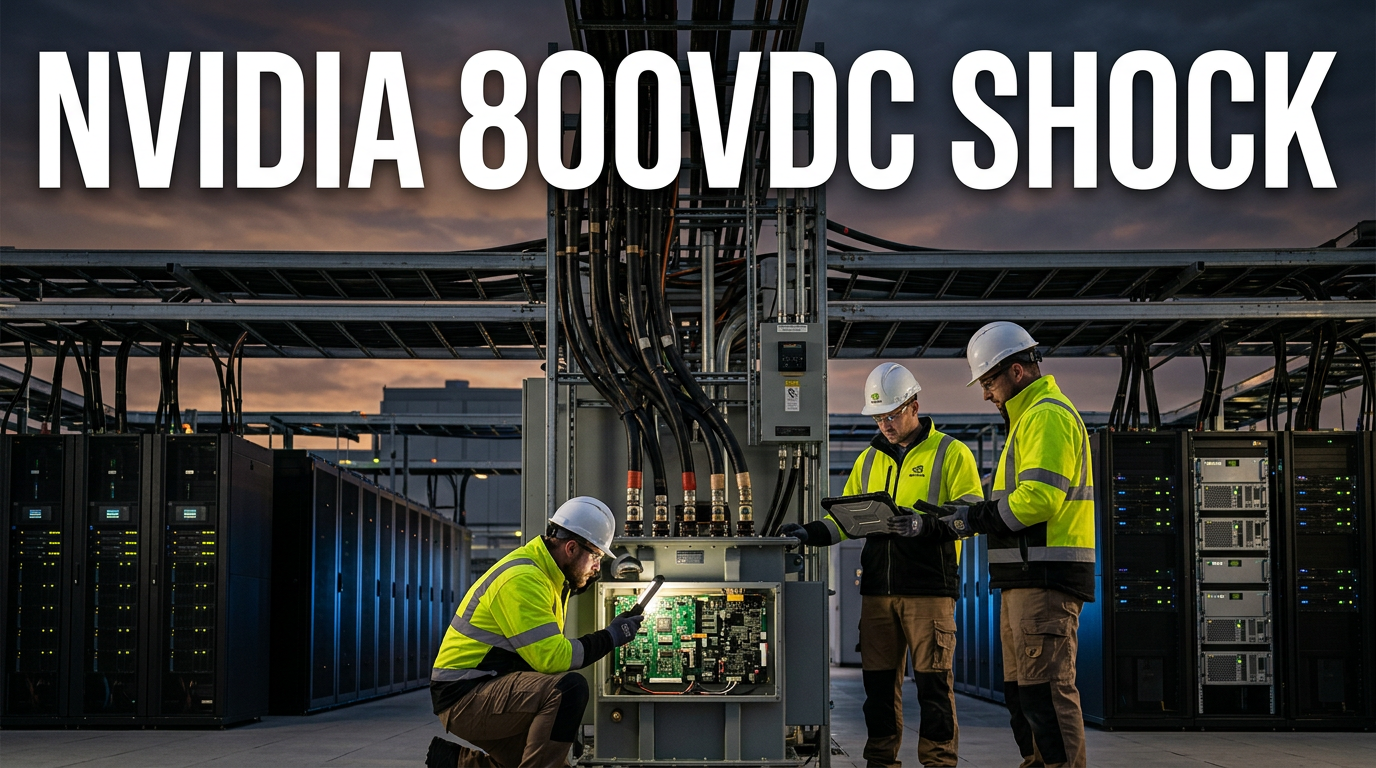
It also explains in news format why Nvidia is trying to raise data center voltage by about 15 times compared with the existing standard, and how this change will affect the power semiconductors, MLCCs, copper, batteries, UPS, and data center investment markets.
The key takeaway is simple.
The bottleneck in AI competition is moving from chips to electricity, and we are entering an era in which what matters more than ‘how many GPUs you bought’ is ‘how many tokens you can produce with the same amount of electricity.’
1. Why did the voltage issue suddenly become important in AI data centers?
The biggest difference between traditional data centers and AI data centers is the power consumed by a single server rack.
In the past, a typical data center server rack was built to use roughly a few kW to around 10kW of power.
But AI data centers, by packing in high-performance GPUs densely, have pushed rack-level power consumption up to around 150kW.
And that is not the end of it.
Nvidia is preparing ultra-dense racks based on the next-generation Rubin Ultra GPU in 2027.
These racks can hold up to 576 GPUs, and a single rack may consume power at the 1MW level.
1MW is comparable to the power used by an entire large apartment complex.
In other words, AI data centers are now becoming less like simple server buildings and more like giant power-consuming factories.
That means AI infrastructure competitiveness is no longer determined by GPU performance alone.
How efficiently power is delivered, converted, cooled, and stored is becoming the key variable that determines data center investment returns.
2. How does electricity currently move to the GPU in a data center?
AI semiconductors are not parts that you simply plug electricity into and use directly.
Electricity coming from the external grid changes voltage and form multiple times as it moves through several stages.
-
First, AC power at tens of thousands of volts enters the data center from the external transmission grid.
-
At the data center substation, this voltage is stepped down to the level of a few hundred volts.
-
The PSU mounted in the server rack converts AC to 54V DC.
-
It is then stepped down again to around 12V.
-
Finally, through the motherboard VRM, it is converted to around 1V, the voltage actually used by the GPU.
There is an important point here.
The problem is not the final 1V used by the GPU.
The real bottleneck is the section that transports power inside the data center to the server rack.
At present, this section mainly uses 54V DC, but as the power demand of AI racks grows too large, the 54V structure is hitting its limits.
3. Why has the 54V structure reached its limit?
The basic formula for power is simple.
Power = Voltage × Current
When the power demanded by one rack increases but voltage remains low, current has to rise dramatically.
For example, to deliver 1MW at 54V, nearly 20,000 amps of current are required.
Compared with household current levels in the tens of amps, that is an absurdly large amount of current.
The problem is that as current rises, power losses increase sharply.
Losses in a wire are proportional to the square of the current.
If current doubles, losses quadruple, and if current increases tenfold, losses increase 100-fold.
Some reports estimate that moving to 1MW-class AI racks could increase power loss by as much as 70 times compared with the previous generation.
In the end, a significant portion of the electricity is lost as heat before it even reaches the GPU.
To cool that heat, the cooling system must work harder, which in turn increases power consumption again.
In this structure, AI data center operating costs have no choice but to rise quickly.
4. Nvidia’s solution: 800VDC
Nvidia’s solution is to dramatically increase the voltage used to transport power.
Raising the voltage from the existing 54V to 800V DC makes the voltage about 15 times higher.
When delivering the same 1MW of power, about 20,000 amps are needed at 54V, but only around 1,250 amps at 800V.
As current decreases, wire losses and heat generation fall significantly.
The wires do not need to be as thick, and copper usage can also be reduced.
Nvidia says that switching to 800VDC can reduce copper usage by as much as 45%.
As AI infrastructure grows, there has been a lot of discussion about rising copper demand, and 800VDC is also a technical choice made to ease that burden.
In other words, 800VDC is not simply a matter of changing a voltage number.
It is a structural transition that simultaneously changes the power efficiency, cooling cost, copper usage, rack design, and component ecosystem of AI data centers.
5. How will data center structure change when switching to 800VDC?
The core of the 800VDC transition is that the location where electricity is converted changes.
At present, AC is converted to DC near the server rack, and then stepped down to a lower voltage.
But in an 800VDC structure, power is distributed after being converted to high-voltage DC near the data center entrance.
The step-down process is pushed back as much as possible.
The high 800V voltage is maintained close to the rack, and only in the final stage is it reduced to the voltage the GPU can use.
This reduces current in the internal power distribution section of the data center and also lowers power loss.
In the process, some existing components disappear, while new components emerge as essential.
6. Components that will disappear or shrink: copper busbars, PSUs, and centralized UPS
First, the role of copper busbars decreases.
Under the existing 54V structure, very thick copper wiring was required because large amounts of power had to be delivered at low voltage.
There are even stories that the busbars inside a single 1MW-class rack can weigh as much as 200kg.
With the switch to 800VDC, current falls significantly, so copper usage can be reduced.
Second, the PSU inside the server rack also shrinks in importance.
Right now, each rack contains a PSU that takes up space.
But in an 800VDC structure, power conversion equipment is moved outside the rack, allowing that space to be used more for GPUs and compute devices.
Third, the centralized UPS structure is also likely to change.
Traditional data centers place large UPS systems on one side of the building to supply power to the whole system during outages.
Going forward, power storage devices may become more distributed around the racks.
7. New device attracting attention ① SST
The first device attracting attention in the 800VDC era is SST.
SST stands for Solid State Transformer.
In the past, the transformer that changed voltage and the conversion device that turned AC into DC were separate.
SST integrates these functions into a semiconductor-based electronic device.
It serves as a key gateway that converts tens of thousands of volts of AC power into 800V DC at the data center entrance.
Because it enables smaller, faster, and more efficient power control than mechanical transformers, it is emerging as a core device in AI data center power infrastructure.
8. New device attracting attention ② Power semiconductors
Power semiconductors are not chips that perform calculations like AI chips.
They are semiconductors that raise and lower voltage, convert AC to DC, and control the flow of electricity.
The representative market for power semiconductors was originally electric vehicles.
EVs must convert DC from the battery into AC used by the motor, and when charging, the reverse conversion is needed.
The key component required here is the power semiconductor.
One background reason Nvidia could choose 800VDC is the EV industry.
Because 800V fast-charging technology for EVs has already been validated to some extent, the technology could be transferred to data centers.
However, to handle 800V high voltage stably, conventional silicon-based devices alone have limitations.
That is why next-generation power semiconductors based on SiC, or silicon carbide, and GaN, or gallium nitride, are becoming important.
It is why global power semiconductor companies such as Infineon, onsemi, and Texas Instruments are moving to view the AI data center market as a new growth axis.
The market for data center power semiconductors is highly likely to grow sharply over the next 10 years.
This sector could become a new investment theme in the semiconductor industry alongside the expansion of AI infrastructure.
9. New device attracting attention ③ High-voltage MLCCs and capacitors
In AI servers, capacitors, especially high-voltage MLCCs, are becoming increasingly important.
Capacitors are components that store electricity for a very short time and then release it quickly.
If a battery is like a tank that stores water for a long time, a capacitor is more like a ladle that quickly gives and quickly receives.
AI computation involves hundreds of GPUs moving at the same time, causing power demand to spike instantly.
A rack that had been idle can jump from 30% load to 100% load in an instant.
This change can happen in milliseconds.
There are even concerns that in gigawatt-scale AI factories, total power demand could swing by more than 1,000MW per second.
In effect, the electrical grid could experience a shock similar to a power plant turning on and off within one second.
At that moment, capacitors absorb the sudden fluctuation in power.
That is why the industry sees capacitors as joints in high-voltage AI data centers.
AI servers are already known to use 10 to 15 times more MLCCs than ordinary servers.
If the 800VDC structure spreads, demand for MLCCs that can withstand high voltage is likely to grow even more.
That is why Japanese companies such as Murata and Korean companies such as Samsung Electro-Mechanics are focusing on expanding high-value-added products for AI servers.
10. New device attracting attention ④ Sidecar batteries and distributed power storage
One interesting concept in Nvidia’s next-generation rack architecture is the sidecar.
The server rack itself is filled with GPUs and server trays, while the power-related components are attached separately next to the rack.
It is a structure where power equipment rides alongside the rack like a sidecar attached to a motorcycle.
Nvidia’s Kyber rack sidecar concept includes several 110kW power shelves and lithium-ion battery units.
This structure is similar to attaching a small power plant and storage unit next to the rack.
It is a direction that moves away from dependence on centralized UPS systems and toward securing power stability at the rack level.
In future AI data center investment, battery companies, power management system companies, and distributed UPS-related firms are also likely to become important parts of the value chain.
11. What is different between Nvidia’s 800V and Google, Meta, and Microsoft’s 400V?
There are two major trends in the AI data center voltage war.
One is the 800VDC approach led by Nvidia.
The other is the Diablo specification from the Open Compute Project, involving Google, Meta, Microsoft, and others.
The Diablo specification was released in May 2025, and the number presented there is not 800V but 400V.
That does not mean the 400V approach delivers half the performance.
To be precise, it is a structure that uses +400V and -400V together.
The voltage difference between both ends ultimately becomes 800V.
Nvidia’s approach is closer to a structure that uses a single 800V line and a reference line.
By contrast, the Diablo approach uses +400V, -400V, and a center line.
To use an analogy, Nvidia’s approach is like building an eight-story building above ground.
The Google camp’s approach is like creating four floors above ground and four floors underground.
The overall height is the same, but the voltage burden on each line is lower.
12. Why does each big tech company choose a different voltage structure?
The reason Nvidia prefers a single 800V structure is that the wiring is simpler.
Fewer wires are needed, and rack design optimization is easier.
Nvidia is in a position where it can push GPUs, racks, networking, and power design in an integrated way.
For ultra-dense AI training systems, a simple and powerful 800V structure can be advantageous.
On the other hand, the reason the Google, Meta, and Microsoft camp chooses a +400V and -400V structure is practicality and standardization.
400V-class components are already widely used in electric vehicles and industrial power markets.
They can use proven components, and the insulation design burden is relatively lower.
From the perspective of cloud providers, open standards and supply chain diversity may be more important than a closed optimization designed for a specific company.
In the end, this is not simply a fight between 800V and 400V.
It is a competition between an Nvidia-style optimized ecosystem and a big tech-style open-standard ecosystem.
13. It is highly likely that 54V, 400V, and 800V will coexist going forward
It is unlikely that one side will win completely and the other disappear.
Nvidia-style 800VDC may be rapidly applied to ultra-dense AI training racks.
Big tech companies using their own AI chips or operating medium-density cloud infrastructure may choose the +400V and -400V structure.
For ordinary servers and existing data centers, the 54V structure is also likely to remain in use for the time being.
In other words, the AI data center market may move toward a division of voltage structures by use case rather than settling on a single standard.
This is complicated but creates a major opportunity for data center operators, power equipment companies, and semiconductor companies alike.
14. The real core point that other news tends to understate: the winners in AI will be the companies that control power efficiency
Most news stories describe Nvidia’s 800VDC only as a technology shift.
But the deeper essence is economics.
As AI models grow larger, electricity and cooling costs make up a larger share of training and inference expenses.
Going forward, the competitiveness of AI service companies will not be determined by model performance alone.
Companies that generate more tokens with the same amount of power will gain cost competitiveness and better margins.
This metric is called tokens per watt.
In the past, it was important how many GPUs a company could secure.
Going forward, what matters more is how much power efficiency can be improved even with the same GPUs.
Companies with weak power infrastructure may not be able to run the GPUs they secure, no matter how good they are.
By contrast, companies that integrate power design, cooling, power semiconductors, capacitors, and battery systems well can achieve higher AI investment returns with the same amount of capital.
That is the least discussed but most important point in the market.
AI infrastructure competition is now expanding beyond semiconductor supply chain competition into power supply chain competition.
15. The AI power infrastructure value chain to watch from an investment perspective
Nvidia’s shift to 800VDC in AI data centers could lift multiple industries at once.
The first is power semiconductors.
SiC- and GaN-based power semiconductors are essential for high-voltage, high-efficiency conversion.
The second is MLCCs and capacitors.
Demand may structurally increase for key components that stabilize the momentary power fluctuations of AI servers.
The third is SSTs and power conversion equipment.
Devices that convert AC to high-voltage DC at the data center entrance become new core infrastructure.
The fourth is batteries and distributed UPS systems.
There is a possibility of moving from centralized power backup to rack-level distributed power storage.
The fifth is the power grid and cooling infrastructure.
AI data center expansion can also grow local power grids, generation facilities, liquid cooling, and thermal management industries together.
The sixth is the copper and wiring industry.
While 800VDC may reduce copper usage, the overall scale of AI data center construction could continue to increase demand for power cables and distribution equipment.
Therefore, rather than seeing copper demand as simply declining, it is more accurate to say that demand is shifting toward higher-value power components suited to high-voltage distribution structures.
16. From a global economic perspective: AI data centers are becoming a new source of demand for the power industry
The expansion of AI data centers will also have a major impact on the global economy.
First, power demand is increasing structurally.
As AI model training and inference grow, data center power consumption will keep rising.
Second, big tech capital expenditures will be reorganized around power infrastructure.
Whereas GPU and server purchases were once the main focus, the investment scope will now extend to substations, distribution equipment, cooling facilities, and battery systems.
Third, the competitiveness of national power grids will be linked to the competitiveness of the AI industry.
Regions with cheap and stable electricity may gain an advantage in attracting AI data centers.
Fourth, renewable energy, nuclear power, and natural gas generation may receive renewed attention.
Because AI data centers need stable 24/7 power, electricity mix strategy becomes important.
Fifth, AI infrastructure investment may create a cycle not only for semiconductors but also for power equipment.
In this respect, 800VDC is not just a technology story but a signal of global capital expenditure and industrial restructuring.
17. Conclusion: The bottleneck in AI competition is moving from chips to electricity
Over the past three years, the key question in the AI infrastructure industry has been, “How many GPUs can you secure?”
But the question going forward will change.
“How efficiently can you supply the electricity needed to run those GPUs?” will become the core issue.
Nvidia’s 800VDC strategy symbolizes this change.
Google, Meta, and Microsoft’s +400V and -400V strategies are also attempts to solve the same problem in different ways.
In the end, the future of AI data centers is likely to become a comprehensive infrastructure competition in which GPUs, power semiconductors, MLCCs, batteries, cooling, and the power grid are all combined into one.
The real winner in the AI era may not be the company with the strongest chip, but the company that can run that chip to the fullest on the most efficient power system.
< Summary >
AI data centers are seeing rack-level power consumption rise from 150kW to as much as 1MW.
With the existing 54V structure, current becomes too large and power loss and heat generation spike sharply.
Nvidia is pursuing an 800VDC transition to solve this.
800VDC can reduce current, lowering power loss, copper usage, and cooling burden.
In this process, SSTs, power semiconductors, high-voltage MLCCs, capacitors, and distributed battery systems are emerging as key components.
Google, Meta, and Microsoft are pursuing an open standard based on +400V and -400V.
Going forward, there is a strong chance that 54V, 400V, and 800V will coexist in AI data centers depending on the use case.
The key takeaway is that the bottleneck in AI competition is moving from GPUs to power infrastructure.
Going forward, tokens per watt, meaning how much AI output can be produced with the same electricity, is likely to become the core measure of company competitiveness.
[Related Articles…]
- AI Data Center Power Infrastructure Investment Trends
- Power Semiconductors and the AI Infrastructure Value Chain
*Source: [ 티타임즈TV ]
– 엔비디아가 데이터센터 전압을 15배 올리면 벌어질 일들