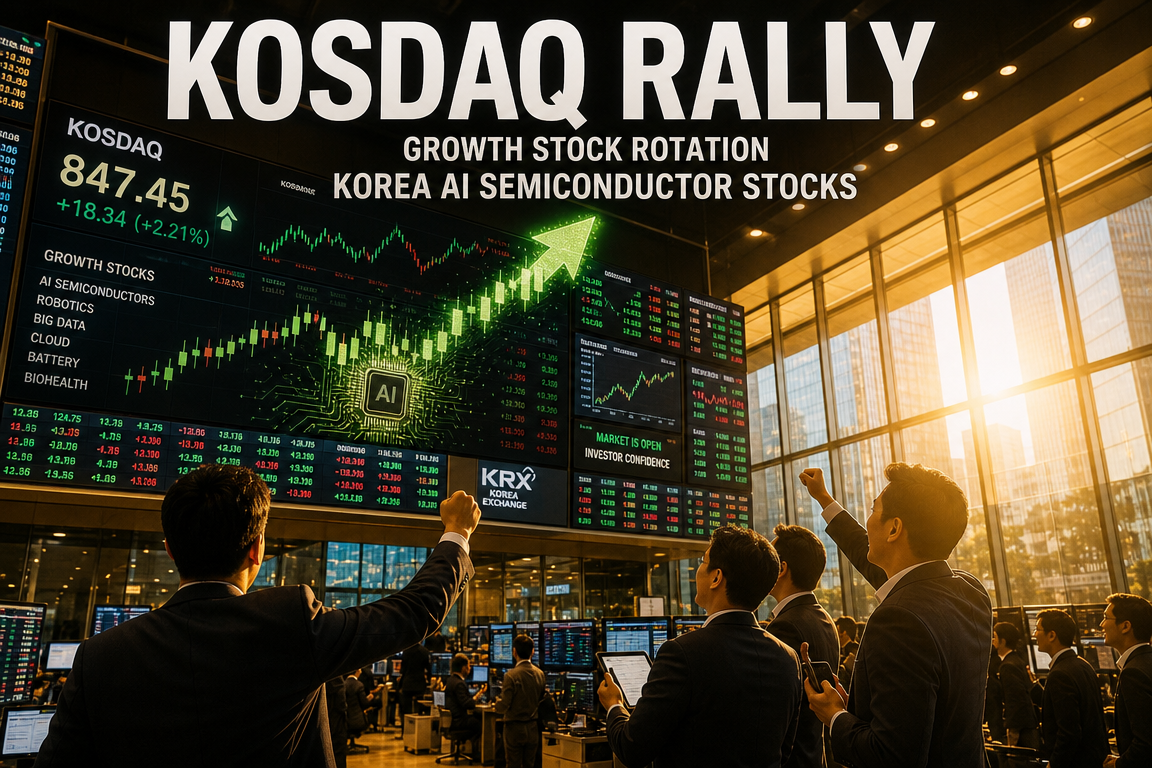
● KOSDAQ Explodes, Growth Stocks Surge
Why KOSDAQ Surged Sharply While KOSPI Remained Quiet: Why Capital Shifted into Small and Mid-Cap Growth Stocks
The key point in today’s market is that KOSDAQ did not rise simply because it was strong; rather, capital that had exited KOSPI searched for a new destination and moved into KOSDAQ.
At first glance, the session may appear to be a straightforward case of a sharp KOSDAQ rally and a flat KOSPI. In practice, however, it reflects the combined effect of fatigue in leading semiconductor stocks, slower U.S. labor data, reduced odds of further rate hikes, liquidity expectations, and a renewed revaluation of growth names.
As Samsung Electronics and SK Hynix temporarily lost momentum, the market shifted back toward KOSDAQ, where sectors such as biotech, AI, robotics, secondary batteries, gaming, and entertainment represent a market built on future growth expectations.
That said, one point should not be overlooked.
A single strong day for KOSDAQ does not by itself confirm the start of a broad, sustained bull market.
Relative to the start of the year, the index remains closer to a recovery phase. This move is better characterized as a rapid rebound from an oversold level rather than a decisive breakout.
1. First reason for KOSDAQ’s strength today: KOSPI’s leading stocks began to pause
Until recently, the domestic market was largely driven by Samsung Electronics and SK Hynix.
Supported by AI semiconductor demand, HBM expectations, and the outlook for a memory cycle recovery, these names effectively pulled the broader KOSPI higher.
In practical terms, KOSPI was a market led by large-cap semiconductors.
The issue is that after a meaningful advance, even strong companies can see momentum slow as expectations become fully reflected in valuations.
When Samsung Electronics and SK Hynix stop rising and enter a consolidation phase, KOSPI as a whole tends to become subdued.
KOSPI is highly sensitive to the performance of its largest constituents.
Accordingly, when large-cap semiconductor stocks pause, the index loses direction.
By contrast, KOSDAQ is often driven by multiple themes and growth sectors rather than a single dominant large-cap stock.
When investors conclude that KOSPI offers limited near-term upside, capital typically searches for an alternative.
This time, that alternative was KOSDAQ.
2. Second reason: weaker U.S. labor data reduced rate pressure
Last Friday’s U.S. labor data, which showed a slowdown in job creation, also had a material impact.
In the U.S. economy, employment is a key input for the Federal Reserve’s policy decisions.
When employment remains too strong, wage pressure tends to rise and inflation becomes harder to bring down.
In that case, the Fed is more likely to consider further rate increases or maintain elevated rates for longer.
When labor conditions begin to soften, however, the Fed becomes less able to justify aggressive tightening.
The market quickly translates this into the following sequence of assumptions:
“The probability of further rate hikes has declined.”
“As a result, liquidity may tighten less than expected.”
“Growth and technology stocks can therefore justify a higher valuation premium again.”
This logic applies especially well to KOSDAQ, which is highly sensitive to interest-rate changes.
That is because KOSDAQ contains many companies valued more on future growth expectations than on current earnings.
When rates are high, the present value of future earnings declines.
That compresses growth valuations.
When rate pressure eases, names with credible growth narratives can recover quickly.
3. When capital is abundant, investors buy “the story,” not just earnings
In markets, capital moves quickly.
It does not remain in one place if it sees stronger upside elsewhere.
When rate-hike pressure eases and liquidity expectations improve, investors become more willing to rotate into risk assets.
In Korea, KOSDAQ is the most representative risk-on market.
Although KOSDAQ is more volatile than KOSPI, it can outperform sharply when expectations improve.
The index tends to react strongly when the following sectors move together:
-
AI software and AI semiconductor-related stocks
-
Biotech and healthcare growth stocks
-
Robotics, automation, and smart factory names
-
Secondary battery materials and equipment stocks
-
Gaming, content, and entertainment stocks
-
Autonomous driving, automotive electronics, and future mobility names
The common factor across these sectors is that share prices can rise on future growth expectations even before current earnings expand materially.
For that reason, when rate pressure eases, buying interest can quickly concentrate in KOSDAQ growth names.
4. The catch: KOSDAQ is still in negative territory year to date
Despite today’s sharp advance, a more disciplined view is necessary.
As noted in the original text, KOSDAQ remains roughly around -10% year to date.
In other words, the move is better viewed as part of a recovery from a deep drawdown than as a new high-level breakout.
This is one of the most common investor mistakes.
A large one-day gain can create the impression that the market regime has fully changed.
However, when viewed in index terms, the market may still simply be recovering lost ground.
Markets that have fallen significantly can produce outsized rebounds on relatively modest positive catalysts.
This is commonly referred to as a technical rebound.
The challenge is that a technical rebound requires additional conditions to evolve into a sustained trend.
5. Conditions required for KOSDAQ’s rebound to become a genuine bull trend
For KOSDAQ to move beyond a short-term rebound and emerge as a leading market in the second half, several conditions must be met.
① The U.S. rate path must become clearer
The market favors rate cuts.
More precisely, it prefers confirmation that rates are no longer moving higher.
If the Fed lowers the probability of additional hikes and inflation continues to moderate, conditions become more supportive for growth stocks.
However, a single soft labor report is not sufficient to remove uncertainty.
If the next inflation, consumption, or wage data come in stronger again, rate concerns could quickly return.
② The pause in KOSPI’s semiconductor leaders should not turn into a deep correction
KOSDAQ performs best when KOSPI does not collapse.
If KOSPI weakens too sharply, sentiment across the domestic market deteriorates.
The most constructive scenario is one in which Samsung Electronics and SK Hynix consolidate without falling materially, while KOSDAQ growth stocks advance through sector rotation.
In other words, large-cap semiconductors should pause while small and mid-cap growth names lead.
③ Earnings confirmation from KOSDAQ companies must follow
Initial rebounds can be driven by expectations.
However, a durable rally requires earnings validation.
This is especially true for sectors such as biotech, AI, robotics, and secondary battery equipment, where optimism can fade quickly if visibility remains limited.
Markets ultimately buy the story first, but later demand evidence.
Revenue growth, margin improvement, order backlog expansion, and global customer wins are the key indicators that must follow.
④ Retail participation alone is not enough
Retail flows are important in KOSDAQ rallies, but a sustained advance requires participation from institutions and foreign investors.
Foreign investors, in particular, are sensitive to the exchange rate, U.S. yields, and global risk appetite.
A stable won and a favorable global backdrop would support stronger foreign capital inflows into KOSDAQ.
6. The real point often missed in other reports: this KOSDAQ rally is a duration bet on growth stocks
Viewing the move simply as a “theme-stock rally” misses the core mechanism.
The more important issue is that the market is once again betting on growth-duration exposure.
Put simply, future earnings matter more than current earnings for growth stocks.
The value of those future earnings changes materially with interest rates.
Higher rates reduce the present value of future earnings, which weighs on growth valuations.
Lower expected rates increase the present value of future earnings, allowing growth stocks to rebound more quickly.
KOSDAQ is the market most sensitive to this mechanism.
This rally should therefore be viewed not merely as a liquidity-driven move, but as a revaluation of growth stocks in response to changing rate expectations.
That is the key point that is often underexplained in short-form market coverage.
7. Signals to watch when KOSDAQ strength becomes excessive
Not every KOSDAQ rally is an attractive opportunity.
In a more volatile market, risk management becomes even more important.
① Check whether trading value is concentrated in only a few themes
If the index rises while only a handful of sectors surge, the move may reflect short-term speculative flows rather than a broad market improvement.
It is important to see whether buying expands across multiple growth sectors such as AI, biotech, robotics, and secondary batteries.
② Check whether advancing issues broaden meaningfully
A healthy rebound is usually accompanied by a wide increase in advancing stocks.
By contrast, if the index rises but only a few large KOSDAQ names advance, market breadth may be weak.
Broader participation matters more than the index level alone.
③ Be cautious if margin financing in KOSDAQ rises too quickly
As margin exposure increases in KOSDAQ, the risk of sharp declines also rises.
When leveraged retail participation expands rapidly, the market can rise faster in the short term, but liquidation pressure also becomes stronger during corrections.
A rapid increase in margin balances after a sharp rally should be treated with caution.
④ A renewed rise in U.S. Treasury yields could change sentiment
One of the main drivers of the current rebound is easing rate pressure.
Accordingly, if the U.S. 10-year Treasury yield rises sharply again, growth stocks may face renewed headwinds.
KOSDAQ investors should monitor not only domestic developments but also U.S. Treasury yields, the dollar index, and the KRW/USD exchange rate.
8. Three scenarios for KOSDAQ in the second half
Scenario 1: Positive case — easing rate pressure and rotation into growth stocks
If U.S. labor data continues to soften gradually and inflation remains contained, the market may build stronger expectations for rate cuts.
In that case, KOSDAQ could see strong sector rotation centered on biotech, AI, robotics, and secondary battery materials and equipment.
While KOSPI semiconductors consolidate, KOSDAQ could show relative outperformance.
Scenario 2: Neutral case — a sharp one-day rebound followed by range trading
If the slowdown in labor data is positive but uncertainty remains around inflation and rates, the market may struggle to build conviction.
In that case, KOSDAQ could retreat after an initial surge and then trade within a range.
Stock selection would become more important, and the gap between fundamentally supported names and speculative themes would likely widen.
Scenario 3: Negative case — renewed rate pressure and profit taking
If U.S. economic data turns stronger again or inflation proves sticky, expectations for rate cuts may recede.
In that case, KOSDAQ growth stocks could face renewed valuation pressure.
Names that have risen mainly on expectations rather than earnings could see sharper corrections.
9. Key investor checkpoints
-
Determine whether the KOSDAQ surge is a one-day move or whether trading value continues to expand.
-
Monitor whether softer U.S. labor data is followed by more stable inflation readings.
-
Check whether Samsung Electronics and SK Hynix remain stable rather than declining sharply.
-
Confirm whether buying interest broadens across AI, biotech, robotics, and secondary battery sectors.
-
Track margin balances and signs of retail overheating in KOSDAQ.
-
Focus on companies with earnings improvement potential rather than purely thematic momentum.
10. Conclusion: Is KOSDAQ entering a new cycle?
Today’s KOSDAQ rally is a meaningful signal.
It indicates that capital has temporarily rotated away from large-cap semiconductor-led KOSPI and into growth stocks.
The interpretation that U.S. labor data has reduced the probability of further rate hikes is also supportive for KOSDAQ.
However, it is still more appropriate to view the move as a strong recovery attempt rather than a confirmed bull-market shift.
For KOSDAQ to become the leading market in the second half, rate stability, improved liquidity, earnings confirmation, and inflows from foreign and institutional investors will all be necessary.
The central point is straightforward.
KOSDAQ may be driven by growth expectations, but it needs earnings to sustain the move.
At this stage, the market warrants both interest and selectivity.
< Summary >
The main drivers of KOSDAQ’s sharp advance are fatigue in large-cap semiconductor leaders on KOSPI and easing rate pressure following weaker U.S. labor data.
Capital has rotated from KOSPI, led by Samsung Electronics and SK Hynix, into KOSDAQ growth sectors such as AI, biotech, robotics, and secondary batteries.
However, since KOSDAQ remains in negative territory year to date, the move is better characterized as a recovery from prior losses than as a confirmed trend reversal.
For the rally to continue in the second half, rate stability, earnings improvement, broader trading participation, and inflows from foreign and institutional investors are required.
The real market theme is not simply a rise in thematic stocks, but a revaluation of growth equities driven by changing rate expectations.
[Related Articles…]
*Source: [ 내일은 투자왕 – 김단테 ]
– 코스닥만 대폭등한 이유! #코스닥 #코스피 #하이닉스
● AI-Semiconductor Shock
Samsung Electronics and SK Hynix: Is the correction temporary or trend-driven? The key issue is not earnings, but the erosion of five expectations
When Samsung Electronics and SK Hynix weaken, the first thing to assess is not simply the earnings release.
The semiconductor cycle remains strong, and AI chip demand is still firm.
However, share prices move ahead of earnings.
The market is more sensitive to the question of whether this growth rate can be sustained.
This report links Samsung Electronics, SK Hynix, HBM, DRAM, foundry, China’s semiconductor industry, and hyperscaler investment to frame the current correction in semiconductor equities.
The key issue is not how much money companies are making, but whether the pace of earnings growth is slowing.
That distinction is necessary to determine whether the current move is a temporary pullback or the start of a structural correction.
1. The semiconductor cycle remains in a strong uptrend
First, the baseline must be clear.
Earnings for Samsung Electronics and SK Hynix remain strong.
Global semiconductor companies, including Samsung Electronics, SK Hynix, Micron, and TSMC, are reporting record-level profitability trends.
AI data center investment, HBM demand, higher server DRAM prices, and long-term supply agreements are supporting revenue and operating profit recovery across the sector.
SK Hynix has established a strong position in HBM, while Samsung Electronics is benefiting from memory market recovery and expectations for foundry restructuring.
The issue is not whether conditions are good, but whether they can continue to improve.
Equities discount future expectations before current results.
As a result, semiconductor stocks can correct even when earnings are strong.
Prices may decline not because results deteriorate, but because investors see a possible slowdown in growth from a very elevated base.
2. First driver of the correction: pricing momentum may slow
One of the most important variables for semiconductor equities is product pricing.
DRAM prices, server memory prices, and PC memory prices have all risen sharply.
However, investors should focus not only on absolute prices.
The more important factor is whether the rate of price increases can be sustained.
For example, if a semiconductor price rises from 100 to 200, the increase is 100%.
If it then rises from 200 to 300, the price still rises by 100, but the growth rate falls to 50%.
In other words, prices can continue rising even as growth rates slow.
At that point, the market may interpret the move as a slowdown in growth momentum.
Revenue can still rise, but if operating profit growth decelerates, valuation re-rating pressure emerges.
That is the central mechanism behind semiconductor stock corrections.
As concerns increase that semiconductor prices may have peaked, Samsung Electronics and SK Hynix become more vulnerable to correction.
If DRAM price gains begin to slow materially from 2026 Q3 and Q4 onward, or weaken in some segments, the market may react quickly.
If semiconductor prices fall, revenue growth will slow, and operating profit growth is likely to slow more sharply.
Even if volumes increase, lower prices will weigh on profitability.
3. Second driver: competition for market share is intensifying
Strong earnings and maintaining market share are not the same thing.
Even if Samsung Electronics and SK Hynix report solid results, the market will view the sector negatively if competitors gain share faster.
DRAM, HBM, and foundry markets should be assessed separately.
3-1. DRAM: CXMT’s rise in China is a growing concern
In DRAM, Samsung Electronics, SK Hynix, and Micron remain the established leaders.
However, China’s CXMT is expanding its presence rapidly.
If CXMT successfully lists and secures significant capital, China’s memory semiconductor value chain could strengthen further.
If Chinese technology groups such as Alibaba and Tencent deepen their linkages with the domestic semiconductor ecosystem, Samsung Electronics and SK Hynix may face pressure on long-term customer retention.
Greater adoption of domestic DRAM in China could reduce export opportunities for Korean semiconductor companies.
That concern alone can drive preemptive corrections in semiconductor stocks.
3-2. HBM: SK Hynix’s dominance may become less pronounced
HBM is currently the most important segment in the AI semiconductor market.
SK Hynix has been widely viewed as the primary beneficiary after securing a strong position in NVIDIA’s supply chain.
However, Samsung Electronics and Micron are also strengthening their HBM capabilities.
If Micron expands NVIDIA shipments and intensifies HBM mass-production competition, SK Hynix’s share could gradually decline.
The overall market is still expanding, so revenue may continue to grow.
But the market does not focus only on absolute revenue.
What matters is whether the premium attached to clear market leadership remains intact.
If SK Hynix begins to lose share in HBM, the stock may face near-term pressure.
3-3. Foundry: Samsung Electronics’ key vulnerability
The foundry segment is a more important variable for Samsung Electronics than for SK Hynix.
Samsung remains strong in memory, but in foundry it still trails TSMC by a wide margin.
It retains competitiveness in some high-performance semiconductor segments, but defending share in mid- and low-end segments remains difficult.
Even if Samsung announces large-scale foundry investment and major projects, commercial benefits will take time to materialize.
It may take at least two years, so in the near term the market may price in concerns that share losses could continue.
4. Third driver: concern that the AI value chain could shift toward China
Another important factor is the possibility that the center of gravity in AI could partially shift from U.S. technology leaders to China’s AI ecosystem.
Current global AI model usage and token consumption trends suggest that Chinese AI models are gradually gaining influence.
The U.S.-led AI value chain has grown on the basis of large-scale data center investment and aggressive capex by hyperscalers.
That has driven explosive demand for NVIDIA GPUs, HBM, server DRAM, and SSDs.
In that framework, stronger U.S. AI investment also benefited Samsung Electronics and SK Hynix.
However, if AI demand shifts toward China, the dynamic changes.
China may pursue a different model than the U.S. by not relying as heavily on large capex-driven data center expansion.
If China strengthens its own AI models, semiconductors, and data center ecosystem, export opportunities for Korean semiconductor firms may narrow.
The rise of CXMT is also connected to this trend.
If the AI-to-semiconductor value chain is absorbed more fully into China’s domestic ecosystem, the long-term growth premium for Korean semiconductor companies may weaken.
5. Fourth driver: AI companies must prove monetization
The most fundamental question in AI is this:
Are AI companies actually generating profits?
Rising AI usage, increasing token consumption, and expanding data center investment are all positive signals.
However, if AI companies cannot recover their large investment costs, semiconductor demand may eventually weaken.
If AI companies fail to monetize effectively, hyperscaler capex growth could slow.
Slower investment would reduce demand for GPUs and HBM.
That would weaken expectations for an AI semiconductor supercycle.
If token usage or AI service spending trends soften, the market may treat this as an early warning signal.
When AI indicators weaken, semiconductor equities and other AI-related stocks often correct together.
Semiconductor stocks are not just manufacturing equities; they also carry growth-stock characteristics tied to AI monetization expectations.
6. Fifth driver: can hyperscalers continue buying semiconductors?
The most important variable is hyperscaler demand.
Hyperscalers refer to large cloud and AI infrastructure companies such as Google, Microsoft, Amazon, and Meta.
The AI data center buildout and large-scale GPU and HBM purchases by these firms have created the semiconductor supercycle.
For Samsung Electronics and SK Hynix, hyperscalers are effectively the most important end customers.
If their free cash flow, or FCF, weakens or turns negative, the market becomes more cautious.
That is because investors begin to question whether these companies can continue buying expensive AI semiconductors at the same pace.
This is also linked to concerns about an AI bubble.
If hyperscalers continue to increase AI investment, semiconductor demand should remain supported.
By contrast, if they slow investment, demand expectations for HBM, DRAM, NAND, and foundry capacity could all weaken simultaneously.
That said, a temporary decline in FCF does not automatically mean semiconductor purchases stop.
Large technology firms can continue investing through cash balances, bond issuance, long-term capex plans, and cloud revenue growth.
Therefore, the key issue is not short-term negative FCF, but whether the commitment to AI infrastructure investment remains intact.
7. Is the correction in Samsung Electronics and SK Hynix temporary or structural?
At present, the semiconductor cycle remains strong.
Earnings trends for Samsung Electronics and SK Hynix have not clearly rolled over.
Accordingly, the current decline appears to be more a correction in expectations than a deterioration in fundamentals.
However, if the following conditions emerge together, the move could turn into a structural correction.
- DRAM price growth slows sharply or prices begin to fall
- SK Hynix’s HBM share declines faster than expected
- Samsung Electronics’ foundry share recovery is delayed
- China’s CXMT and the domestic AI value chain expand more rapidly
- AI monetization indicators weaken and hyperscaler investment slows
If these variables remain stable, the correction is more likely to remain temporary.
In particular, if long-term HBM supply contracts, server DRAM demand, AI data center investment, and global liquidity remain supportive, semiconductor equities could resume their upward trend.
8. Key factors to watch after August and September: fiscal liquidity matters more than monetary policy
Many investors focus primarily on the Federal Reserve and policy rates.
However, fiscal-side liquidity will also matter in the second half of the year.
If U.S. government spending, Treasury issuance patterns, and fiscal liquidity remain supportive, capital may return to growth and semiconductor equities.
Semiconductors are not only cyclical stocks; they also respond to the AI investment cycle and global liquidity conditions.
Investors should therefore monitor actual liquidity creation, not only interest-rate cuts.
If liquidity conditions improve, Samsung Electronics and SK Hynix may regain momentum after the current correction.
9. The real issue that is often missed in other coverage
The most important issue is not semiconductor company earnings, but customer investment durability.
No matter how advanced Samsung Electronics and SK Hynix become, the ultimate buyers are hyperscalers.
In other words, the core of semiconductor investing is not supply-side analysis, but end-demand analysis.
Many reports focus on Samsung earnings, SK Hynix’s HBM share, or DRAM pricing.
However, a deeper look shows that the more important question is whether Google, Microsoft, Amazon, and Meta can maintain their AI budgets.
Hyperscaler FCF, cloud revenue growth, AI monetization, and data center capex are the real leading indicators for semiconductor equities.
Another issue that should not be overlooked is China’s strategy.
AI growth in China is not automatically positive for Korean semiconductor companies.
If China strengthens its own AI models and domestic memory ecosystem, the benefits to Korean firms may be limited.
Ultimately, the key question for Samsung Electronics and SK Hynix is not whether AI demand is rising, but whether that demand translates into semiconductor purchases from Korea.
10. Five indicators investors should monitor
- DRAM prices and price momentum
Investors should watch not only for price increases, but also for slowing growth rates.
- HBM market share shifts
Changes in NVIDIA supply share among SK Hynix, Samsung Electronics, and Micron are critical.
- China’s CXMT growth rate
Faster semiconductor self-sufficiency in China could reduce the long-term premium for Korean firms.
- AI monetization indicators
Token usage, AI service revenue, and cloud AI demand should be monitored together.
- Hyperscaler capex and free cash flow
The sustainability of AI data center investment is central to the semiconductor supercycle.
11. Conclusion: semiconductor equities remain strong, but expectations are elevated
The correction in Samsung Electronics and SK Hynix still appears more consistent with a reset in expectations than with a deterioration in earnings.
The semiconductor cycle remains strong, and AI chip demand is intact.
However, markets always discount the future.
If slower DRAM price growth, weaker market share, expansion of China’s AI value chain, softer AI monetization, and slower hyperscaler investment all appear at once, the correction could become structural.
If these five variables remain stable, the current move is more likely to represent a temporary fluctuation within a longer-term uptrend.
The key for investors is not whether semiconductor earnings are strong, but whether growth expectations remain intact.
Those who understand that distinction will be better positioned for the next semiconductor cycle.
< Summary >
Earnings for Samsung Electronics and SK Hynix remain strong, but share prices reflect future expectations first.
The main drivers of the correction are DRAM price momentum, HBM share, CXMT’s growth, AI monetization, and hyperscaler investment continuity.
The current move appears more like an expectation reset than a collapse in fundamentals.
If these five variables worsen together, the correction could become structural.
The most important question is not whether AI demand is rising, but whether that demand is translating into actual semiconductor sales for Samsung Electronics and SK Hynix.
[Related Articles…]
- AI Semiconductor Supercycle and Korea’s Investment Strategy
- Global Liquidity Conditions and the 2026 Economic Outlook
*Source: [ 경제 읽어주는 남자(김광석TV) ]
– 삼성전자·SK하이닉스 일시적 하락인가? 추세적 조정인가? ‘5가지 결정요인’ [경읽남 257화]