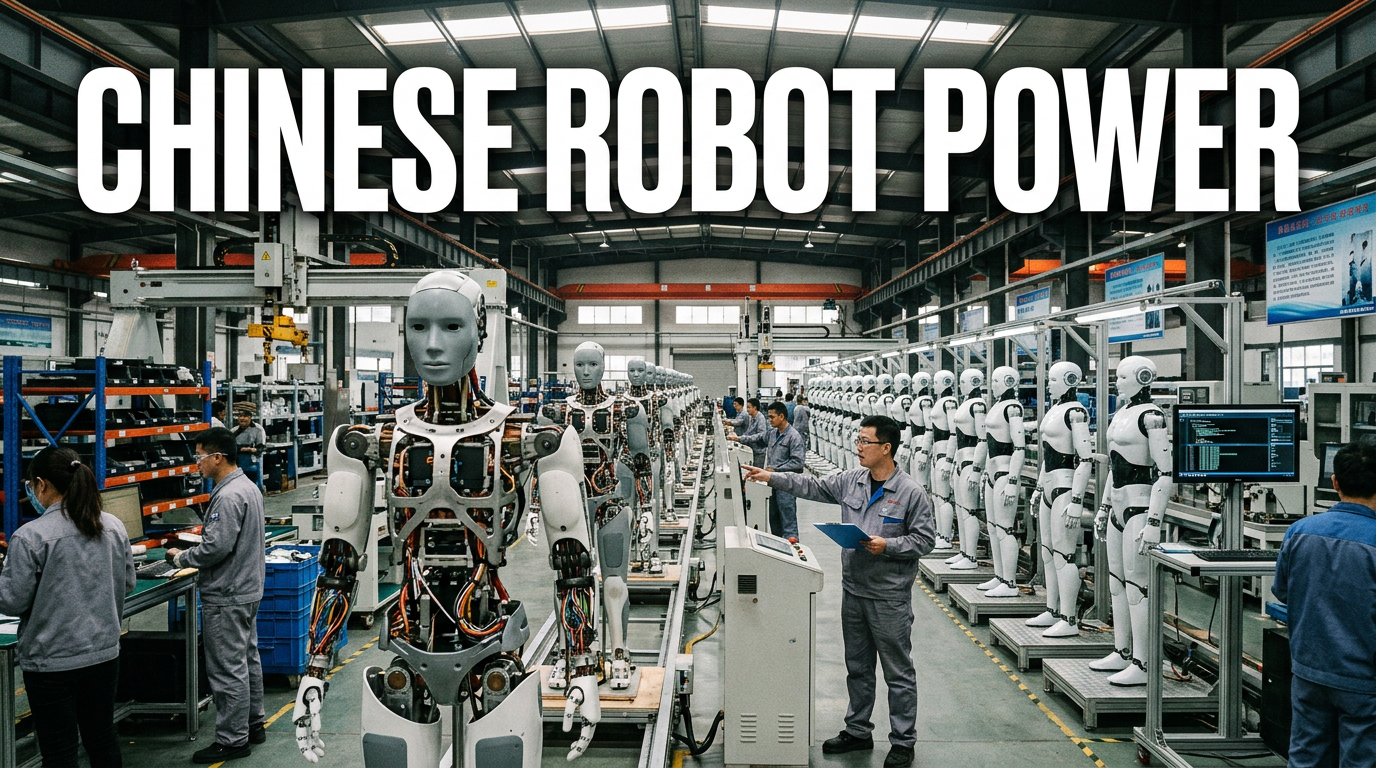
● China Robot Threat Supply Chain Domination
The real threat from China’s humanoid robots is not ‘100,000 units shipped’ but control of the supply chain and AI brain
The core point of this issue is simple.
The claim that Chinese humanoid robots are about to take over factories worldwide is still closer to exaggeration.
But in the component ecosystem that builds the robot’s body, especially the supply chains for joints, motors, reducers, and sensors, China is already seizing the lead at a frightening pace.
Even more important is that Chinese capital and companies are now shifting from the robot’s ‘body’ to its ‘brain’—that is, embodied AI, world models, VLA models, and AI semiconductors.
In the end, competition in the robotics industry is shifting from “who made more” to “who can make them cheaper, who can collect more physical data, and who can build AI that can actually be deployed in factories.”
1. The 100,000-unit shipment story for Chinese humanoid robots is overwhelming if you look only at the numbers
The Chinese government and industry estimate that shipments of Chinese humanoid robots in 2025 were around 20,000 units.
But in just the first half of 2026, shipments exceeded 40,000 units, and the year-end target has been set at 100,000 units.
On the surface, that looks like a market growing fivefold in a single year.
Just from this number, it seems as if China has completely captured the humanoid robot market.
But an important question arises here.
Where exactly are all those robots actually working?
The robots shown in videos dance, run, do kickboxing, and even run marathons.
But whether they are actually producing productivity on manufacturing automation lines is a completely different matter.
2. Looking at China’s three leading humanoid robot companies reveals the reality of the market
At present, the companies most often mentioned in China’s humanoid robot market are Unitree, Agibot, and UBTECH.
Because each company has a different position and character, looking at these three gives a fairly clear picture of the reality of China’s robotics industry.
① Unitree: The star behind the robot most people have seen in videos
Unitree is a robotics company based in Hangzhou, China.
Many of the humanoid G1 group-dance videos and quadruped robot videos people have seen are Unitree products.
In its listing preparation process, the company valuation was cited at about 60.993 billion yuan, or roughly 13 trillion won.
Unitree’s 2025 revenue is about 1.699 billion yuan, or roughly 370 billion won.
With year-over-year growth of 330%, the pace of growth is certainly impressive.
However, the atmosphere changes when you look at the revenue mix.
- Scientific research and education: 73.6%
- Commercial consumer use: 17.4%
- Factories and industrial sites: 9%
In other words, of every 10 Unitree robots, fewer than 1 actually goes to a factory or industrial site.
That is far from the image that Chinese humanoid robots have already taken over factories.
② Agibot: Rapidly increasing production, but highly dependent on government demand
Agibot is a Shanghai-based company that, since its founding in February 2023, is said to have surpassed cumulative production of 15,000 units in less than three years.
Its 2025 revenue is about 1.05 billion yuan, or roughly 230 billion won.
Agibot’s distinguishing feature is the large share of government and state-owned capital projects.
It is said to have won more than 10 state-owned projects worth over 50 million yuan each.
In other words, growth appears to be driven less by market demand and more by policy demand and public projects.
③ UBTECH: The only case with confirmed deliveries to actual factories
UBTECH is a Shenzhen-based robotics company founded in 2012.
Founder Zhou Jian started from robot joint motors and is now known for its industrial humanoid Walker series.
UBTECH’s 2025 shipments are said to be only about 1,000 units, far fewer than Unitree or Agibot.
But there is an important difference.
It is a company with confirmed actual customers.
UBTECH is said to have delivered around 500 units to manufacturing sites such as BYD, Volkswagen, Foxconn, and Airbus.
In other words, even if China as a whole is talking about 100,000 units shipped, the number of robots clearly working in actual factories is only about 500 by the original source’s 기준.
3. To put it simply, Chinese humanoid robots are still closer to ‘data producers’ than ‘factory workers’
If you look at China’s humanoid robot market冷정하게, current demand can be broadly divided into three categories.
- Research robots used in labs, universities, and educational institutions
- Policy-driven robots deployed in government and state-owned capital projects
- Industrial robots used in factory automation tests
The largest share at present is research use and government demand.
They are not yet at the stage of being used on a large scale in real manufacturing automation environments.
But this should not simply be seen as a bubble.
Having many research robots installed means large amounts of physical data are being accumulated for robot learning.
A large number of government projects means the initial market is being supported by policy.
Even if factory deployment is limited, the fact that testbeds keep expanding is also important.
In other words, China is not immediately selling finished robots; it is closer to a stage of mass-training the humanoid robot ecosystem.
4. Why haven’t humanoids been fully deployed in factories yet?
Humanoid robots can be broadly divided into three parts.
- Body: legs, frame, joints, walking control
- Hands: manipulation ability to grasp and release objects, and tactile sensors
- Brain: embodied AI that judges situations and generalizes tasks
The area where China is currently strong is the body.
The areas that are still weak are the hands and brain.
① Body: The area where China is most advanced
Bipedal robots are extremely difficult technically.
Walking like a human is similar to balancing a stick on the palm of your hand while moving.
You have to control 20 to 50 joint motors more than 1,000 times per second.
If control is delayed by just 0.01 seconds, the robot can lose balance and fall.
But this area has been largely solved.
Level walking, stair climbing, and running at around 3 meters per second are already entering a stable stage.
The various demonstration videos shown by Chinese companies are achievements in this ‘body’ domain.
② Hands: The first bottleneck blocking factory deployment
The human hand has about 17,000 tactile receptors.
By contrast, even the most advanced robot hands currently have only around 12 to 19 degrees of freedom, and sensors numbering in the dozens.
The rate at which a robot drops an unfamiliar object when grasping it is said to be around 5% to 15%.
That may look quite good in everyday use.
But factories apply completely different standards.
A factory line cannot tolerate even a 99% success rate.
That is because if the line stops, losses of tens of thousands of dollars per minute can occur.
A hand that misses an object 5 to 15 times out of 100 is hard to place on a manufacturing line.
So the tasks humanoids currently take on are mostly simple repetitive jobs.
Examples include parts transport, loading and unloading, logistics movement, and repetitive picking tasks.
③ Brain: The real battleground is embodied AI
The biggest problem is the robot’s brain.
At present, robots are making progress in learning a single specific task.
But when moved to another line, they have to learn again.
Humans can adapt to a new process after only a few hours of observation.
Robots still lack that kind of generalization ability.
The reason is a shortage of physical data.
The physical data referred to here is not simple text or image data.
It is real-world behavioral data that includes the force used when grasping an object, slipping, center of gravity, joint angles, failed motions, and environmental changes.
In the end, the future of humanoid robots depends on how quickly embodied AI develops.
5. The United States is not yet a definitive winner either
What is interesting is that the United States is also not yet a clear winner.
Tesla Optimus is one of the most closely watched humanoid projects in the world.
But Tesla has not publicly disclosed Optimus production numbers in a clear way.
Elon Musk has also said that Optimus is still closer to a learning stage than to productive work.
In other words, even if robots are inside Tesla factories, their role is largely to collect data rather than replace actual production.
This is important.
Neither the U.S. nor China has a clear winner yet in terms of finished products.
The humanoid robotics industry is still in a prelude stage just before large-scale commercialization.
6. And yet China remains frightening because of the supply chain
The real threat from Chinese humanoid robots is not the finished product itself.
The real threat is the way it is taking control of the global supply chain.
As of 2025, the component cost of one Chinese-made humanoid robot is said to be around $35,000.
There is also a forecast that by 2030 it could fall below $17,000.
Unitree’s G1 is already being offered at a starting price of $13,500.
This price is not simply the result of better technology.
It is possible because China has restructured the entire robotics supply chain.
7. The key to humanoid robot cost is the ‘joint’
Looking at the component cost share for Tesla Optimus Gen 2, the core becomes clear.
- Ball screw: 19%
- Torque motor: 16%
- Reducer: 13%
- Force sensor: 11%
- Coreless motor: 8%
- Bearing: 5.5%
The top three alone account for nearly half of the total cost.
And these parts are mostly related to robot joints.
If batteries were the key cost item in electric vehicles, joints are the key cost item in humanoid robots.
Just as China gained price competitiveness in the EV market by dominating the battery supply chain, a similar move is emerging in robotics, where the focus is on taking control of the joint supply chain.
8. China has pushed the domestic localization rate of the joint supply chain above 70%
The precision reducer market was originally strong in Japan and Germany.
In particular, precision reducers such as harmonic drives were effectively monopolized by Japanese companies.
Over the past 10 years, China has localized these parts one by one.
At present, reducer, servo motor, joint module, sensor, and frame companies in China are growing rapidly.
According to the original source, the domestic localization rate of China’s humanoid supply chain has surpassed 70%.
The reason this matters is simple.
To make robots cheaply, you need to buy parts cheaply.
To buy parts cheaply, the supply chain must be close.
When the supply chain is close, prototypes can be fixed quickly, remade, and tested again.
9. Three hidden strengths of China’s robotics ecosystem
① Density of component suppliers
In Shenzhen and the Yangtze River Delta region, motor, reducer, sensor, and frame suppliers are clustered within a radius of just tens of kilometers.
Locals even say that parts sourcing can be finished in the time it takes to eat a bowl of noodles.
Even if that is somewhat exaggerated, the essence is clear.
It means prototype development is overwhelmingly fast.
An environment where designs and parts can be changed and tested several times a day is not something money alone can create.
② Manufacturing capabilities accumulated in the EV industry
Over the past 10 years, China has built the ability to make motors, batteries, sensors, and power-control technologies cheaply and quickly in the EV market.
But humanoid robots use similar components.
They all need motors, batteries, sensors, and control devices.
In other words, China’s EV ecosystem becomes the foundation of the robotics industry 그대로.
This point is also important for future economic prospects.
The industrial transition from EVs to robots could become the next growth engine for Chinese manufacturing.
③ Vertical integration
One reason Unitree was able to lower the G1 price is that it makes key components itself.
Companies that have to buy motors, reducers, joint modules, and servo drivers from outside and then assemble them have a hard time creating the same price competitiveness.
In the end, China’s strength is not a single technology.
It is an ecosystem that combines component suppliers, manufacturing clusters, an EV industrial base, and vertical integration.
10. China’s weakness is also clear: ball screws and AI semiconductors
China has not taken control of everything.
Rather, two important bottlenecks still remain.
① Ball screw: It still hasn’t fully captured the No. 1 cost component
Ball screws account for about 19% of humanoid robot cost.
They are a high-difficulty component needed for precise positioning.
According to the original source, about 90% of precision ball screws are supplied by German and Japanese companies.
In other words, China has localized many joint-supply chain components, but it has not yet fully dominated one of the most expensive individual parts.
② AI semiconductors: the robot’s brain still depends heavily on U.S. chips
China’s major humanoid companies are known to rely on AI semiconductor platforms such as Nvidia Jetson Thor for high-performance robot computation.
UBTECH, Unitree, Agibot, Galbot, and EngineAI are not free from this trend.
Simply put, the body is being made by China, but the brain that moves it still runs on American semiconductors.
This is a very important point in the U.S.-China technology competition.
If the United States strengthens export controls on AI semiconductors, it could affect the pace of advancement in China’s humanoid robotics industry.
Conversely, if China secures its own AI chips and robot models, the landscape of the robotics industry could change dramatically.
11. Chinese capital is now moving from the ‘body’ to the ‘brain’
Chinese companies are well aware of their weaknesses.
Looking at how Unitree plans to use the 4.2 billion yuan it is seeking through listing, the direction is clear.
- Intelligent robot model R&D: 48%
- Robot body development: 26%
- New product development: 10%
- Manufacturing base construction: 15%
Nearly half of the funds are being directed to the robot’s brain, that is, intelligent model development.
This means money is flowing more into making smarter robots than into simply producing more robots.
A similar shift is appearing in China’s 2026 AI investment trends.
It is said that about 18% of newly funded Chinese AI companies are classified in the world model and VLA sectors.
VLA stands for Vision-Language-Action, a model that connects visual information, language understanding, and action decisions.
This field is exactly the core of embodied AI.
If a chatbot is AI that answers only in words, embodied AI is AI that sees, judges, and moves in the real world.
12. The most important point often missed by other YouTube videos or news reports
The core of China’s humanoid robot story is not ‘shipments’ but the ‘data flywheel’.
On the surface, 100,000 units shipped becomes the headline.
But the volume actually deployed in factories is limited.
Then are the remaining robots meaningless?
Not at all.
The robots placed in labs, schools, government projects, and test factories all become devices that generate physical data.
They accumulate data on robots falling over, dropping objects, overheating joints, sensor malfunctions, and failures in environments humans did not expect.
This data later becomes the raw material for training embodied AI models.
In other words, China’s current mass shipment of humanoid robots should be seen not as simple sales but as the construction of data infrastructure.
From this perspective, China’s strategy is far more frightening.
- Lower hardware prices to widely deploy robots.
- Create initial demand through research institutions and government projects.
- Accumulate physical data through mass use.
- Use that data to advance embodied AI.
- Reduce dependence on the United States through domestication of AI semiconductors and robot models.
Once this structure is complete, China is no longer simply a country that sells robots cheaply.
It becomes a nation that possesses the robot body, data, AI models, and manufacturing ecosystem together.
13. Where are the opportunities for Korean companies and investors?
Even if China has become stronger in bodies and supply chains, not all opportunities have disappeared.
Rather, the areas that remain open are clear.
① Robot hands and tactile sensors
Robot hands are still a key bottleneck blocking factory deployment.
Tactile sensors, slip detection, force control, and precision gripper technology still offer major opportunities.
For a humanoid to grasp diverse objects as stably as a human, innovation in this area is needed.
② Industrial embodied AI software
For robots to go beyond doing only one task well and adapt quickly to new tasks, software is critical.
Industrial AI software that connects factory-specific process data, work instructions, simulations, digital twins, and reinforcement learning could become the key.
③ High-reliability robot components
Even if China has price competitiveness, the high-reliability component market still presents separate opportunities.
In aerospace, defense, semiconductor fabs, and precision manufacturing, stability and durability matter more than simply low cost.
Korean companies can find opportunities in this high-value-added component segment.
④ AI semiconductors and edge computing
Humanoid robots cannot rely only on the cloud.
Because they must make immediate judgments on site, they need edge AI semiconductors that compute inside the robot.
Power efficiency, heat management, and real-time inference performance will become important.
⑤ Factory automation integration solutions
More important than building one good humanoid robot is connecting it well to the factory system.
To achieve real productivity, robots must be integrated with MES, ERP, logistics systems, safety systems, and vision inspection equipment.
Korean manufacturing can be strong in this integration-solution area.
14. Key points to watch going forward
- We need to see how much China’s humanoid robot actual factory delivery share rises from 9%.
- We need to check whether Unitree and Agibot shift revenue from research/government use to industrial use.
- It is important whether industrial robot companies like UBTECH secure repeat orders.
- We need to see how quickly China resolves bottlenecks in ball screws and high-precision reducers.
- The key is whether Chinese AI semiconductors that can reduce dependence on Nvidia are actually mounted in robots.
- We should watch whether world models and VLA-based embodied AI solve the problem of generalizing factory tasks.
15. Final interpretation: China is taking control of the ‘ecosystem’ before the humanoid ‘finished product’
At present, saying that Chinese humanoid robots have taken over factories worldwide is an exaggeration.
The volume clearly delivered to actual factories is still limited.
Most of it is closer to research use, education use, government projects, and data collection.
But China should not be underestimated.
China has already secured strong price competitiveness in the supply chain that makes robot bodies.
The ecosystems for joints, motors, reducers, sensors, and frames are tightly connected.
Now China’s focus is moving to the robot’s brain.
Embodied AI, world models, VLA, AI semiconductors, and physical data are becoming the next battlefield.
In the end, competition in humanoid robots is not just competition in robot manufacturing.
It is a massive industrial power struggle connecting the global supply chain, AI semiconductors, manufacturing automation, the robotics industry, and economic prospects.
< Summary >
China’s target of shipping 100,000 humanoid robots is flashy, but the volume confirmed to be delivered to actual factories is still limited.
Unitree has a high share of research and education use, Agibot relies heavily on government projects, and only UBTECH has clearly documented deliveries to actual industrial sites.
China’s real strength lies less in finished products and more in the robot supply chain centered on joints, motors, reducers, and sensors.
However, ball screws and AI semiconductors still depend heavily on Germany, Japan, and the United States.
Going forward, the decisive battleground is likely to be the robot’s hands and brain, especially embodied AI and physical data.
Korean companies should look for opportunities in tactile sensors, robot hands, industrial AI software, high-reliability components, and edge AI semiconductors.
[Related Articles…]
- The next battleground in the humanoid robot industry
- Outlook for AI semiconductors and global supply chain restructuring
*Source: [ 티타임즈TV ]
– 휴머노이드 몸 장악한 중국, 뇌 장악에 나섰다