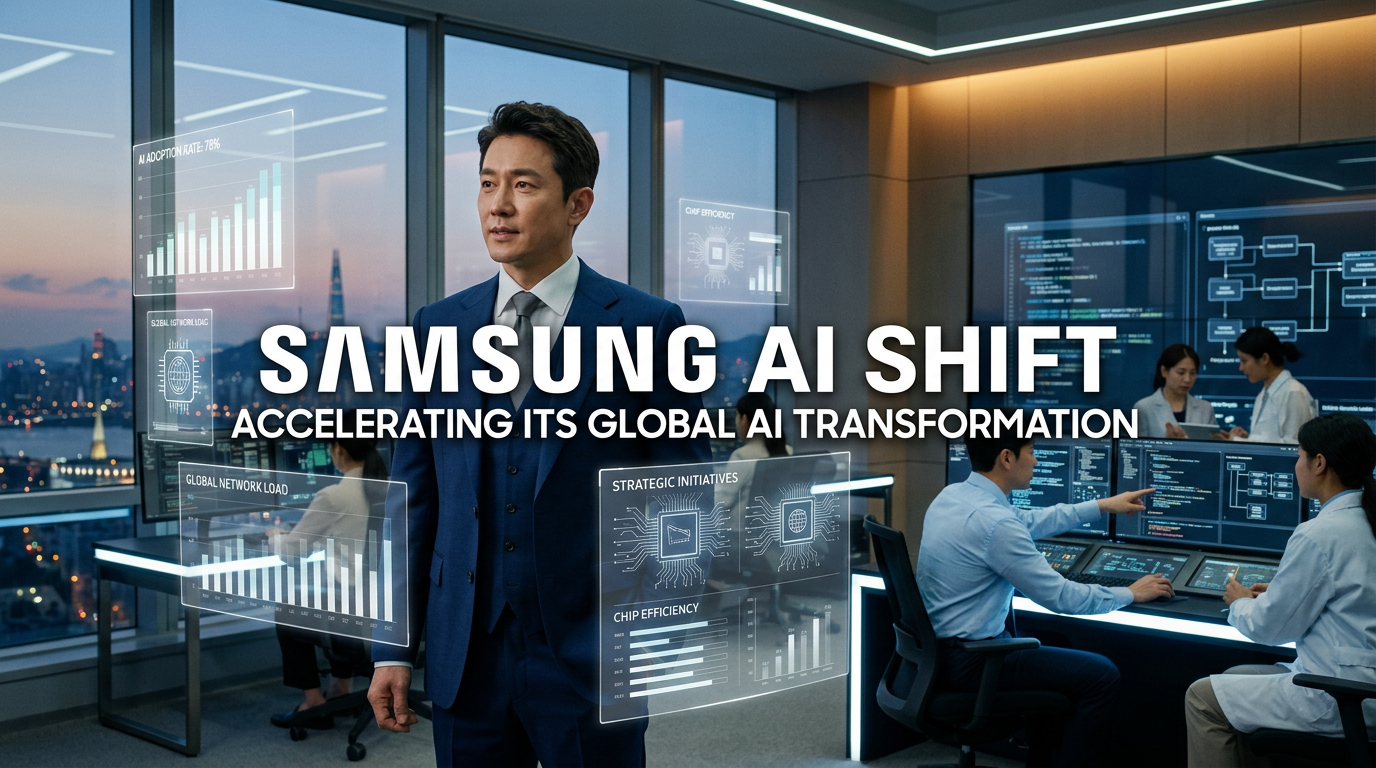
● Samsung Creates CAIO Role to Accelerate AX and Reshape AI Accountability
Samsung Creates CAIO Position… Full-Scale Acceleration of AI Transformation Begins
Starting with Samsung Display and Samsung Electro-Mechanics, some Samsung affiliates have newly created the position of Chief AI Officer, or CAIO.
This change is not just a simple organizational reshuffle. It can be read as a signal that Samsung Group is elevating AI Transformation, or AX, into a core pillar of management.
In particular, since the direction of rapidly embedding AI across all affiliates has already been set under the leadership of Executive Chairman Lee Jae-yong, the creation of the CAIO position can be seen as a move to clearly appoint “on-site leaders” responsible for executing that strategy.
In this article, we will organize everything at once, including
why Samsung is creating CAIO positions now,
what changes have started first at each affiliate,
and what the real core point is that other news reports often do not cover.
1. Samsung’s Creation of the CAIO Position Is Not Just Another Job Title
The CAIO is responsible for overseeing internal artificial intelligence and overall AX operations.
Simply put, this is not a declaration that “we should adopt AI.”
It is a position that clearly defines “who will take responsibility, which departments will be connected, and what results will be produced.”
The fact that Samsung Display and Samsung Electro-Mechanics recently appointed CAIOs through organizational restructuring means that they intend to connect AI not merely to experimentation, but to productivity, yield, automation, and work innovation.
This is also important in the context of global economic trends.
Companies today are in a situation where it is difficult to simply expand headcount due to interest rates, economic slowdown, and geopolitical risks.
As a result, they are moving toward reducing costs and increasing productivity through AI,
and Samsung appears to be seriously joining that trend.
2. Who Took on the CAIO Roles at Samsung Display and Samsung Electro-Mechanics?
Samsung Display: The Head of the AX Research Institute Becomes CAIO
At Samsung Display, Vice President Roh Chul-rae, head of the AX Research Institute, has taken on the CAIO role.
The AX Research Institute led by Vice President Roh was originally an organization under the CTO that researched
automation technologies using AI,
improvements in process productivity,
and manufacturing efficiency.
In other words, this appointment can be interpreted as elevating “a team that researches AI”
into “an organization responsible for the company’s overall AI strategy.”
The core point is the production site.
In the display industry, defect rates, process precision, and equipment efficiency determine performance.
When AI is introduced here,
process data analysis, anomaly detection, predictive maintenance of equipment, and automated quality control become possible.
Ultimately, the CAIO is not a position that merely talks about introducing AI.
It becomes the center of manufacturing innovation that is directly connected to profitability.
Samsung Electro-Mechanics: The Head of the Central Research Institute Becomes CAIO
At Samsung Electro-Mechanics, Vice President Jang Woo-seok, head of the Central Research Institute, has taken on the CAIO role.
Vice President Jang previously served as head of the Automation Technology Center, which was responsible for improving process productivity based on AI,
and he is also known to be currently responsible for AX-related organizations.
This is highly significant.
The fact that a research institute head has taken on the CAIO role means that Samsung Electro-Mechanics sees AI not merely as office automation,
but as a core manufacturing capability.
In particular, for high-precision component industries such as MLCCs, package substrates, and camera modules, where Samsung Electro-Mechanics operates,
AI-based process optimization and quality prediction are extremely important.
In other words, this appointment signals that AI is no longer remaining in the laboratory
but is turning into a strategic asset directly connected to on-site productivity.
3. Why Samsung Created a Separate CAIO Position
Even before this, each affiliate had AX center heads or related overall managers.
Nevertheless, the creation of a separate CAIO position appears to reflect an internal judgment that, frankly speaking, “we can no longer move slowly.”
There are three important points here.
First, Samsung Is Trying to Raise AI to the Level of a Company-Wide KPI
In the past, AI may have looked like a task handled by the IT department or an experimental organization.
Now, it is being included as a core indicator that determines management performance.
Second, Samsung Is Trying to Clarify Accountability
A common feature of companies that fail in AI adoption is that
“it is unclear who has final responsibility.”
Through the CAIO role, Samsung appears to be trying to clarify the structure of responsibility
from strategy establishment to execution and performance measurement.
Third, Samsung Is Trying to Push Group-Level AI Standardization
If each affiliate operates separately, AI will not spread effectively.
Therefore, Samsung appears to be trying to align AI adoption at each company not as separate projects,
but as a common operating language across the group.
This is also a direction that reduces
“duplicate investments and system fragmentation across organizations,”
which is one of the most difficult challenges when large corporations adopt AI.
4. Samsung Electronics Elevated Its AX Team into the AX/PI Center
Samsung Electronics recently elevated its AX Team under the Management Support Division into the AX/PI Center.
Here, PI stands for process innovation.
In other words, this means not simply inserting AI,
but redesigning the entire workflow.
This part is truly important.
Many companies think of AI adoption as something like “introducing a chatbot.”
But real results do not come from that level.
True transformation comes from restructuring existing processes around AI, including
document creation, decision-making, collaboration structures, procurement, human resources, finance, customer response, and quality control.
The fact that Samsung Electronics elevated the organization to the AX/PI Center means
AI has entered not simply as a technology adoption project, but as a tool for management innovation.
5. AX Will Also Be Included in Executive Evaluations… This Is a Major Change
Samsung Electronics plans to increase the score allocation for “enhancing AX capabilities” in its executive Management by Objectives, or MBO, evaluation in October
from the previous 2 to 5 points to 20 points.
This is not just a numerical adjustment.
The inclusion of AI in executive compensation and evaluation means
Samsung will no longer separate people into those “who must work on AI” and those “who do not have to.”
In other words, AX is becoming not an optional task, but a survival task.
The strongest internal changes in a company begin not with meetings or presentations,
but with evaluation sheets.
Samsung’s sharp increase in AX scoring should be seen as a strong commitment
to turning AI transformation from a slogan into an execution mandate.
6. Why This Becomes Even More Important When Connected to the Global Economy
Samsung’s latest move does not end as just one piece of domestic corporate news.
The global economy is currently being shaped simultaneously by five major trends:
high interest rate burdens, a manufacturing slowdown, supply chain restructuring, rising labor costs, and competition in AI investment.
In this environment, corporate competition is shifting
from “how much can be sold”
to “how quickly efficiency can be improved.”
That is why AI transformation, digital transformation, automation, and data-driven management
are becoming core variables that determine the earnings and stock prices of large corporations.
Samsung’s creation of CAIO positions is close to a declaration that Korea’s leading manufacturing company
does not intend to fall behind in the AI race.
In particular, in industries such as semiconductors, displays, and electrical and electronic components,
the effects of AI adoption are directly connected to productivity, defect rates, R&D speed, and cost competitiveness,
so the market is likely to pay close attention to this change.
7. The Most Important Point That Other News Reports Often Do Not Mention
There is another point that I consider the most important here.
The Core Point of AI Adoption Is Not Technology, but a Change in the Organizational Power Structure
Many people view AI only in terms of models, servers, GPUs, and chatbots.
However, real corporate innovation is determined by
who has decision-making authority,
who can access data,
who allocates budgets,
and who evaluates performance.
The creation of the CAIO position is precisely about changing this power structure.
The department responsible for AI is no longer a department that “asks for cooperation.”
It is being elevated into a core axis of management.
That is the real core point.
Samsung Is Using AI Not as IT, but as a Weapon for Manufacturing Competitiveness
Externally, AI is often discussed mainly in areas such as services, search, advertising, and content.
But Samsung is moving in a completely different direction.
Samsung’s essence is manufacturing.
That is why Samsung’s AX is not a generative AI showcase.
It is connected to process optimization, quality stabilization, equipment efficiency, and accelerated R&D.
Ultimately, this is directly connected to competitiveness in
semiconductors, displays, and electronic components.
CAIO Roles Are Likely to Spread Across All Samsung Affiliates in the Future
The fact that some affiliates have already adopted the role means
there is a high possibility that it will spread to other affiliates.
In particular, affiliates with large workforces and complex processes
will have a greater need to appoint dedicated AI leaders.
Therefore, within Samsung Group,
CAIO roles, AX centers, and dedicated AI organizations are likely to become more standardized going forward.
8. Checkpoints for Investors and the Industry
Samsung’s latest change should be viewed as a mid- to long-term industrial trend rather than a short-term event.
The checkpoints are as follows.
First, the Speed at Which Manufacturing AI Is Reflected in Earnings
It is important to see whether AI actually leads to process improvement and cost reduction.
Second, Differences in Adoption Speed by Affiliate
AX results may differ depending on the nature of each business, such as displays, electrical and electronic components, and semiconductors.
Third, Whether a Group-Standard AI Platform Emerges
If Samsung builds an AI system commonly used across affiliates,
efficiency will improve faster and adoption speed will accelerate.
Fourth, Competitors’ Responses
Major domestic and global manufacturers are also likely to expand AI leaders and dedicated organizations in similar ways.
This trend will ultimately become a benchmark
for measuring the speed of AI transformation in Korean manufacturing.
9. In One Sentence
Samsung’s creation of the CAIO position means
it has moved beyond the stage of “trying to use AI”
and entered the stage of “redesigning management and production methods with AI.”
And this change is not simply an organizational reshuffle.
It is a trend directly connected to AI transformation at Korean conglomerates, manufacturing innovation, and the reshaping of global competitiveness.
< Summary >
Samsung Display and Samsung Electro-Mechanics are accelerating AI Transformation, or AX, by creating CAIO positions.
Samsung Electronics has elevated its AX Team into the AX/PI Center and is strengthening execution by significantly increasing the weight of AX in executive evaluations.
The core point is not AI adoption itself, but the reorganization of manufacturing competitiveness and organizational structures around AI.
CAIO roles and AX organizations are likely to spread further across Samsung affiliates going forward.
[Related Articles…]
- How Samsung’s AI Transformation Could Reshape Semiconductors and Manufacturing
- Enterprise AX Expansion: The Next Stage of Organizational Innovation and Productivity
*Source: https://zdnet.co.kr/view/?no=20260813100301#_enliple