● Nvidia Domination Threatened
Why Nvidia’s Dominance Could Be Shaken: Google, Apple, HBM, Power, and Packaging at a Glance
The most important point in this piece is not simply “who can beat Nvidia?”
The core point is how the AI semiconductor market will change over the next 10 years, which companies will survive, and where Korea should invest.
Professor Kim Jung-ho of KAIST named Google and Apple as companies that could threaten Nvidia.
Nvidia’s share of the current AI data center market is overwhelming, but he said that 10 years from now it could fall from around 90% to the 60–70% range.
The reason this outlook matters is clear.
AI semiconductor competition is no longer just a battle over GPU performance; it is becoming a full-stack competition in which memory, packaging, data center power, software ecosystems, AI models, and cloud infrastructure are all combined.
1. Why are Google and Apple the strongest candidates to threaten Nvidia?
Professor Kim first mentioned Google and Apple as the companies most likely to challenge Nvidia in the future.
Companies like AMD, Amazon, Tesla, Samsung, and SK hynix are also in the candidate pool, but Google and Apple are very different because they are not just semiconductor companies; they are ecosystem companies.
Why Google is strong: TPU, cloud, AI models, and ad/YouTube revenue structure
- Google has its own AI chip, TPU.
- It already has Google Cloud and data center infrastructure.
- It has a revenue structure that keeps money flowing through search, YouTube, Android, advertising, and subscription services.
- It has a data-driven platform that can connect AI agents, commerce, and search-based AI services.
What Google lacks is memory.
That is why cooperation with Korean memory companies such as Samsung Electronics and SK hynix could become more important.
In particular, as HBM demand continues to rise, Google could become a very important customer and partner in the Korean semiconductor supply chain.
Why Apple is strong: money, device ecosystem, and user access
- Apple has massive cash reserves.
- It has a device ecosystem directly connected to consumers around the world through the iPhone, iPad, Mac, Apple Watch, and more.
- It can build a strong position in on-device AI and personalized AI services.
- If needed, it also has the financial power to acquire AI chip companies or AI model companies.
Apple is not a company that directly sells data center GPUs like Nvidia.
But once AI enters devices, Apple can shake up the AI semiconductor market in a completely different way.
2. What does it really mean when Nvidia’s market share declines?
It does not mean Nvidia will collapse.
Rather, Nvidia is still highly likely to remain a powerful company.
However, it means that it will be difficult to maintain its near-90% monopoly in the AI data center GPU market as it does now.
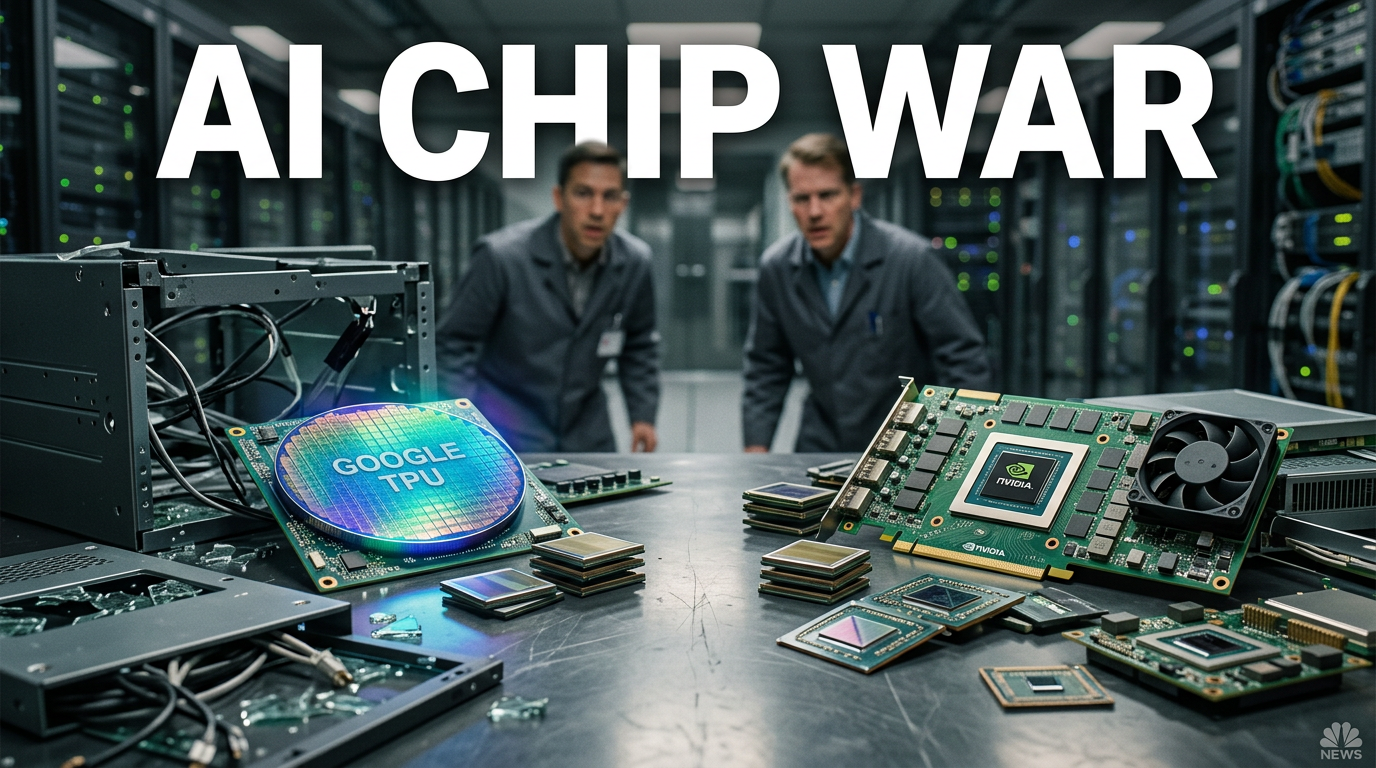
The outlook is that 10 years from now, as Google TPU, AMD GPUs, various NPUs, in-house AI chips, and big tech dedicated semiconductors increase, its share could fall to around 60–70%.
What matters here is that Nvidia is already transforming.
Nvidia is moving beyond being a simple GPU company into an AI infrastructure company.
It is pursuing a strategy that bundles data centers, networking, CUDA software, AI models, physical AI, and the robotics ecosystem.
In other words, the future competition between Nvidia and big tech is not about a single chip, but about who will dominate the entire AI infrastructure.
3. The 6 most promising semiconductor technologies over the next 10 years
Professor Kim presented six technologies that will deserve attention over the next decade.
These technologies are essential key takeaways for understanding AI semiconductors, the global economic outlook, and the semiconductor investment cycle.
① HBM, HBF, and HBS memory revolution
The first technology he highlighted was the memory revolution centered on HBM.
AI training and inference require memory that can process huge amounts of data at high speed.
No matter how good GPU performance is, if memory bandwidth is insufficient, overall system performance drops.
That is why HBM is regarded as a technology that solves a key bottleneck in the AI era.
This is also exactly why Samsung Electronics and SK hynix continue to attract attention in the global AI semiconductor market.
② 3D packaging
3D packaging is a technology that connects multiple semiconductors vertically or in three dimensions to improve performance and power efficiency.
In the past, packaging was seen only as a back-end process, but now it has become a core element of AI semiconductor competitiveness.
TSMC’s strength does not come simply from being good at foundry manufacturing.
Customers flock to it because it can provide high-performance packaging solutions as well.
③ Chiplets
Chiplets are a technology that assembles multiple small semiconductor blocks like Lego pieces to create a single high-performance system.
Putting every function into one giant chip has limitations in terms of cost and yield.
In the future, AI semiconductors are likely to advance rapidly through the combination of proven chiplets.
In this process, the importance of packaging technology and interconnect technology will grow even more.
④ Glass substrates
Glass substrates are a material drawing attention in next-generation semiconductor packaging.
They offer advantages over existing organic substrates in flatness and thermal stability, making them potentially suitable for high-performance AI chips.
Although they are not yet in the stage of full-scale popularization, the strategic value of glass substrates could grow as high-performance semiconductors for AI data centers continue to expand.
⑤ Silicon photonics
Silicon photonics is a technology that uses light instead of electrical signals to transmit data.
In AI data centers, the amount of data moving between chips and between servers is exploding.
Electrical signals alone have limitations in speed and power efficiency.
That is why silicon photonics is emerging as a key technology to solve data center power issues and communication bottlenecks.
⑥ Next-generation computing: quantum computing, neuromorphic computing, and optical computing
Quantum computing, neuromorphic computing, and optical computing are important technologies in the long term.
However, Professor Kim placed these technologies lower in priority.
The reason is that it may take longer before the market fully opens.
In other words, in the short term, HBM, 3D packaging, chiplets, and silicon photonics are more realistic investment points, while quantum computing and neuromorphic computing should be viewed as long-term future technologies.
4. Which Korean company could become “Korea’s Google”?
Professor Kim judged that among Korean companies, Samsung Electronics is relatively well positioned.
Samsung has memory, foundry, smartphones, and a device ecosystem.
But its weaknesses are also clear.
It lacks AI models and data centers.
Samsung Electronics: strong in memory and devices, but needs AI models
For Samsung to truly become a full-stack company, simply making semiconductors well is not enough.
It also needs on-device AI in smartphones, its own AI services, AI models, and a data center strategy.
Samsung’s Galaxy ecosystem is a powerful asset.
But to connect AI services and revenue models the way Google or Apple does, a much bigger strategic shift is needed.
SK hynix: could expand from memory into a data center ecosystem
SK hynix has a strong position in the HBM market.
If this is combined with SK Group’s data center, power, and AI agent strategies, it could move beyond being a simple memory company.
The Ulsan data center project can also be understood in this context.
Even if SK is not directly doing everything itself, it can still be seen as a move to expand into the AI ecosystem through power, land, and data center infrastructure.
Hyundai Motor: potential in physical AI and AI factories
Hyundai Motor has potential in physical AI based on automobiles.
Autonomous vehicles, robotics, smart factories, and in-car AI agent commerce could become key areas.
However, how much semiconductor supply Hyundai can secure on its own is still an issue.
The key is how it connects power semiconductors, automotive AI semiconductors, and physical AI infrastructure.
Naver and Kakao: AI agent commerce as a survival strategy
For Naver, a strategy that transforms commerce and search with AI is important.
In the future, users are likely to ask AI agents to handle product comparison, purchasing, reservations, and payments instead of typing keywords into a search box.
To protect Naver Shopping and search advertising revenue, it must secure leadership in the AI agent commerce market.
For Kakao as well, connecting messenger-based lifestyle AI agents with commerce could become a core challenge.
5. How far can Korean-born AI semiconductor startups grow?
Korean AI semiconductor startups such as FuriosaAI, Rebellions, DEEPX, and Mobilint are more than just ordinary venture companies.
If these companies do not grow, Korea may remain a memory powerhouse while struggling to secure leadership in system semiconductors and AI infrastructure.
Professor Kim emphasized that these companies must secure at least some reference cases in domestic data centers.
They may not be able to deliver perfect performance from the start, but technology can only grow through trial and error in real data center environments.
Even in the era when Korea was making Pony cars, they were not world-class vehicles from the beginning.
But Korea started, gained experience in the domestic market, and eventually grew into a global automotive company.
AI semiconductor startups need a similar level of patience.
6. Where should the tax revenue from the semiconductor boom go?
Professor Kim said the semiconductor boom may continue for a while, but it will not last forever.
He explained that memory demand will keep growing, but there may be periods of rest due to financing burdens or slower investment cycles in the middle.
So where should the money being earned now be used?
The core point is basic science, talent development, data center infrastructure, power grids, and future technology investment.
Why aggressive investment in talent development is necessary
Providing tuition and living expenses to doctoral students in science and engineering may not be as costly as people think.
But it can have a very large effect on national competitiveness.
A proposal was also made to expand AI departments to major universities nationwide and train outstanding students in a model similar to military academies.
To survive in the long-term competition over the semiconductor supply chain, Korea must train AI semiconductor talent, packaging talent, power semiconductor talent, and silicon photonics talent.
Why the G3 project is needed
Korea once had the G7 project.
It was a national project that pushed long-term R&D with the goal of reaching the technological level of the world’s seven leading economies.
Now the view is that a G3 project is needed.
To compete with the United States and China, a fast-follower strategy alone is not enough.
It is not enough to simply follow research that others are already doing; Korea must invest in technologies that do not yet exist, even if failure is possible.
7. AI competitiveness is ultimately power competitiveness
AI data centers use enormous amounts of electricity.
In the future, the competitiveness of the AI industry will depend not only on semiconductor performance, but also on how stably power can be supplied.
Professor Kim said the power issue should be approached practically, not ideologically.
Solar power, nuclear power, LNG, and cogeneration each have advantages and disadvantages.
Because it is difficult to solve the problem with just one energy source, a balanced energy portfolio is needed.
When building semiconductor clusters and data centers, the problem that often takes the longest is not technology but civil complaints.
If transmission lines, substations, water supply, and power infrastructure are not built on time, it is difficult to operate even the best semiconductor factory properly.
8. Four semiconductor technologies the government must nurture
Professor Kim presented NPU, power semiconductors, silicon photonics, and packaging as technologies the government should strategically support.
NPU
An NPU is a semiconductor specialized for AI computation.
It can be more power efficient than GPUs in certain AI inference tasks, so it can be used in on-device AI, data center inference, robotics, and automobiles.
Power semiconductors
Power semiconductors are core components that efficiently convert and control electricity.
Their importance continues to grow in electric vehicles, data centers, renewable energy, and industrial power systems.
Silicon photonics
Silicon photonics is a technology that can solve the bottlenecks in data movement and power consumption in AI data centers.
As AI models grow larger, communication between servers explodes, making this a very important field in the long term.
Packaging
Packaging is no longer just a simple back-end process.
Future AI semiconductors are moving toward a structure in which multiple chips are assembled into a single system.
Therefore, packaging is a strategic technology that Korea must secure.
9. Will the AI bubble burst, or merely cool off?
The AI bubble theory appears periodically.
The reason is that investment in AI infrastructure is so large.
Building data centers, buying GPUs, securing power, and hiring talent all require enormous amounts of money.
If interest rates rise or financing conditions worsen, growth could slow temporarily.
But Professor Kim saw this less as a bursting bubble and more as something like a balloon losing a bit of air and then being refilled.
In other words, the entire AI industry is unlikely to collapse; rather, investment speed and stock prices may fluctuate psychologically.
Structural growth in AI semiconductor demand, data center power demand, and HBM demand is still likely to continue.
10. Why is the United States likely to be the final winner in the AI era?
Professor Kim said the United States is highly likely to become the final winner in the AI era within the next 10 years.
The reason is not simply that it has more money.
- The United States has strong semiconductor design capabilities.
- It dominates the EDA software ecosystem.
- It has a long accumulation of technology centered in Silicon Valley.
- Big tech, cloud, AI models, startups, and venture capital all move together there.
- It has an ecosystem that can connect software and hardware at the same time.
China is a formidable competitor, but the accumulated strength of the United States in semiconductor design, software, capital, and ecosystem is difficult to catch up with in a short time.
He also explained that the reason Russia, despite being a technological power, has not become a leader in AI semiconductors is because it lacks an ecosystem like Silicon Valley.
11. The real core point that other YouTube channels or news outlets rarely mention
The most important but relatively under-discussed core point in this piece is not the “Nvidia vs. Google and Apple” narrative.
The real core point is that leadership in the AI industry is moving from individual semiconductors to a full-stack ecosystem.
In the past, making good semiconductors was enough to be competitive.
But in the future, semiconductors alone will not be enough.
Memory, foundry, packaging, power, data centers, AI models, software, cloud, and user services all need to be connected.
From this perspective, Korea’s biggest risk is remaining a country that is only good at memory.
If the profits earned from HBM are not reinvested into system semiconductors, NPUs, power semiconductors, silicon photonics, packaging, and AI talent development, Korea could lose leadership in the next cycle.
In other words, the current semiconductor boom may be not just a simple earnings improvement, but perhaps Korea’s last major opportunity to transform its industrial structure.
12. Conditions for Korea to become a semiconductor winner
Professor Kim emphasized that Korea must move beyond a fast-follower culture and toward a first-place nation culture.
At this point, simply following the paths others have already made quickly is not enough.
If Korea truly wants to become a leading AI semiconductor power, it needs the following conditions.
- A corporate culture that aims for world No. 1 is needed.
- Research funds must also be invested in future technologies with a high chance of failure.
- Infrastructure that allows data centers and semiconductor factories to be built quickly is needed.
- Power grid and water supply issues must be solved at the national strategy level.
- The market must be opened so AI semiconductor startups can secure domestic reference cases.
- Long-term investment in basic science and science and engineering talent development is needed.
In the end, Korea’s semiconductor future is not just Samsung Electronics’ and SK hynix’s problem.
It is a matter connected to the national power grid, university education, the startup ecosystem, government R&D, corporate investment, and public consensus.
< Summary >
Nvidia’s share of the AI data center market is currently overwhelming, but 10 years from now it could fall to around 60–70% due to challenges from Google and Apple.
Google is strong because it is a full-stack company with TPU, cloud, YouTube, search, and an ad revenue structure.
Apple can shake up the on-device AI market based on its enormous financial power and device ecosystem.
The key technologies over the next 10 years are HBM, HBF, HBS, 3D packaging, chiplets, glass substrates, silicon photonics, quantum computing, neuromorphic computing, and optical computing.
Korea should not be complacent with the memory boom.
It must invest boldly in NPU, power semiconductors, silicon photonics, packaging, AI talent development, and data center power infrastructure.
The AI bubble may face short-term corrections, but it is difficult to see it as a bursting bubble that destroys structural demand.
The final winner in the AI era over the next 10 years is likely to be the United States, and Korea should aim to become a technology-leading country at the G3 level rather than just a fast follower.
[Related Articles…]
- Google TPU is Reshaping the AI Semiconductor Landscape
- 3D Packaging Becomes the New Battleground in AI Chips
*Source: [ 티타임즈TV ]
– “엔비디아를 가장 위협할 기업, 구글과 애플입니다” (김정호 카이스트 교수)