
● Agentic AI Power Shift
The Final Puzzle of Agentic AI: Ontology… Why Is It Rising Again Now?
Today’s core point is exactly this.
Why agentic AI has suddenly evolved into “AI that does work,”
why it still has limitations on its own,
how ontology and neuro-symbolic AI fill that gap,
and why Palantir and Saltlux are at the center of this trend. Let’s organize it all at once.
1. How Far Has AI Come: Three Major Waves
The flow of AI is easiest to understand in three major stages.
The first was the early AI era centered on rules and perceptrons.
It was a period of experimentation to see whether machines could make logical judgments on top of von Neumann-style computing.
The second was the era when machine learning, deep learning, and transformers became mainstream.
During this period, large-scale data and scale pushed performance upward.
The foundation of the generative AI, LLMs, and LRMs we use today came from this era.
The third is the agentic AI era we are discussing now.
AI is now moving beyond simply “generating” answers,
and is trying to understand goals, create plans, call tools, collaborate with other AIs, and actually complete tasks.
In other words, AI is moving from a conversational tool to an actor that performs work.
2. Why Agentic AI Has Become Important
Earlier LLMs were strong at answering questions.
But agentic AI takes a question and connects it to the next action.
The important change here is reasoning and planning.
Instead of simply generating responses,
AI has begun to judge what should be done, and in what order, to achieve a goal.
That is why concepts such as deep research, research mode, orchestration, and multi-agent collaboration have grown rapidly recently.
To put it simply,
if an LLM was a smart speaking tool,
agentic AI has become closer to a working teammate.
3. But Why Is It Still Not Enough: The Fundamental Limits of LLMs
There is an important point here.
No matter how good LLMs become, hallucinations, instability, lack of explainability, and cost issues do not completely disappear.
That is because LLMs are fundamentally probability-based models.
They are strong at predicting the next token,
but they are not built as structures that strictly manage “facts” themselves.
That is why LLMs alone struggle to fully cover complex business processes, accurate decision-making, security-sensitive environments, and organizations with distributed internal data.
This is where ontology reappears.
4. What Is Ontology: Why It Is Needed Again in the AI Era
Ontology is, simply put, “a semantic blueprint that organizes concepts and relationships.”
Who is a higher-level concept of whom,
what attributes certain data has,
how things are connected to each other,
and structuring all of this so that machines can understand it is what ontology does.
It is an old concept that traces back to Aristotle’s logic and predicate logic,
but today it is being interpreted in a completely new way within the context of AI.
That is because human knowledge is not complete with text alone,
and meaning is completed only when relationships and context exist.
Ontology enables machines to handle those relationships and contexts.
5. LLMs and Ontology Are Not Competitors, but Complements
Many people misunderstand this, but ontology is not a technology that is better than LLMs.
Their roles are different.
LLMs are the starting point for flexible generation and reasoning,
while ontology plays the role of structuring, verifying, and connecting the results.
Simply put, an LLM is closer to the “brain,” while ontology is closer to the “skeleton of knowledge.”
When the two are combined, hallucinations decrease,
accuracy improves,
and AI can move from business automation to business autonomy.
6. Why Neuro-Symbolic AI Is Rising Again
One of the most important recent trends is neuro-symbolic AI.
There are areas where non-symbolic approaches, such as deep learning and LLMs, are strong,
and there are areas where symbolic approaches, such as ontology and logic, are strong.
Combining these two is neuro-symbolic AI.
The reason this combination matters is very clear.
LLMs can “speak” well,
but they are weak in explainability and strict verification.
Ontology, on the other hand, is strong in structure and verification,
but weak in unstructured data and large-scale generation.
That is why the two must be connected to create real enterprise AI, defense AI, financial AI, and manufacturing AI.
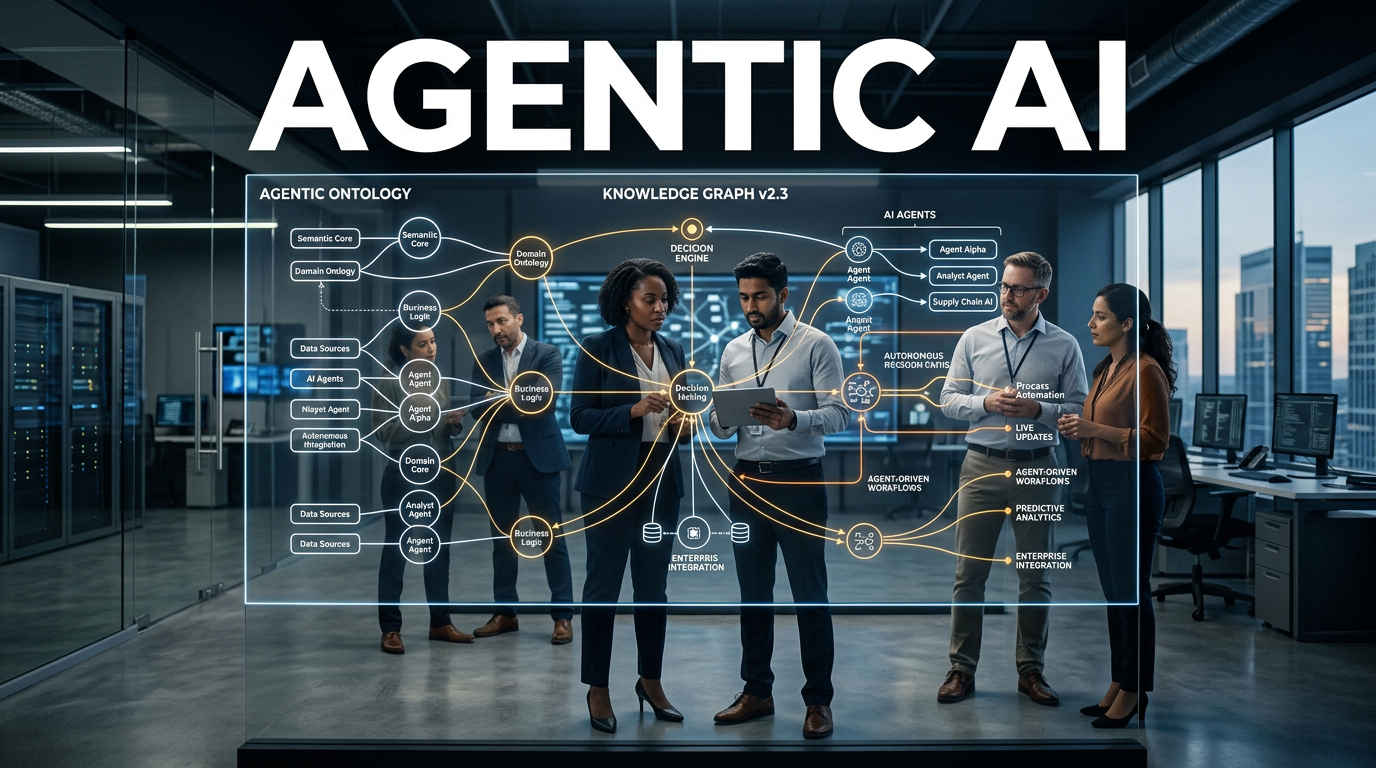
7. The Role of Ontology in Agentic AI
Agentic AI does not work alone.
Multiple models, multiple tools, and multiple agents collaborate.
What is needed at this point is organization.
And for an organization to collaborate, it needs a common language and role definitions.
That common language is ontology.
With ontology, agents can define what they know,
what they should call,
and in what order they should divide up tasks.
In other words, the productivity of agentic AI does not increase simply by increasing the number of agents.
It increases only when there is a structure that allows them to cooperate.
8. Why MCP and A2A Have Become Important
This is also why MCP and A2A are frequently mentioned in the agentic AI ecosystem recently.
MCP serves as a standard pathway that connects models with tools,
while A2A supports the communication structure through which agents cooperate with other agents.
In other words, the era is no longer about a single agent doing well alone,
but about agents forming teams.
And when the operating rules of that team are connected to ontology, it becomes a real business system.
9. The Change Shown by Deep Research: From “AI That Answers Once” to “AI That Thinks Multiple Times”
If you look at deep research-style features, the change is clear.
Earlier AI had a structure where one question led to one answer,
but now AI expands a question in multiple directions, searches, reads, reviews, asks again, and plans.
In this process, LLMs operate repeatedly multiple times.
In other words, AI is no longer immediately producing an answer,
but has begun to automate the “working process” until it reaches the goal.
This is the essence of agentic AI.
10. Why Palantir Makes Money with Ontology
Looking at Palantir makes it easier to understand why ontology becomes a business.
The core point is that it enables semantically integrated decision-making on top of data silos,
even while leaving those data silos in place.
In other words, it is not a method of physically gathering all data in one place.
It is a method of connecting only the necessary data and showing it in an interpretable form at the necessary moment.
This approach is especially powerful in areas where security and operational efficiency matter, such as defense, manufacturing, finance, and logistics.
Palantir does not operate ontology merely as a conceptual model,
but as something closer to an enterprise operating system.
11. The Real Reason Palantir Is Strong: Semantic Layer and Dynamic Ontology
Many people see Palantir only as an “expensive solution,” but the core point is not the price.
The core point is dynamic ontology.
Even when data structures change and business operations change,
the important point is that the system can continue to adapt through ontology and the semantic layer.
The reason this is possible is that it does not simply store data,
but connects data, logic, and action into a single flow.
That is why Palantir is not merely a BI tool,
but closer to a real-time operational decision-making platform.
12. Practical Points Shown by Saltlux and Lucia
What is interesting in the Saltlux case is that operating costs dropped dramatically when ontology and LRM were combined.
The core point is not to blindly increase the size of LLMs,
but to structure knowledge with ontology and efficiently run only the necessary computation and reasoning.
This approach reduces costs while improving accuracy,
and also makes it usable in enterprise on-premises environments.
It is especially meaningful in sectors such as defense, public services, and manufacturing, where dependence on external clouds can be a burden.
13. The Difference Between General LLMs and Ontology-Based AI
A general LLM provides answers within the scope of what it has learned in response to a question.
There is also RAG with search attached, but it is still centered on document retrieval.
By contrast, ontology-based AI structures the question,
verifies the answer based on domain knowledge and relationships,
and, if necessary, connects the result to action.
The biggest difference here is the difference between “answer generation” and “task execution.”
What companies will truly want going forward is not AI that answers well,
but AI that responsibly handles work.
14. A Core Point That Is Rarely Discussed Elsewhere: Ontology Is Essentially AI’s Quality Management System
This is one of today’s most important points.
Many news stories and YouTube videos only talk about how “AI has become smarter.”
But the real core point is not AI itself, but the quality of knowledge that AI can trust and use.
Ontology is the structure that manages that knowledge quality.
In other words, ontology is not merely a supporting tool that improves AI performance,
but a quality management system that gives AI a stable standard.
Without this perspective, enterprise AI eventually runs into hallucinations, duplication, and cost explosions.
15. Another Core Point: If You Build an AI Platform Before Defining the Problem, You Will Fail
This part is truly important.
Many organizations try to build the platform first.
But to do it properly, the order should be the opposite.
The problem must be defined first.
Then the data needed to solve that problem should be identified,
how that data should be modeled with ontology should be examined,
and only then should LLMs and agents be connected.
If this order is reversed, the probability of failure rises sharply.
16. Industries Where Real-World Adoption Is Moving Quickly
The fields where ontology and agentic AI currently fit best are as follows.
First, defense and public services.
This is because data silos, security, and real-time judgment are core point issues.
Second, manufacturing and supply chains.
This is because parts, equipment, quality, predictive maintenance, and SCM all need to be connected.
Third, finance and insurance.
This is because risk assessment, underwriting, product explanation, and regulatory compliance are important.
Fourth, logistics and mobility.
This is because real-time location, routing, demand forecasting, and redistribution are central.
17. What Korean Companies Should Prepare Now
What Korean companies need to do now is clearer than it may seem.
They should stop seeing ontology only as a difficult philosophical concept,
and instead view it as an operational language that organizes real business processes.
And LLMs should be used as engines that interpret, generate, and collaborate through that operational language.
Another important point is on-premises infrastructure and security.
In areas with large amounts of sensitive data, such as defense, public services, and manufacturing, relying only on the cloud has limits.
Internal operating structures, proprietary models, proprietary ontologies, and proprietary agents are needed.
18. Core Keywords Not to Miss from an SEO Perspective
The core keywords that naturally connect with this article are global economic outlook, AI trends, agentic AI, ontology, and neuro-symbolic AI.
These five keywords are likely to continue increasing in search volume and industry interest together.
In particular, AI trends and the global economic outlook no longer move separately.
This is because changes in industrial structure, cost reduction, productivity innovation, defense, and supply chain restructuring are all connected to AI.
Summary
Agentic AI is the stage where AI has evolved from “AI that answers” into “AI that works.”
But its true completion does not come from LLMs alone, but from their combination with ontology.
Ontology is core infrastructure that organizes AI’s knowledge quality and collaboration structure.
As the cases of Palantir and Saltlux show, the competition ahead will depend more on knowledge structure and operational efficiency than on model size.
Ultimately, problem definition, data organization, ontology design, and agentic AI integration are the keys to success.
[Related Articles…]
Palantir’s Enterprise AI Platform Strategy and the Rise of Ontology
How Agentic AI Is Reshaping Workflow Automation and Industry
*Source: 대한민국 인공지능 여기까지, 솔트룩스