● Korean Chip Last Chance, AI Boom, Rate Pressure, HBM Surge
Samsung Electronics and SK hynix: Conditions for a Rebound and the Last Window for Korea’s Semiconductor Industry
The key issue in this article is not simply whether Samsung Electronics and SK hynix will rise.
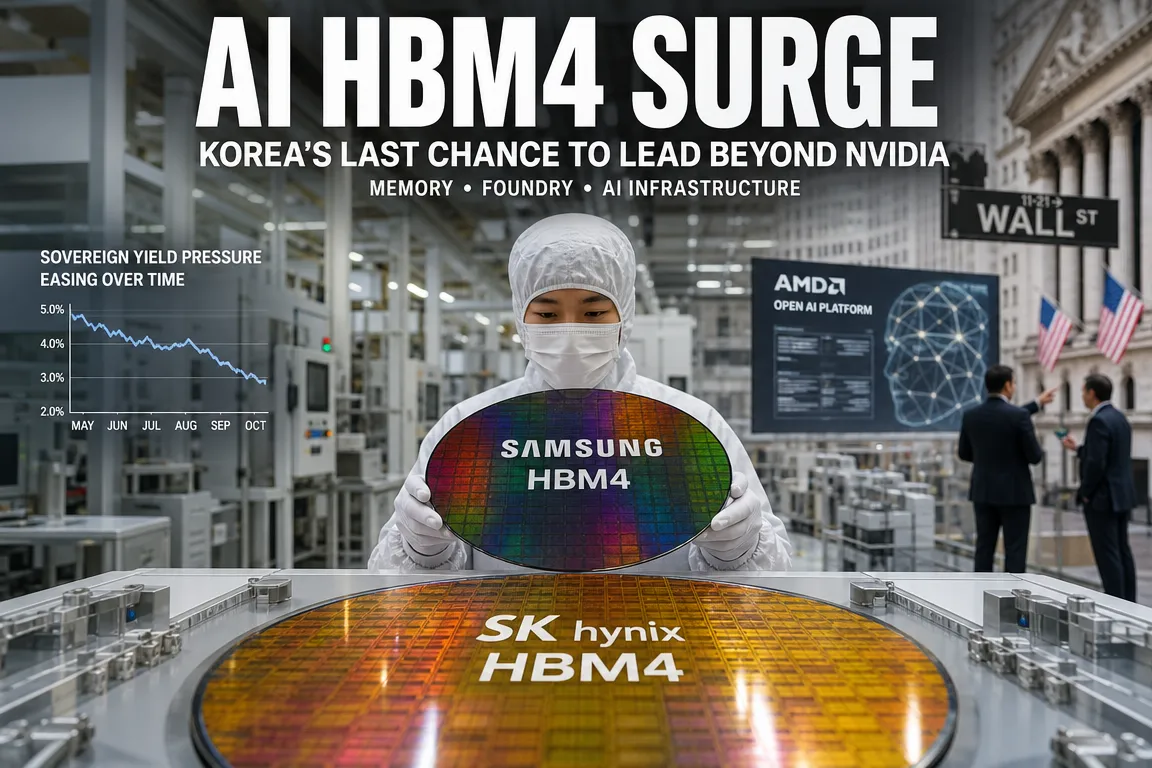
The real question is whether the AI semiconductor cycle can withstand pressure from sovereign bond yields, and whether Korea’s semiconductor industry can expand beyond its dependence on Nvidia into AMD, foundry, HBM4, and AI infrastructure platforms.
One point that the market often overlooks is that Korea currently holds a critical choke point in memory, but this position may not be permanent.
In that sense, this may be both an opportunity for Samsung Electronics and SK hynix and a final window to reshape the structure of Korea’s semiconductor industry.
1. The market’s main question: Can AI growth outpace bond yields?
The dominant global equity issue is the balance between AI growth and sovereign bond yields.
If AI infrastructure investment continues to expand, corporate earnings expectations should improve.
Conversely, persistently elevated bond yields remain a valuation headwind for equities.
In simple terms, the future earnings generated by AI must exceed the burden of higher rates for Samsung Electronics and SK hynix to be re-rated.
The discussion highlighted a clear view.
If AI growth is strong enough to outweigh rates, the AI cycle and semiconductor cycle can extend further.
In that case, Korea’s semiconductor competitiveness could strengthen again.
In particular, Samsung Electronics and SK hynix’s preparations for HBM4 and the next generations beyond it remain an important medium- to long-term positive factor.
However, there is also a downside scenario.
If AI expectations rise while rates remain high and earnings fail to meet forecasts, markets may begin to question the narrative quickly.
In that case, the adjustment may extend beyond a normal correction and trigger a broader reassessment of AI semiconductor valuations.
2. Conditions for Samsung Electronics and SK hynix to regain leadership
The discussion identified four main conditions for upside in Samsung Electronics and SK hynix.
First, the AI cycle must be extended.
Demand for Nvidia GPUs, HBM, data center investment, and AI server expansion must continue.
AI infrastructure spending must remain intact for memory prices and earnings estimates to keep rising.
Second, HBM price increases must meet market expectations.
The discussion noted that next year’s HBM price increases are being debated in a range of 50% to 100%.
The scale of HBM price increases and HBM bit growth are key variables for earnings estimates at SK hynix and Samsung Electronics.
SK hynix, in particular, has established a leadership image in the HBM market, and its pricing power directly affects earnings and valuation.
Third, shareholder returns must be confirmed as a continuing policy rather than a one-off event.
For foreign investors to assign higher multiples to Samsung Electronics and SK hynix, policies such as dividends, share buybacks, and share cancellations must be clearly articulated.
Samsung Electronics needs to present a new policy after its existing three-year shareholder return plan.
For SK hynix, capital allocation policy linked to buybacks, cancellations, ADR demand, and potential index inclusion has become increasingly important.
Fourth, bond yields must decline.
High rates act as a gravitational force on equity markets.
Even when earnings provide upward momentum, stocks do not rise easily if the rate burden is too strong.
Ultimately, further gains in Samsung Electronics and SK hynix require stability in U.S. Treasury yields, stable oil prices, and easing inflation pressure.
3. A key variable the market overlooks: Middle East risk and oil prices can move semiconductor stocks
When evaluating semiconductor stocks, many investors focus only on HBM, Nvidia, and earnings releases.
However, the discussion placed emphasis on external variables such as Middle East conflict and international oil prices.
If tensions in the Middle East persist or escalate, oil prices may rise.
Higher oil prices can revive inflation expectations.
Rising inflation concerns can push bond yields higher again.
Higher yields pressure growth stocks and semiconductor valuations.
Conversely, if Middle East risks ease and oil prices stabilize, bond yields may decline more quickly.
In that case, Samsung Electronics and SK hynix could gain significant upside momentum.
In short, semiconductor investors must monitor global oil prices, U.S. Treasury yields, and geopolitical risk alongside company fundamentals.
4. HBM alone is not enough: The next battleground in AI semiconductors is the platform
One of the most important points in the discussion was the visit by AMD’s CEO to Korea.
AMD appears to be pursuing an integrated AI platform that combines Korea’s memory semiconductors, NPU capabilities, and foundry capacity, rather than limiting itself to GPU and CPU sales.
This is highly significant.
AI infrastructure is no longer a contest over a single GPU or CPU.
The key issue is how tens of thousands, or even millions, of chips, servers, and data centers are interconnected and optimized.
Three concepts are central here.
Scale-up refers to the technology that connects chips to chips.
Scale-out refers to the technology that links servers into clusters.
Scale-across refers to the structure that connects data centers to data centers.
Nvidia remains the strongest company in this area.
It offers not only GPUs, but also NVLink, InfiniBand, networking equipment, and software ecosystems as a near-turnkey solution.
For global hyperscalers, the conclusion is often that using Nvidia’s solution is easier than building a stack internally.
However, if this structure persists, AMD, Intel, and Korean semiconductor companies may become increasingly dependent on Nvidia’s ecosystem.
For that reason, AMD needs to build an open ecosystem, open standards, and an alternative platform.
In that process, Korea’s HBM, memory, and foundry capabilities could emerge as key partners.
5. Dependence on Nvidia is both an opportunity and a risk: Korea’s semiconductor choke point
Global memory leaders currently treat Nvidia demand as one of their top priorities.
The reason is straightforward.
Nvidia is the largest market and the center of HBM demand.
However, as noted in the discussion, if everyone focuses only on Nvidia, the industry may eventually become too dependent on Nvidia’s terms.
Korea’s true strength lies in its memory choke point.
In the AI era, high-bandwidth memory is as important as high-performance GPUs.
Even the best AI accelerator cannot deliver expected performance if data transfer bottlenecks are not resolved.
This is where Samsung Electronics and SK hynix occupy a strategically important position in the global AI supply chain.
However, a choke point is not a permanent advantage.
This position may not last indefinitely.
Just as Intel lost leadership during the transition from the PC and server CPU era to the GPU and AI era, Korea’s semiconductor industry could also fall behind if it remains confined to memory.
6. A more important opportunity for Samsung Electronics: AMD cooperation and foundry reacceleration
The potential partnership with AMD may have greater strategic significance for Samsung Electronics than for SK hynix.
The reason is that Samsung Electronics has both memory and foundry businesses.
If AMD works with Korean companies from the design stage and the resulting products are manufactured in Samsung Electronics’ foundry, the situation changes materially.
For years, Samsung Electronics has been challenged by its need to narrow the gap with TSMC in foundry.
If an ecosystem emerges that connects AMD, AI semiconductors, NPUs, HBM, advanced packaging, and foundry production, Samsung Electronics could evolve from a memory company into a core manufacturing partner for the AI infrastructure ecosystem.
That would be an important factor in re-rating Samsung Electronics’ valuation multiple.
There are, however, conditions.
Technical credibility, yield, advanced process competitiveness, and customer-specific design support must improve together.
Simply stating that Samsung has a foundry business is not enough.
The company must develop ecosystem competitiveness strong enough that customers want to work with Samsung from the design stage.
7. The most important point the market overlooks: Korea’s semiconductor industry may already be near a peak
Other news coverage and online commentary typically focus on Samsung Electronics’ target price, SK hynix’s earnings, HBM orders, and Nvidia shipments.
But the more important question is this.
What if this moment, when Korea’s semiconductor industry appears strongest, is actually the last opportunity for structural transition?
Korea is currently strong in HBM and memory.
Nvidia CEO Jensen Huang has visited Korea, and AMD’s CEO has also met with Korean companies.
It is clearly positive that global AI semiconductor companies want to work with Korea.
At the same time, it is also a signal that Korea must evolve.
In the past, Korea’s semiconductor strength was based on manufacturing competitiveness: low cost, fast execution, and mass production.
However, that is no longer sufficient in the AI semiconductor era.
Going forward, customer-specific design, advanced packaging, power efficiency, system optimization, and software integration will matter more.
The industry must expand from memory to hardware, from hardware to platforms, and from platforms to software ecosystems.
If Korea’s semiconductor industry succeeds in this transition, Samsung Electronics and SK hynix could be re-rated not as cyclical stocks, but as core AI infrastructure companies.
If it fails, the current HBM boom may end as a temporary peak.
8. Materials, components, and substrates must be viewed differently from large-cap semiconductor stocks
The discussion also addressed valuation pressure in substrate, IT components, and materials companies.
This is an important distinction for investors.
For Samsung Electronics and SK hynix, the argument that they are still cheap at 4x PER may be plausible.
But some substrate and IT component companies may already be pricing in earnings expectations for 2028 and 2029.
In other words, these companies must prove not only that future earnings will improve, but also that a 12x PER in those years is actually inexpensive.
That is a much harder standard.
Large-cap semiconductor companies currently have strong earnings and cash flow, while some components companies may already reflect substantial future growth in their valuations.
Accordingly, even within the AI semiconductor theme, large memory companies and materials, parts, and equipment firms should be approached with different investment frameworks.
9. Power infrastructure is also a key variable: Investors should focus on onsite power, not just utilities
As AI data centers expand, power infrastructure has become a major investment theme.
However, the discussion emphasized that investors should focus not on utilities broadly, but on onsite power.
Onsite power refers to systems that generate and supply electricity directly near data centers or industrial sites.
As AI infrastructure grows, pressure on the grid will increase, and the need for onsite power solutions may rise.
Solar energy may also be linked to long-term contract structures.
That said, even within the power sector, investors should distinguish between companies whose orders are already reflected in earnings and those whose results are likely to begin accelerating next year.
Markets typically assign higher expectations to companies where new earnings are still being added.
10. When should investors consider selling? A checklist for Samsung Electronics and SK hynix
The original discussion ended with the question of when to sell.
Although the full response was not disclosed, the earlier analysis suggests a fairly clear framework for exit decisions.
First, when AI growth can no longer outpace rates.
If bond yields remain high while AI investment growth slows and earnings estimates are revised down, the core investment thesis for semiconductor stocks weakens.
Second, when expectations for HBM price increases weaken.
If next year’s HBM price increases come in below market expectations, or if competition compresses margins, earnings estimates may deteriorate.
Third, when shareholder returns appear to be a one-time event.
If buybacks, cancellations, and dividend expansion are not confirmed as ongoing policy, foreign investors may be less willing to assign higher multiples.
Fourth, when dependence on Nvidia deepens further and alternative ecosystems fail to develop.
Even if Korea holds a choke point in memory, excessive concentration on one customer can weaken bargaining power.
Fifth, when there is no visible recovery in Samsung Electronics’ foundry business.
Samsung’s long-term re-rating will likely depend not only on memory, but also on foundry and AI platform collaboration.
If progress on this front remains delayed, the upside for the stock may be limited.
11. Investor positioning by scenario
Bull case.
AI investment continues to expand, HBM prices rise sharply, and bond yields stabilize.
If Samsung Electronics and SK hynix also strengthen shareholder returns and expand cooperation with AMD and Nvidia, large-cap semiconductors could again become market leaders.
Base case.
AI demand remains intact, but rates do not decline easily, and HBM price increases remain near the midpoint of expectations.
In that case, Samsung Electronics and SK hynix may trade sideways.
Guidance from earnings releases and conference calls would likely determine near-term direction.
Bear case.
If Middle East tensions escalate, oil prices rise, and bond yields move higher again, semiconductor stocks could correct.
If AI spending also slows or HBM pricing power weakens, the pressure would be greater.
Substrate and component names that have already discounted future growth may be more volatile.
12. Conclusion: Korea’s next move will be decided not by HBM alone, but by platform transition
The near-term conditions for another strong move in Samsung Electronics and SK hynix are HBM pricing, AI demand, bond yields, and shareholder returns.
However, the factor that will determine the long-term trajectory of Korea’s semiconductor industry is different.
The key issue is whether the industry can transition from a memory-centric business to a core AI infrastructure platform business.
Nvidia and AMD are working with Korea for a clear reason.
Korea has memory capabilities that are difficult to replace in the AI semiconductor supply chain.
But assuming that advantage will last indefinitely would be a mistake.
What is needed now is not simply to benefit from the HBM boom, but to use the resulting cash flow and technological capability to expand into foundry, advanced packaging, customer-specific design, power efficiency, and AI infrastructure platforms.
This is therefore a major opportunity for Korea’s semiconductor industry.
At the same time, if no meaningful structural change follows, it may also become the last opportunity.
< Summary >
The conditions for a renewed rally in Samsung Electronics and SK hynix are an extended AI semiconductor cycle, higher HBM prices, stronger shareholder returns, and lower bond yields.
Middle East risk and oil prices can affect semiconductor valuations directly through their impact on sovereign yields.
AMD’s visit to Korea is an important signal that Korea’s semiconductor industry can reduce dependence on Nvidia and expand into an AI infrastructure platform ecosystem.
Korea holds a memory choke point in HBM and memory, but that position may not be permanent.
Samsung Electronics can create a new growth path through AMD cooperation and foundry reacceleration.
For SK hynix, HBM competitiveness and shareholder return policy are central to re-rating.
Ultimately, the key issue for Korea’s semiconductor industry is not memory alone, but the transition to an AI infrastructure platform.
[Related Articles…]
AI Semiconductor Cycle and HBM Investment Strategy
How Bond Yield Changes Affect Global Equities and Growth Stocks
*Source: [ 경제 읽어주는 남자(김광석TV) ]
– 삼전닉스 다시 갈 조건 나왔다…한국 반도체, 지금이 마지막 기회일까 | 경읽남과 토론합시다 | 3자토론 이형수x장우진x김광석 [4편]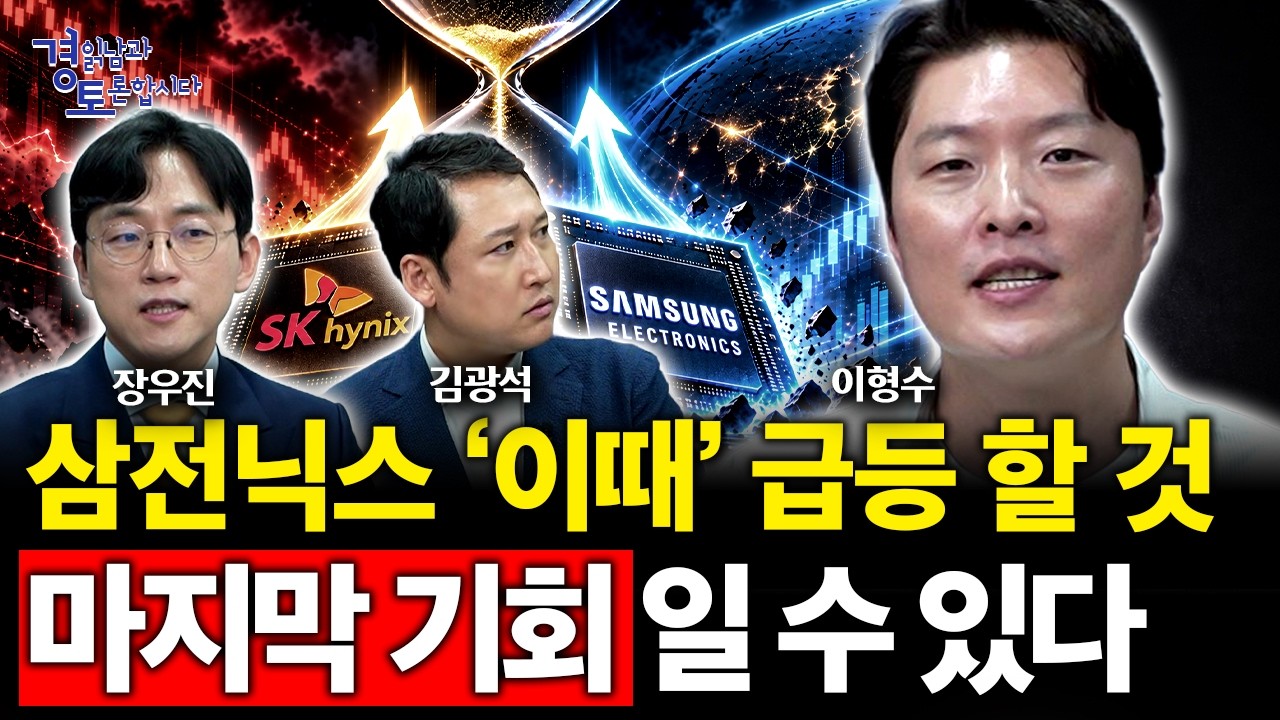
● Ukraine, Korea, Hype, Migration, K-Soft Power, Boom
The Substance Behind the “Korea Rumor” Spreading in Ukraine: War, Hallyu, Migration Demand, and the K-Soft Power Economy
The key point here is not simply that “people in Ukraine like Korea.”
This piece examines how perceptions of Korea changed after the war in Ukraine, why life in Korea is often seen as more convenient than in Europe, how Hallyu is translating into tourism and migration demand, and what this means for the global economic outlook and K-brand industries.
What many accounts miss is that Korea is increasingly viewed not merely as a travel destination, but as an option combining safety, opportunity, culture, and social connection.
This trend has implications for tourism, study-abroad demand, international marriage, content industries, consumer goods exports, and AI-driven platform business models.
1. Video Background: Full Interview with Sandra, a Ukrainian Native
The source material is a full interview with Sandra, a Ukrainian native, published on a YouTube channel.
The full version combines episodes 1 to 3 released between October 2 and October 11, with filming dated September 30.
The main topics include wartime experience in Ukraine, the unexpectedly high convenience of life in Korea, differences between Europe and Korea, rumors about Korea circulating in Ukraine, and the spread of Hallyu.
-
00:36 The unusual reaction people have after coming to Korea
-
04:48 Why Europe feels frustrating by comparison
-
11:14 The reality of Ukraine collapsing in an instant because of war
-
19:06 The desire to remain in Korea and rumors about Korea in Ukraine
-
26:08 Why Ukrainian women are interested in Korea
-
29:42 The renewed second wave of Hallyu in Ukraine
2. What Is Meant by Saying Ukrainians Have “Caught” Korea
The phrase “everyone in Ukraine has caught it” is not meant literally.
It refers to becoming deeply accustomed to Korean culture and lifestyle in a way that is difficult to reverse.
Foreign visitors to Korea commonly point to speed, convenience, safety, and urban infrastructure.
Korea combines public transit, delivery services, security, healthcare access, cafe culture, retail infrastructure, and high-speed internet in a dense system.
For many foreigners, this daily system itself is striking.
Features that Koreans consider routine, such as same-day delivery, 24-hour convenience stores, dense subway networks, and fast administrative processing, are uncommon in many other countries.
This is why interest in Korea extends beyond K-pop fandom into lifestyle satisfaction.
3. Why Europe Can Feel Frustrating by Comparison
Sandra says that after becoming accustomed to Korea, Europe can feel frustrating.
This is an important point.
Although Europe is still widely associated with a high standard of living, many foreign residents find Korea far faster and more efficient in daily life.
-
Korea has short public transit intervals and dense mobility networks.
-
Mobile payments, reservations, maps, and delivery apps are highly usable.
-
There are many stores and services open late at night.
-
Perceived personal safety is a major advantage.
-
The pace of urban life is fast, and response times are short.
Although this may appear to be a simple lifestyle comparison, it is closely linked to national competitiveness.
When digital infrastructure, service quality, urban management, and mobile ecosystems are integrated, foreign residents are more likely to view the country as an attractive place to stay.
Over time, this can support demand in education, employment, tourism, entrepreneurship, and remote work.
4. The Reality of War in Ukraine: “Bombs Fell Without Warning”
The most serious part of the interview is the war experience.
Sandra says she directly witnessed the start of the war and experienced bombs falling suddenly.
War can seem remote when viewed through news reports and statistics, but for those involved it means the sudden collapse of normal life.
Her account includes family contact losses, seeing bodies, and situations in which speaking Ukrainian or expressing patriotism could become dangerous.
Her description of losing contact with her grandmother, grandfather, and uncle shows how war disrupts family ties and the foundations of daily life.
Such experiences do not only cause grief; they also influence migration decisions, preferences for safer countries, and long-term planning.
5. Why Korea Appears More Valuable After War
For someone who has experienced war, Korea may not simply look like an interesting country, but like a place where life can be lived safely.
This distinction is important.
People who first discover Korea through Hallyu content may initially be drawn by dramas, music, food, or fashion.
But after living in Korea, they often respond more strongly to security, transportation, healthcare, administration, and urban infrastructure.
In other words, interest in Korea moves from cultural consumption to confidence in the quality of life.
This is a critical factor for Korea’s tourism industry and foreign resident policy.
6. The Rumors About Korea Circulating Within Ukraine
The “rumors” emphasized in the video can be understood as the spread of a very attractive image of Korea within Ukraine.
Once interest in Korea is established through Hallyu, people who have visited Korea reinforce expectations by sharing first-hand experiences.
The key point is that word-of-mouth is shifting from fandom into practical lifestyle information.
-
Korea is perceived as safe.
-
Seoul is seen as having rich experiences and many things to do.
-
There is also interest in Korean men, Korean culture, and Korean relationship norms.
-
K-pop, K-dramas, K-beauty, and Korean food create demand for visits.
-
In some cases, this develops into a desire to live in Korea long term.
This kind of word-of-mouth may expand demand not only for K-content, but also for K-tourism, K-beauty, K-food, Korean language education, and study abroad.
7. What It Means to Say Seoul Must Be Visited Four Times a Year to Be Properly Seen
The claim that Seoul would need to be visited four times a year to be properly explored reflects a shift in tourism structure.
In the past, foreign tourism in Korea focused on major landmarks such as Gyeongbokgung, Myeongdong, Namsan, and Hongdae.
Today, districts such as Seongsu, Hannam, Apgujeong, Yeonnam, Euljiro, Jamsil, Yeouido, The Hyundai, the Han River, cafe streets, pop-up stores, K-beauty shops, and concept stores have become tourism content in themselves.
Seoul is increasingly selling a lifestyle rather than simply a location.
This has significant implications for the global economy outlook.
Tourists are not only taking photos; they are spending on food, fashion, cosmetics, goods, cafes, performances, beauty services, and experiential retail.
As a result, Seoul’s urban competitiveness supports both domestic consumption and foreign spending.
8. Why Ukrainian Women Are Interested in Korea
The video includes a provocative subtitle suggesting that some women came to Korea to meet Korean men.
This should be interpreted carefully.
It would be inaccurate to generalize that women from a particular country come to Korea solely to meet Korean men.
However, it is true that Hallyu dramas and content shape curiosity about Korean male images and relationship culture.
Male characters in K-dramas are often portrayed as considerate, responsible, emotionally expressive, and romantic.
These portrayals are not identical to reality, but they influence initial interest in Korea.
The key issue is not romance itself, but the fact that Hallyu is creating motivations for physical movement and travel.
This is a clear example of content industries expanding into tourism, aviation, hospitality, consumer goods, and education markets.
9. Why a Second Wave of Hallyu Has Re-Emerged in Ukraine
The video also refers to a renewed second wave of Hallyu in Ukraine.
Hallyu no longer depends only on the popularity of a few K-pop acts.
It has become a multi-industry ecosystem involving dramas, films, variety shows, webtoons, games, beauty, fashion, food, Korean language learning, and travel content.
In an environment where online content consumption has increased after the war, platforms such as Netflix, YouTube, TikTok, and Instagram have amplified the spread of Korean content.
AI recommendation algorithms are strengthening this trend.
Once users watch a single K-drama, they are likely to receive recommendations for Korean variety shows, K-pop, travel vlogs, and Korean language learning content.
This is where AI trends and Hallyu expansion intersect.
Whereas broadcasters and record labels once led overseas expansion, algorithms now intensify preferences and automatically connect fandoms.
10. The Economic Core: Korea Is Moving from a Cultural Exporter to a Lifestyle Model Exporter
The most important takeaway is that Korea is not simply selling content.
Foreign audiences discover Korea through content, but when they visit, they respond even more strongly to the country’s living system.
This is a major change for the Korean economy.
The key is no longer only earnings from K-pop albums or drama distribution rights.
Korean urban living, consumer culture, beauty routines, cafe culture, and digital services are also being exported.
Over time, this could affect exchange rates, tourism balance, service exports, consumer goods exports, and brand premium.
In a period of global consumption weakness driven by inflation, fandom-based spending tends to be more resilient.
Consumers with strong attachment to a brand are often willing to keep buying even when prices rise modestly.
11. The Core Point Most News Coverage Misses
First, Hallyu is no longer only an emotional industry; it is now a mobility industry.
People do not stop at consuming Korean content; they want to visit Korea in person.
This connects to aviation, hotels, duty-free retail, medical tourism, education, and foreign employment.
Second, war and instability increase preference for safe countries.
Geopolitical risk such as the war in Ukraine leads people to ask where it is safe to live.
Although Korea is a divided country, it is often rated highly in terms of day-to-day security and urban systems.
Third, Korea’s digital convenience is a strong competitive advantage for foreigners.
Fast internet, mobile payments, map applications, delivery apps, and reservation systems all raise satisfaction among foreign residents and visitors.
These services can be further expanded through AI trends into multilingual tourism, automated translation, and personalized safety guidance.
Fourth, Korea’s next export category is experience.
The market is moving beyond exporting cosmetics, food, and content.
Experiences unique to Korea are becoming commercial products.
Seongsu pop-up stores, Han River picnics, K-beauty procedures, idol merchandise tours, and visits to filming locations are all monetizable.
Fifth, cultural industries may serve as a buffer for Korea amid supply chain volatility.
Semiconductors, automobiles, and batteries remain critical, but they are more exposed to global supply chain risk.
Content and tourism create a different growth engine.
While tourism is affected by airfare and exchange rates, stronger brand loyalty can improve resilience to external shocks.
12. Opportunities for Korean Companies
This trend provides practical implications for companies.
Interest in Korea is growing not only in Ukraine, but also in Eastern Europe, Central Asia, Southeast Asia, and Latin America.
Korean companies should convert this attention into localization rather than treating it as general advertising.
-
K-beauty companies should operate content in Ukrainian, Russian, and English.
-
Tourism platforms should build Seoul itineraries tailored to foreign visitor movement patterns.
-
Education companies can combine Korean language learning with study-abroad information.
-
AI startups can develop automated translation, personalized recommendations, and safety information for foreign tourists.
-
Content companies need strategies that convert K-drama fandom into travel, merchandise, and commerce.
AI-driven personalization is likely to become a core mechanism in Hallyu-related business.
For example, if a user in Ukraine watches a large amount of K-dramas, the platform can naturally recommend Seoul filming-location tours, related fashion brands, Korean language courses, and K-beauty products.
This may generate higher conversion rates than conventional advertising.
13. Areas Where Korean Society Should Be Cautious
As interest in Korea grows, several cautions are necessary.
First, excessive generalization about foreign visitors should be avoided.
Statements such as “Ukrainian women come to Korea to meet Korean men” may attract attention, but they risk oversimplifying individual motivations.
Second, the gap between Hallyu image and reality should be reduced.
Korea appears beautiful and romantic in content, but real life also includes high living costs, competition, language barriers, and visa constraints.
Third, Korea should strengthen infrastructure for foreign residents.
Without multilingual guidance, healthcare access, housing information, legal support, and employment information, positive impressions may not be sustained.
Fourth, sensitivity is needed toward people with wartime and refugee backgrounds.
Their stories are connected to real trauma, not simply content material.
14. Outlook: Hallyu Should Be Viewed as an Economic Indicator
This case shows that Hallyu should no longer be viewed only as a cultural phenomenon.
It is also a force shaping national branding, tourism balance, foreign spending, service exports, urban competitiveness, and talent inflows.
When the global economy is uncertain and inflation and exchange-rate volatility remain high, the value of national branding becomes more important.
When people like a country, they buy its products, visit it, learn its language, and consider long-term stays.
This is how culture becomes economics.
Korea has already entered that transition.
The challenge now is to turn this attention into a durable industrial structure rather than a short-lived trend.
< Summary >
Sandra’s interview shows that interest in Korea inside Ukraine has expanded beyond Hallyu fandom into demand for lifestyle, safety, migration, and tourism.
War experience has increased preference for safe countries, and Korea’s security and urban infrastructure are strongly appealing to foreigners.
Seoul is evolving from a landmark-based destination into a city that sells lifestyle and consumer experiences.
Hallyu, combined with AI recommendation systems, is driving demand for K-dramas, K-pop, K-beauty, Korean language learning, and travel to Korea.
The central point is that Korea is moving beyond being a cultural exporter toward becoming a lifestyle model exporter.
Going forward, the Korean economy may capture new growth opportunities across content, tourism, consumer goods, education, and AI-enabled platform services.
[Related Articles…]
*Source: [ 달란트투자 ]
– 우크라 내부에 싹다 퍼진 한국에 대한 기막힌 소문 | 산드라 풀버전