● Cooling Arms Race
AI Data Center Cooling War: The Real Way to Increase GPU Computing Power Without Building More Data Centers
The core point of the AI race has now shifted beyond “who can build a better model” to “who can run the GPUs they have for longer, faster, and at higher density.”
Land is scarce, power grids cannot keep up, and NVIDIA GPUs are hard to get in the quantities you want even if you have the money.
In this situation, the almost only lever for increasing an AI data center’s computing power is cooling technology.
In this article, we will easily organize the key technologies from air cooling to direct liquid cooling, immersion cooling, and two-phase cooling, and also cover why NVIDIA is not yet officially pushing immersion cooling, and why oil refiners and power equipment companies are entering the AI infrastructure market.
1. AI Looks Like Software, But the Money Is Flowing Into Hardware
The AI we experience is screen-based services like ChatGPT, Gemini, and Claude.
That is why many people think of AI as a software industry.
But the direction money actually flows tells a different story.
US big tech companies are estimated to have invested about $320 billion in AI infrastructure in 2025 alone.
Most of that money goes not into AI model development labor, but into GPU purchases, data center construction, power 확보, and cooling facility deployment.
In other words, AI may look like software on the surface, but underneath it is fundamentally driven by AI infrastructure investment and hardware competition.
In the end, AI competition is a battle over “who can compute more.”
And that computing power is determined by the number of GPUs, data center floor space, power supply, and cooling efficiency.
2. You Could Just Build More Data Centers, But the Reality Is Not That Simple
The simplest way to increase computing power is to build more data centers.
You secure land, build the facility, fill it with GPUs, and bring in electricity.
But right now, all four of these are blocked.
2-1. First Bottleneck: There Is Not Enough Land to Build Data Centers
AI data centers use massive amounts of electricity and water.
So they often run into local resident backlash, environmental regulations, and power grid burdens.
In the US, some analyses suggest that about $64 billion worth of data center projects have been delayed or scrapped over the past two years due to siting issues.
A data center is not just a matter of putting up a building.
Power grids, cooling water, communications networks, local government permits, and community acceptance all have to align.
2-2. Second Bottleneck: GPUs Are Expensive, and Hard to Buy Even If You Have the Money
The core of AI data centers is NVIDIA GPUs.
But GPUs are expensive and supply is limited.
As big tech companies sweep up preorders, smaller cloud providers and later-stage AI companies struggle to secure the GPUs they want.
The AI semiconductor supply chain has already become one of the most important bottlenecks in the global economy.
2-3. Third Bottleneck: Power Grid Expansion Takes Too Long
Data centers need electricity right away.
But building power plants and transmission lines takes years at minimum, and often more than five years.
The AI industry is growing explosively on a yearly basis, while power infrastructure moves on a five-year cycle.
This speed gap is the biggest structural problem in the current AI data center market.
3. That Is Why Cooling Becomes the Core Technology for AI Computing Power
If land, GPUs, and electricity cannot be increased immediately, there is only one solution.
Use the resources you already have more efficiently.
That is where cooling technology comes in.
If cooling is improved, more GPUs can run on the same amount of power.
More servers can be packed into the same space.
Because GPUs do not slow down from overheating, actual computational performance also improves.
In other words, cooling is not simply “technology for cooling servers.” It is a technology that simultaneously improves power efficiency, real estate efficiency, and GPU utilization.
4. Why Have AI GPUs Become So Hot?
Inside a GPU are tiny switches called transistors.
As electricity flows and these switches turn on and off, resistance is created, and some of that energy turns into heat.
The problem is that the number of transistors inside the latest AI GPUs is enormous.
NVIDIA’s latest GPUs contain more than 200 billion transistors.
That means performance has become incredibly powerful, but heat output has also surged.
4-1. One GPU Generates Heat on the Level of a Hair Dryer
The maximum power consumption of an NVIDIA H100-class GPU is about 700W.
The Blackwell-generation B300 rises to about 1,400W.
The next-generation Rubin chip is expected to use more than 1,800W per unit.
Given that a household hair dryer typically consumes around 1,500W, a single palm-sized GPU produces about as much heat as running a hair dryer at full blast.
4-2. One AI Rack Equals Dozens to Hundreds of Hair Dryers
A typical cloud server rack used to produce about 5 to 10kW of heat.
But an NVIDIA GB200 AI rack generates about 120kW of heat.
That is similar to running about 80 hair dryers at the same time.
In next-generation AI platforms, one rack could move toward using 1MW-scale power.
At that point, the heat generated by one rack would be equivalent to more than 600 hair dryers.
At that level, conventional HVAC systems alone cannot handle the load.
5. If Heat Is Not Managed, Both GPU Performance and Lifespan Collapse
If heat is not properly removed in an AI data center, two problems arise.
5-1. The GPU Slows Itself Down
When a GPU exceeds a certain temperature, it automatically reduces its performance.
This is called throttling.
It is similar to a person running slower because they are too hot.
You end up having bought an expensive GPU but cannot use its full performance because of heat.
5-2. Server Lifespan Shortens
When chips, substrates, and solder joints repeatedly heat up and cool down, they expand and contract slightly each time.
Physical stress accumulates in this process.
Eventually, joints weaken, microscopic cracks form in the substrate, and the likelihood of server failure rises.
In AI data center operating costs, downtime and replacement costs are a major burden.
Cooling is not just a performance issue; it is also a question of equipment lifespan and total cost of ownership.
6. Three Ways Cooling Increases Computing Power
To understand why cooling is a core lever in AI data centers, look at it from the perspectives of electricity, land, and chips.
6-1. Electricity: Redirect Power That Was Going to Cooling Into Computation
The power a data center can receive is limited.
That power is mainly used in two places.
One is IT equipment such as GPUs and servers.
The other is auxiliary equipment such as cooling devices, fans, pumps, and chillers.
The industry tracks this with PUE, or Power Usage Effectiveness.
The closer PUE is to 1, the better the efficiency.
If PUE is 1.5, it means that for every 1 unit of electricity used by servers, 0.5 additional units are used for cooling and auxiliary equipment.
6-2. Improving PUE Is the Same as Improving GPU Utilization
For example, suppose a data center receives 100MW of power.
If PUE is 1.5, the power actually used for computation is about 67MW.
The rest goes to cooling and auxiliary equipment.
But if cooling efficiency is improved and PUE is lowered to 1.2, the power used for computation rises to about 83MW.
If PUE is lowered to 1.05, about 95MW can be used for computation.
That means far more GPUs can be run within the same power contract.
This is the biggest reason the data center cooling market is drawing attention.
6-3. Land: Put More GPUs Into the Same Area, More Densely
If heat cannot be removed, servers must be spaced farther apart.
That means more data center floor space is needed.
But if cooling performance improves, rack power density can be increased.
When a 10kW rack becomes a 100kW rack, far more GPUs can be placed in the same space.
This reduces AI data center real estate costs.
6-4. Chips: Extract the Full Real Performance From the GPUs You Already Have
If cooling is good, GPUs can maintain high clocks without throttling.
Without buying additional GPUs, you can extract more compute from existing chips.
In the end, cooling becomes an investment efficiency tool that partially substitutes for new GPU purchases.
7. The Most Common Current Method: Air Cooling
Most existing data centers use air cooling.
Simply put, the entire building is operated like a giant air conditioner.
Cold air is pushed up from beneath the floor, and server fans pull that air in to cool the chips.
The heated air exits from the back of the server and then releases heat again through cooling equipment and outdoor cooling towers.
The principle is similar to how an outdoor air conditioner unit blows out hot air.
7-1. Air Is Inefficient at Moving Heat
Air is light and has low density.
So the amount of heat it can carry in a given volume is small.
To remove more heat, you have to blow more air harder.
That means more fans and more cooling equipment must run, which leads directly to higher electricity use.
This is why air-cooled data centers often reach average PUE levels around 1.5.
As AI rack power density rises, the limitations of air cooling become more obvious.
8. Why Liquid Cooling Is Rising: Water Is Much More Powerful Than Air
Being in a 25-degree room feels comfortable, but stepping into 25-degree water feels cold quickly.
That is because water removes heat much faster and in greater amounts than air.
By volume, water can hold nearly 3,500 times more heat than air.
That is why AI data center cooling is shifting from air to liquid.
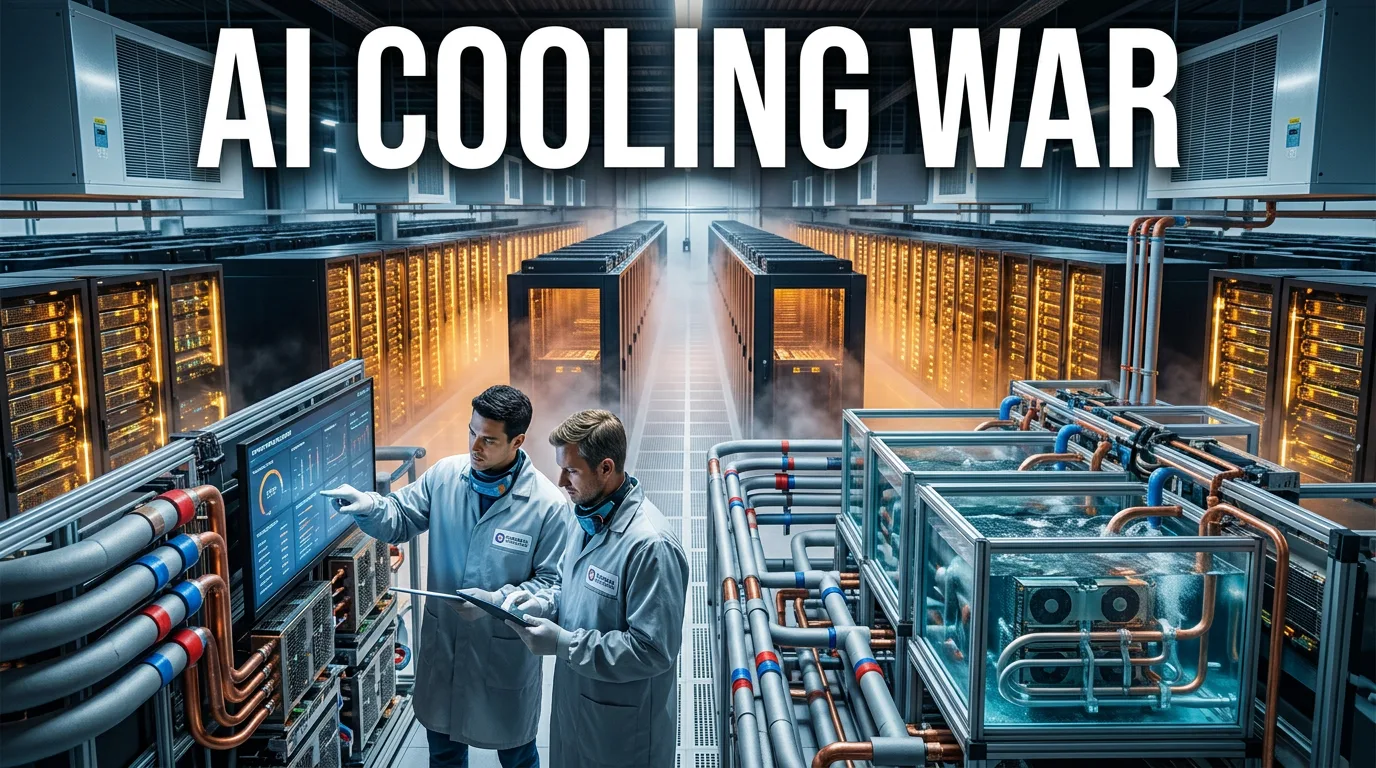
Liquid cooling can be broadly divided into rear-door heat exchangers, direct liquid cooling, and immersion cooling.
9. Rear-Door Heat Exchangers: A Good Way to Upgrade Existing Data Centers
A rear-door heat exchanger attaches a coil plate with cold water flowing through it to the back door of a server rack.
The hot air coming out of the back of the server cools as it passes through this coil plate.
Its advantage is that it can be applied without major reconstruction of existing data center facilities.
It is useful when upgrading already-built data centers.
However, it still removes heat through air.
It has limits when it comes to handling ultra-high-density AI racks.
10. Direct Liquid Cooling: Rapidly Emerging as the Standard for Current AI Data Centers
Direct liquid cooling is also called D2C, or Direct-to-Chip.
A metal cooling plate called a cold plate is attached directly to the GPU, where most heat is generated, and coolant flows through it to remove heat directly.
The principle is similar to cooling a car engine with coolant.
This is the method that is currently becoming the standard most rapidly in AI data centers.
10-1. Advantages of D2C
D2C can reduce PUE to around 1.2 to 1.3.
It can handle more than 100kW of heat per rack.
NVIDIA’s GB200 rack was also designed on the premise of direct liquid cooling.
Its biggest advantage is that it can achieve much higher power density than air cooling.
10-2. Weaknesses of D2C
Because liquid flows inside the server, piping design becomes complex.
Leak risk also has to be managed.
The technical skill level required of operations staff also rises.
Still, at present it is seen as the most realistic alternative before moving directly from air cooling to immersion cooling.
11. Immersion Cooling: Submerging the Entire Server in Liquid
Immersion cooling is a method of submerging the entire server in a special coolant that does not conduct electricity.
If you put electronics into ordinary water, they fail, but immersion cooling uses a special insulating fluid.
This fluid directly absorbs heat from not only the GPU, but also the memory, substrate, and power components across the entire server.
While D2C is a method that focuses on the chip, immersion cooling treats the entire server as a heat-management target.
11-1. Advantages of Immersion Cooling
Cooling efficiency is extremely high.
Some assessments say PUE can be lowered to around 1.05.
Because fans are unnecessary, noise drops significantly.
Servers can be packed more tightly.
It is suitable for ultra-high-density AI data centers.
11-2. Weaknesses of Immersion Cooling
It is difficult to use existing server structures as they are.
Servers, racks, wiring, and maintenance methods must be redesigned from the start for immersion cooling.
The way equipment is removed and replaced also differs from conventional data centers.
Long-term stability of the cooling fluid, material compatibility, and maintenance standards are also important.
12. Two-Phase Cooling: A More Powerful Method for Next-Generation AI Chips
Two-phase cooling is a cooling method that moves between liquid and gas states.
It uses a refrigerant with a low boiling point.
When heat is generated by the chip, the refrigerant quickly boils and turns into gas, taking away a large amount of heat.
It is similar to sweat evaporating and lowering body temperature.
Because more heat can be removed with the same amount of refrigerant, it is being discussed as an important technology for next-generation AI data centers where rack power density rises to the 1MW level.
13. Then Why Isn’t NVIDIA Officially Pushing Immersion Cooling Yet?
On the surface, immersion cooling looks like the answer.
It has high cooling efficiency, reduces power usage, and enables high-density deployment.
But NVIDIA currently centers its official cooling strategy for its GPU servers on D2C.
Immersion cooling is still being approached cautiously in terms of official certification and standardization.
In the industry, this is seen as not just a technical issue but a control issue.
13-1. With D2C, NVIDIA Can Maintain Design Control
D2C is closer to a structure where a cooling company attaches a cooling system to a server architecture designed by NVIDIA.
To use an analogy, it is like a cooling company installing an air conditioner in a house built by NVIDIA.
NVIDIA remains the homeowner.
The center of server design, GPU placement, and system architecture stays with NVIDIA.
13-2. Immersion Cooling Can Shift the Center of Server Design
Immersion cooling is different.
Because the server is placed directly into a tank, the server must be designed from the start to fit the cooling structure.
In that case, the cooling company can move beyond being a simple component supplier and become a company that designs the entire server system.
In the extreme, a cooling solutions company could build a server platform and place NVIDIA GPUs into it.
In that case, NVIDIA could lose some of its control over server design.
That is why analysts say NVIDIA is cautious about immersion cooling certification.
13-3. Still, NVIDIA Cannot Ignore It Forever
If one rack rises to the 1MW class, D2C may reach its limits.
In next-generation high-performance platforms such as Rubin Ultra, stronger cooling methods are likely to be needed.
There are also industry reports that NVIDIA is reviewing immersion cooling partners.
The moment NVIDIA officially gives the green light to immersion cooling, the shape of the data center cooling market could change dramatically.
14. The Core Point Other News Often Misses: Cooling Is Not “Equipment,” It Is a Restructuring of AI Infrastructure Power
Many news stories describe cooling simply as “technology that cools servers.”
But there is a more important point.
Cooling technology is a structural variable that can change who leads the AI infrastructure industry.
14-1. In an Era of GPU Shortages, Cooling Functions as a Kind of “Virtual GPU Expansion”
Even if you cannot buy more GPUs, improving cooling efficiency lets you use existing GPU performance longer and more stably.
Lowering PUE allows more computation with the same power.
Reducing throttling increases real throughput.
In other words, cooling investment can substitute for or supplement physical GPU purchases.
14-2. The Slower the Grid, the Greater the Bargaining Power of Cooling Companies
Power plants and transmission lines cannot be expanded quickly.
By contrast, cooling infrastructure improvements can be applied relatively quickly.
The tighter power constraints become, the more data center operators are forced to spend on cooling efficiency improvements.
That means cooling companies can become not just equipment vendors, but key beneficiaries of the AI infrastructure investment cycle.
14-3. The Shift of Oil Refiners Into AI Infrastructure Companies Is Important
Immersion cooling requires a special dielectric coolant that does not conduct electricity.
Companies that can make this coolant well are, interestingly, oil refiners and lubricants companies.
Not only global refiners such as Shell and ExxonMobil, but in Korea, companies like SK Enmove and GS Caltex are entering the immersion cooling market based on their lubricant technologies.
If batteries and power companies drew attention in the EV era, in the AI data center era even companies with lubricant and thermal management technologies are entering the AI supply chain.
This is one of the most interesting changes in the market that is easy to miss.
15. Data Center Cooling Market Outlook: From Auxiliary Equipment to an Independent Growth Industry
The global data center cooling market is growing rapidly.
It is projected to grow from about $18.8 billion in 2025 to about $54.4 billion in 2034.
That is nearly a threefold increase.
The important point is that the cooling market is turning from a data center accessory market into an independent growth industry.
As AI data centers become denser, cooling equipment is no longer optional; it becomes essential.
This is a change worth viewing as a new investment theme in the global economy.
16. Key Player 1: Vertiv, the Cooling Partner Closest to NVIDIA
Vertiv is a representative data center equipment company that provides both power and cooling infrastructure.
It is also well known as a company that works closely with NVIDIA.
In 2024, it co-released a reference design for the NVIDIA GB200 NVL72.
That means it is not just supplying equipment, but deeply entering the standard for AI data center design.
Vertiv has recently strengthened its portfolio by acquiring companies related to liquid cooling.
It is moving in the direction of offering power, cooling, and rack design together in the AI infrastructure market.
17. Key Player 2: Schneider Electric Binds Power and Cooling Together With Software
Schneider Electric’s strength is power management and software.
Through its EcoStruxure platform, it integrates the management of data center power, cooling, and energy usage.
Once operations begin on this platform, the likelihood of staying within the same ecosystem when replacing or expanding equipment increases.
Just as NVIDIA CUDA binds the developer ecosystem, Schneider is using a strategy to bind the data center operations ecosystem.
As AI data centers become more complex, the importance of this kind of integrated management software may grow even more.
18. Key Player 3: Johnson Controls Shifts From Building HVAC to Data Center Thermal Management
Johnson Controls is originally a company strong in building HVAC, security, and automation systems.
Recently, it has been transforming into a specialist in data center thermal management.
Its large chiller technology is a particular strength.
A chiller is a large cooling device that chills water outside the building and sends it into the data center.
In AI data centers, it is important to remove heat near the chips, but in the end, large cooling infrastructure that dumps that heat outside the building is also important.
Johnson Controls is strengthening its competitiveness in this area.
19. New Entrants: Even Power, Water Treatment, and Oil Companies Are Joining In
As the data center cooling market grows, companies from many industries beyond traditional cooling firms are entering the field.
19-1. Eaton: Expanding From Power Equipment Into Cooling
Power equipment company Eaton entered the thermal management market by acquiring cooling company Boyd Thermal.
In AI data centers, power supply and cooling design cannot move separately.
It is a natural move for a power infrastructure company like Eaton to expand into cooling.
19-2. Ecolab: From Water Treatment to Liquid Cooling
Water treatment company Ecolab entered the data center cooling market by acquiring liquid cooling company CoolIT.
Experience in water management, fluid management, and cooling system operations becomes important competitiveness in AI data centers.
19-3. Oil Refiners: Hidden Giants in the Immersion Cooling Fluid Market
Companies such as Shell, ExxonMobil, SK Enmove, and GS Caltex are entering the development of dielectric cooling fluids.
Whereas the center used to be automotive lubricants, industrial oils, and refining products, high-value cooling fluids for cooling AI servers are becoming a new market.
This is a scene where companies that once refined oil are being pulled into the world of AI infrastructure.
20. Key Points to Watch From an Investment Perspective
AI data center cooling is closer to a structural growth market than a short-term theme.
However, not every cooling company will benefit equally.
20-1. NVIDIA Certification and Reference Designs Matter
AI data center customers prefer proven designs.
Companies included in reference designs with NVIDIA can create barriers to market entry.
In particular, it is worth watching companies moving alongside next-generation GPU platforms such as GB200 and Rubin.
20-2. Integrated Solution Companies May Have the Advantage Over Simple Equipment Makers
Data center cooling is not a market where success comes from doing well with just one chiller, one pump, or one pipe.
Integrated design across power, cooling, server placement, operating software, and maintenance is required.
That is why companies like Vertiv and Schneider Electric that provide the whole system may have the advantage.
20-3. Immersion Cooling’s Turning Point Is NVIDIA’s Decision
For the immersion cooling market to open in earnest, NVIDIA’s official certification and large-scale adoption by major cloud companies are needed.
For now, D2C remains the practical mainstream.
But as rack power density keeps rising, pressure to adopt immersion cooling will inevitably grow.
The moment NVIDIA actively embraces immersion cooling, the valuation and demand outlook for related companies could change significantly.
21. Conclusion: The Next Battlefield in the AI Race Is Not GPU Count, But Cooling Efficiency
At first, AI infrastructure competition was a battle over who could secure the most GPUs.
But now the question is changing.
More important than “how many GPUs did you buy” is “how well can you run the GPUs you have.”
In an era where land, electricity, and chips are all scarce, cooling is effectively the most realistic way to increase computing power.
Data center cooling is no longer a supporting facility.
It is a core industry that determines the profitability, power efficiency, GPU utilization, and infrastructure scalability of AI data centers.
In particular, the spread of liquid cooling and immersion cooling is pulling power equipment companies, cooling equipment companies, oil refiners, and water treatment companies into the AI supply chain.
The next protagonists of the AI era may not be only model developers or semiconductor companies.
Companies that quietly removed heat from behind the servers are increasingly likely to rise as key players in the AI infrastructure market.
< Summary >
AI competition is now moving closer to a hardware and infrastructure battle than a software battle.
To build more data centers, land, the power grid, and GPU supply are all insufficient.
In this situation, cooling technology is the core lever that makes more GPU computation possible with the same power and space.
Air cooling has reached its limits, and direct liquid cooling is now emerging as the mainstream.
Immersion cooling is the most powerful method, but NVIDIA’s official certification and the issue of server design control remain unresolved.
Not only Vertiv, Schneider Electric, and Johnson Controls, but also oil refiners such as Shell, ExxonMobil, SK Enmove, and GS Caltex are entering the AI cooling market.
Going forward, the core competitiveness of AI data centers is likely to depend not only on GPU count, but also on cooling efficiency, power efficiency, and rack density.
[Related Articles…]
AI Data Center Power Crunch and Infrastructure Investment Outlook
NVIDIA GPU Supply Chain and Changes in the AI Semiconductor Market
*Source: [ 티타임즈TV ]
– 데이터센터 더 안 짓고도 GPU를 더 돌리는 방법