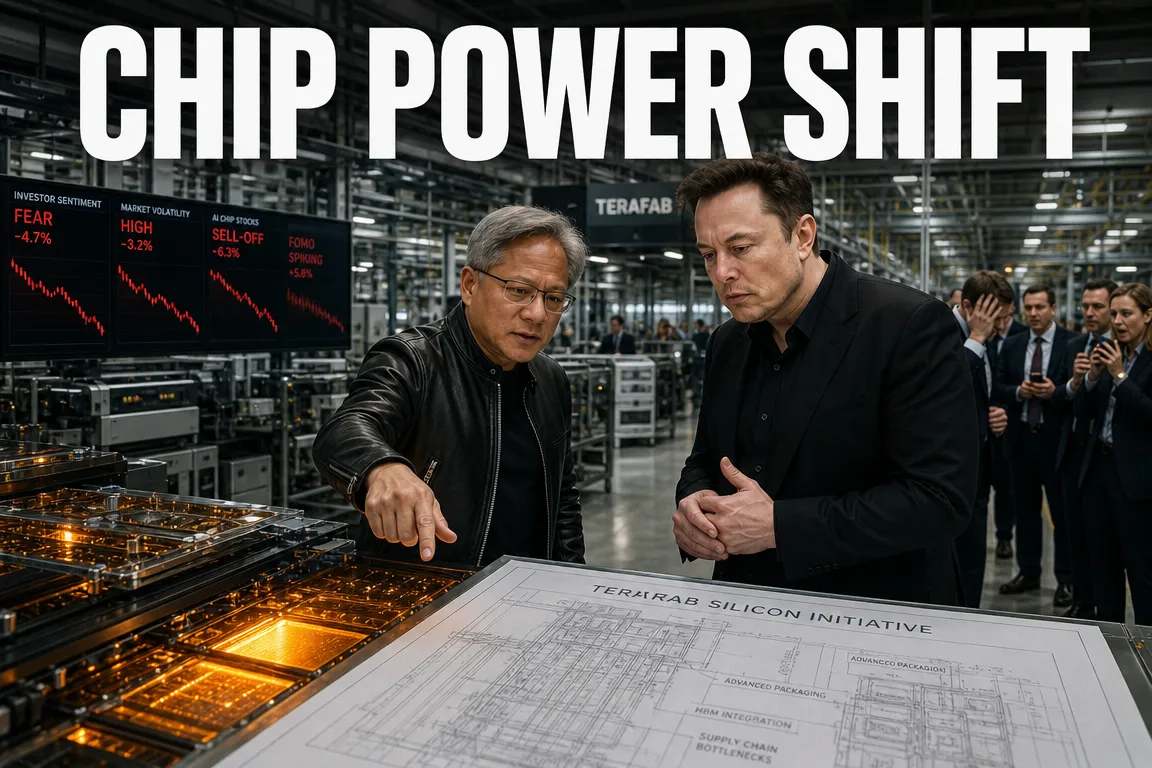
● Tesla AI Merger Frenzy
Tesla at $390 and Jensen Huang Return Speculation: Assessing AI Semiconductor Investment and Merger Scenarios
For Tesla shareholders, the priority is not where Jensen Huang might go, but which company funds semiconductor investment and which shareholders receive the resulting returns.
This report examines unverified Nvidia leadership claims, the relationship between U.S. interest rates and Tesla shares, barriers to in-house AI semiconductor development, a hypothetical SpaceX merger, and tax deferral for overseas share exchanges.
Source verification: The source material contains significant unsupported claims, inconsistent figures, and notation errors.
This analysis is dated November 14, 2026. It does not incorporate independently verified, real-time filings or news reports.
Claims concerning Jensen Huang’s resignation and a petition for his return, a Tesla–SpaceX merger, and major semiconductor fabrication projects cannot be established from the supplied material alone.
1. Fact Check: Why the Source Material Requires Caution
Investment analysis should prioritize evidence over narrative coherence.
Regulatory filings and official announcements should take precedence over media reports and social media interpretations.
| Claim in the Source Material | Verification Required | Implication for Investors |
|---|---|---|
| Jensen Huang’s resignation from Nvidia and a petition for his return | No filing reference, company statement, or original petition is provided. | A potential return should not be treated as a development following an established resignation. |
| Tesla closing at $390.20 | No trading date is specified, and the same source also refers to the “$190 range.” | Treat the figure as an unverified reference price, not a current quote. |
| SpaceX daily closing price and percentage change | The trading venue, ticker, and underlying instrument are unclear. | Establish whether the quotation concerns company shares or a related product. |
| U.S. producer prices and the 10-year Treasury yield | Inflation figures alternate between “6.5%” and “5%,” without observation dates. | These figures do not support a firm conclusion about interest-rate direction. |
| Tesla–SpaceX merger and share exchange | No board approval, agreement, exchange ratio, or other transaction documentation is provided. | Treat the proposal as hypothetical, not an announced transaction. |
| Semiconductor fabrication and supercomputing campus investment | The investing entity, permits, committed capital, and phased spending schedule require verification. | Distinguish announced project scale from capital actually deployed. |
Unsupported allegations concerning private conduct and intelligence agencies are excluded.
Valuation analysis should focus on verified management changes and business implications.
2. U.S. Interest Rates and Tesla Shares: Why Inflation Matters
Although the cited market figures require verification, the underlying relationship between inflation and growth-stock valuations remains relevant.
① The present value of future earnings may decline.
Tesla’s valuation reflects expectations for autonomous driving, robotics, and energy operations alongside vehicle sales.
Higher Treasury yields and required investment returns reduce the present value of distant earnings.
The share-price response also depends on whether yields rise because of stronger growth or inflation concerns.
② Vehicle financing becomes more expensive.
Higher loan and lease costs can weigh on electric vehicle demand.
Subsidized financing offered to support sales may reduce manufacturer profitability.
③ AI infrastructure financing becomes more demanding.
Data centers and semiconductor facilities require substantial upfront expenditure and long payback periods.
Persistently high interest rates can increase project return requirements and financing burdens.
Federal Reserve policy affects Tesla through three channels: valuation discount rates, vehicle demand, and AI investment costs.
Producer prices should be assessed alongside consumer inflation, personal consumption expenditures inflation, employment, and long-term Treasury yields.
3. Model Y and Cybertruck Sales Mix: Is Removing Lower-Priced Models Positive?
The source states that some lower-priced configurations disappeared from U.S. ordering pages, shifting the available lineup toward higher-priced models.
Without dated official ordering pages and pricing records, specific discontinuations and price changes cannot be confirmed.
If verified, the changes could support at least three interpretations.
- Battery or production constraints may have prompted resource allocation toward higher-margin vehicles.
- Low-volume configurations may have been removed to reduce manufacturing complexity and inventory exposure.
- The changes may reflect temporary production transitions or regional order adjustments.
A greater share of premium vehicles can raise average selling prices, but lower volumes and reduced factory utilization may offset the benefit.
Accordingly, “removing cheaper models → higher earnings” remains a hypothesis until supported by financial results.
Key Financial Indicators
- Vehicle deliveries and average selling price trends
- Automotive profitability excluding regulatory credit effects
- Inventory levels, discounts, and financing incentives
- Operating cash flow, capital expenditure, and free cash flow
- Official explanations of battery constraints and expected resolution timelines
Higher profit per vehicle does not necessarily mean higher total cash generation.
4. Jensen Huang and Steve Jobs: Historical Analogy Is Not Investment Evidence
Steve Jobs left Apple in 1985. Apple’s announcement of its NeXT acquisition in late 1996 created the basis for his return.
The acquisition closed in 1997, when Jobs also became interim CEO.
NeXT technology subsequently became an important foundation for Apple’s operating systems.
The significance extended beyond the return of a prominent founder.
The transaction linked technology Apple needed with a formal acquisition agreement and changes in management control.
By contrast, the supplied material does not establish that Jensen Huang resigned.
A comparison with Jobs should therefore not be presented as analysis of an ongoing leadership transition.
CEO appointments and returns generally depend on corporate governance, board authority, and contractual terms.
Online petitions and public endorsements may influence sentiment, but they do not constitute a legal appointment process.
5. In-House AI Semiconductors: Separate Design, Manufacturing, and Software
The semiconductor fabrication plans described in the source require official documentation.
A fundamental industry distinction remains essential.
Chip design expertise and advanced semiconductor manufacturing capability are different competencies.
① Semiconductor Design
Design determines workload optimization, power efficiency, and memory connectivity.
Vehicle inference chips and data-center processors used to train large AI models have different requirements.
② Semiconductor Manufacturing
Manufacturing requires process technology, equipment, materials, yield management, skilled personnel, and reliable operations.
Completing a fabrication plant does not immediately enable competitive production at the required volume.
Nvidia operates primarily as a fabless company, focusing on chip design, systems, and software while outsourcing manufacturing to foundries and other suppliers.
③ Advanced Packaging and Memory
AI accelerators require more than processing chips.
Constraints in high-bandwidth memory and advanced packaging can limit finished-product output.
④ Software Ecosystem
A lower-priced chip may not be economical if model migration and optimization costs are high.
Competitiveness also depends on development tools, libraries, communication performance, and operational reliability.
Developing proprietary chips does not automatically eliminate dependence on Nvidia.
A hybrid strategy may use in-house processors for selected workloads while retaining external GPUs for others.
6. Large Data-Center Plans: Power Availability and Utilization Matter More Than Headline Spending
The source refers to a computing campus with up to 6GW of power capacity and substantial investment across several locations.
These figures remain unverified. Documentation is needed to distinguish site proposals, maximum expansion capacity, and committed investment.
For scale, a 6GW facility operating continuously at 100% load would consume approximately 52.6TWh annually.
This is a theoretical calculation using 6GW × 24 hours × 365 days, not a forecast of actual consumption.
Key Data-Center Execution Requirements
- Timing of grid connections and transmission upgrades
- Electricity pricing and supply reliability
- Cooling, water availability, and local permitting
- Timely procurement of GPUs, memory, and networking equipment
- Sufficient internal demand or external customers to support utilization
Commissioning speed and returns after costs matter more than nominal capacity.
Adding together maximum investment estimates across projects can also be misleading.
Figures may include phased spending or overlapping infrastructure costs.
7. SpaceX Developments Do Not Automatically Benefit Tesla Shareholders
Companies do not automatically share assets or earnings merely because the same individual is involved in their management.
SpaceX data-center investment or lower launch costs would create direct economic rights for Tesla shareholders only through ownership, contracts, or another identifiable relationship.
Specific Starship test schedules, satellite deployment counts, recovery results, and claims concerning Boca Chica Beach require official verification before being presented as current facts.
Reusable launch technology may reduce costs, but one successful flight does not establish commercial profitability.
Assessment requires evidence on repeat-flight reliability, maintenance costs, turnaround times, and customer demand.
A Tesla–SpaceX merger remains hypothetical in the supplied material.
If a transaction is announced, the following terms would determine shareholder outcomes.
- Exchange ratio: The number and class of shares received for each Tesla share
- Valuation: Treatment of each company’s assets, liabilities, and future investment requirements
- Dilution: Reduction in existing shareholders’ ownership from new issuance
- Shareholder rights: Whether voting and economic rights are equivalent
- Liquidity: When and where the replacement shares can be sold
- Approval conditions: Shareholder approval, competition review, and contractual restrictions
An expanded scenario involving an Nvidia acquisition is not a sound investment premise without an actual proposal or agreement.
However, an acquirer’s smaller market capitalization does not, by itself, make an acquisition impossible.
Financing, share issuance, shareholder approval, and regulatory review must also be considered.
8. Capital Gains Tax Deferral for Overseas Shares: What Does the Petition Seek?
The petition described in the source seeks to defer taxation, subject to qualifying conditions, when overseas shares are exchanged through a merger or share exchange, until the replacement shares are sold.
Tax deferral postpones taxation; it does not eliminate the tax liability.
If investors receive only replacement shares but incur a tax liability, they may need to sell assets to fund payment.
This mismatch between taxable gains and available cash is the central policy issue.
Not all overseas mergers and share exchanges should be assumed to receive identical tax treatment.
The outcome may depend on transaction structure, consideration received, applicable law, and cost-basis treatment.
- Signature counts and deadlines cited in the source require verification against the current petition page.
- Meeting a signature threshold does not automatically change the law.
- Any new regime must be assessed for eligibility, effective date, and treatment of prior transactions.
- For an actual transaction, investors should review brokerage guidance and obtain professional tax advice.
9. Beyond the Headlines: The Shareholder’s Economic Return
The following issues are more relevant to shareholder value than personality-driven narratives.
First, determine whether the company funding investment also receives the returns.
Chip supply, computing services, and intellectual property agreements between affiliated companies can directly affect shareholder value through pricing and cost allocation.
Growth across a broader corporate ecosystem may provide limited benefits to minority shareholders in a particular company.
Second, proprietary chips can reduce procurement costs while increasing fixed costs.
Potential savings come with direct exposure to design failures, development delays, and insufficient production scale.
Total cost should include software migration and operating expenses, not merely the price per chip.
Third, low utilization can undermine returns on large AI facilities.
Rapid technological change creates economic obsolescence risk alongside depreciation.
Productive use matters more than procurement volume.
Fourth, share prices can move before formal transaction terms are announced.
Merger-related repricing does not begin only when terms become public.
Markets may incorporate expectations and completion probabilities in advance. An announcement that falls short of expectations can trigger a decline.
Fifth, a prominent executive appointment does not guarantee returns.
Hiring must translate into effective authority, organizational execution, funding, product launches, and customer acquisition before producing financial results.
10. Priorities for Tesla Shareholders Who Bought at $390
A $390 purchase price alone is insufficient to determine whether to buy or sell.
The source’s $390.20 quotation has not been verified as a current market price.
Key Priorities
- Review automotive profitability, cash flow, and capital expenditure requirements in Tesla’s financial results.
- Distinguish autonomous-driving and robotics demonstrations from commercial revenue.
- Verify the entity funding AI semiconductor projects, committed budgets, supply agreements, and operating schedules.
- Check regulatory filings and official announcements before relying on Nvidia leadership or merger reports.
- Assess loss tolerance, tax exposure, and single-stock concentration.
The Nvidia earnings release date and time cited in the source also require confirmation through official investor communications.
Official verification channels include Tesla Investor Relations, Nvidia Investor Relations, SEC EDGAR Search, U.S. Bureau of Labor Statistics Producer Price Data, and the Federal Reserve FOMC Calendar.
These links identify verification sources; their latest documents were not directly reviewed for this report.
< Summary >
- The supplied material does not verify Jensen Huang’s alleged resignation or return, or a Tesla–SpaceX merger.
- U.S. interest rates affect Tesla’s valuation, vehicle demand, and AI investment costs.
- Removing lower-priced models may support average selling prices but does not guarantee higher total earnings.
- AI semiconductor analysis must distinguish design, manufacturing, memory, packaging, and software.
- SpaceX’s operating success does not automatically create value for Tesla shareholders.
- Merger analysis should prioritize exchange ratios, dilution, shareholder rights, liquidity, and taxation.
- Investment funding obligations and cash flows attributable to shareholders matter more than executive-centered speculation.
[Related Articles…]
*Source: [ 오늘의 테슬라 뉴스 ]
– 잡스처럼 돌아올까? 젠슨 황과 일론 머스크의 칩 계획, $390 테슬라 주주는?
● Loss Panic, Averaging Down Trap
Why Planned Stop-Loss Sales Become Averaging Down: Investment Psychology, Compounding, Tax Efficiency, and AI-Assisted Investing
Investors may open a brokerage app intending to sell a losing position, then purchase additional shares after reading an investor forum.
This behavior can reflect psychological biases that override investment rules when losses occur, rather than weaknesses in security analysis alone.
This report examines why stop-loss decisions become averaging down, why product returns differ from investor returns, how risk management supports compounding, how pension savings accounts, IRPs, and ISAs differ, and where AI-assisted investing can be useful.
Two central considerations are why a lower average purchase price can increase portfolio risk and why an executable strategy matters more than a theoretically superior strategy that cannot be maintained.
1. Core Diagnosis: A Rising Market Does Not Guarantee Positive Investor Returns
The discussion identifies a gap between investment product performance and actual investor returns.
Selecting a strong product does not, by itself, ensure a favorable investment outcome.
- Initial appreciation: Prices rise as product performance or industry fundamentals improve.
- Growing attention: Media and investment content highlight strong returns.
- Further appreciation: Reports of gains among peers intensify the fear of missing out.
- Late, concentrated buying: Investors commit substantial capital after prices have risen, sometimes using borrowed funds.
- Correction and exit: Investors sell when market declines produce losses they cannot tolerate.
A product can therefore deliver strong long-term returns while individual investors in that product lose money.
A numerical example illustrates the difference.
If a price rises from 100 to 150 and then falls to 120, an investor who held from the beginning retains a 20% gain.
An investor who purchased at 150, however, records a 20% loss.
The relevant questions extend beyond recent product performance to when capital was invested, how much was committed, and how long the position can be maintained.
Reported fund performance generally resembles a time-weighted return, separating the effects of external cash flows. Money-weighted returns can better capture an individual investor’s experience by incorporating the timing and size of contributions and withdrawals.
Accounts with recurring contributions should assess cash-flow-adjusted returns alongside valuation gains and losses.
2. Four Psychological Biases That Turn Stop-Loss Decisions into Averaging Down
Behavioral economics examines why investors do not consistently make rational decisions.
The challenge is often not a lack of investment rules, but difficulty applying them when gains and losses become immediate.
① Loss Aversion: Avoiding the Realization of a Loss
People generally experience losses more intensely than equivalent gains.
Investors may postpone predetermined sale decisions because selling appears to confirm failure.
However, an unrealized loss remains an economic loss.
Mark-to-market losses represent a decline in current asset value. Decisions to hold or sell should reflect prospective returns and risks.
② Confirmation Bias: Seeking Information That Supports an Existing Position
Searching investor forums for claims that a stock has reached its bottom is a common example.
Communities of investors holding the same security can reinforce optimistic views.
Collecting reassuring information while avoiding contrary evidence can replace analysis with self-justification.
③ Anchoring and Sunk Costs: Treating the Purchase Price as the Decision Benchmark
A commitment to sell only after breaking even can indicate attachment to a historical purchase price rather than current business value.
A company’s future cash flows are independent of an investor’s entry price.
Previously committed money and time do not, by themselves, justify additional investment.
④ The Disposition Effect: Holding Losers and Selling Winners
Investors may retain losing positions while selling profitable holdings prematurely to protect gains.
Repeated behavior of this kind can leave a portfolio concentrated in securities with weakened investment theses.
Review question: “If I did not already own this security, would I invest the same amount at its current price?”
This question does not automatically determine whether to sell, but it helps separate historical purchase prices from current investment decisions.
3. Averaging Down: Distinguishing Planned Purchases from Emotion-Driven Buying
Buying additional shares after a price decline is not inherently inappropriate.
The distinction is whether the purchase follows a pre-existing plan or a rationale developed after losses occurred.
| Category | Planned Additional Purchase | Emotion-Driven Averaging Down |
|---|---|---|
| Investment rationale | Reassesses earnings, cash flows, and financial strength | Assumes a substantial decline implies a rebound |
| Purchase size | Remains within predetermined allocation and budget limits | Increases exposure to accelerate recovery to breakeven |
| Contrary evidence | Reviews evidence that could invalidate the investment thesis | Selectively gathers favorable forecasts |
| Funding source | Uses surplus capital available for long-term investment | Uses living expenses, emergency reserves, or borrowed funds |
| Response to failure | Defines reduction or exit criteria if the thesis deteriorates | Relies solely on further averaging down |
A lower average purchase price does not necessarily mean lower risk.
Purchasing 10 shares at KRW 100,000 requires an initial investment of KRW 1 million.
Purchasing another 10 shares after the price falls to KRW 80,000 increases total invested capital to KRW 1.8 million and reduces the average purchase price to KRW 90,000.
If the price subsequently falls to KRW 60,000, the position is worth KRW 1.2 million, producing a total loss of KRW 600,000.
Without the additional purchase, the loss at the same price would be KRW 400,000.
Thus, averaging down can increase absolute losses by expanding exposure, even as the average purchase price declines.
The 15% stop-loss threshold cited in the discussion illustrates investor psychology; it is not a universal rule for all assets.
A deterioration in an individual company’s investment thesis should be distinguished from a broad market correction affecting a diversified index ETF.
4. Compounding Depends on Capital, Time, and Loss Management
Wealth accumulation depends on three principal variables, not returns alone.
- Invested capital: The initial investment and subsequent contributions.
- Investment horizon: The period during which capital can remain invested without withdrawal.
- Net return: The return retained after fees, taxes, and other costs.
Assuming no additional contributions and a constant annual return, future value equals principal × (1 + annual return)years invested.
Actual returns vary and can be negative; this formula should not be interpreted as a guaranteed outcome.
Illustrative assumption: KRW 10 million invested at 5% annually, with returns reinvested
- After 10 years: approximately KRW 16.29 million.
- After 20 years: approximately KRW 26.53 million.
- After 30 years: approximately KRW 43.22 million.
These calculations exclude taxes, fees, and inflation. A 5% annual return is not guaranteed.
Compounding does not begin abruptly after 20 or 25 years.
It starts when returns are reinvested, with the absolute increase becoming more pronounced over time.
Recovering from a loss requires a proportionately larger subsequent gain.
| Loss | Return Required to Recover Initial Capital |
|---|---|
| 10% | Approximately 11.1% |
| 20% | 25% |
| 30% | Approximately 42.9% |
| 50% | 100% |
Protecting compounding does not require eliminating every mark-to-market loss.
Temporary declines are difficult to avoid in risk assets. Frequent trading intended to prevent them can increase costs and decision errors.
The priority is to reduce risks that can terminate a long-term investment program, including permanent capital impairment, excessive concentration, and forced liquidation.
Cash can lose purchasing power through inflation even when its nominal value remains unchanged.
Long-term asset management should therefore evaluate after-tax, inflation-adjusted value as well as nominal account balances.
5. Investment Claims That Require Qualification
The discussion’s central principles are useful, but several statements require qualification.
- “Long-term investing prevents losses”: Individual companies can underperform for extended periods or be delisted. Diversified market investments can also lose value depending on entry prices and holding periods.
- “Risk assets are high-return assets”: Greater risk does not guarantee higher realized returns, and some risks are not compensated.
- “Risk means uncertainty rather than danger”: Uncertainty is relevant, but financial risk also includes the probability and magnitude of actual losses.
- “Standard deviation measures risk”: Volatility is an important metric, but it does not fully capture credit, liquidity, currency, or extreme-loss risks.
- “Research can overcome uncertainty”: Learning can improve decisions without eliminating forecasting errors.
- “Buffett avoided major losses”: Berkshire Hathaway shares have experienced substantial drawdowns, and individual investments have failed. This claim should not imply an absence of temporary losses.
An annualized compound return of approximately 20% over several decades is exceptional, not modest.
The relevant lesson is not that time resolves every investment problem, but that a resilient investment structure allows time to support wealth accumulation.
6. Priorities Before Pursuing Higher Returns: Income, Spending, Debt, and Tax Efficiency
Building investable capital is a fundamental component of financial management.
Market returns are difficult to control, while savings capacity and cost structures are more directly manageable.
Classify household cash flows into four categories.
- Income: Identify recurring salary and other sustainable income sources.
- Consumption expenditure: Review housing, food, transportation, subscriptions, and discretionary spending.
- Taxes, insurance premiums, and interest: Assess lawful deductions and borrowing costs.
- Savings and investment capacity: Exclude emergency reserves and funds required in the near term.
Reducing monthly spending by KRW 200,000 creates KRW 2.4 million in annual investment capacity.
By comparison, improving the annual return on a KRW 30 million portfolio by 1 percentage point generates KRW 300,000. Higher savings can therefore have a substantial impact during early wealth accumulation.
This is a comparison of amounts, not an assertion that spending reductions and investment gains involve equivalent costs or uncertainty.
Select household statistics according to the analytical objective.
The Household Income and Expenditure Survey supports analysis of income and consumption trends. The Survey of Household Finances and Living Conditions provides information on assets and liabilities.
The surveys have different purposes and publication schedules and should not be treated as interchangeable.
For borrowers, compare the benefits of debt repayment with prospective investment returns.
Reducing high-interest debt lowers interest expenses, but decisions should also account for early repayment charges and emergency liquidity needs.
7. Pension Savings Accounts, IRPs, and ISAs Have Different Tax Structures
Tax advantages can support investment outcomes, but the benefits and liquidity restrictions differ across account types.
| Account | Main Tax Structure | Key Review Items |
|---|---|---|
| Pension savings account | Tax credits for eligible contributions, tax deferral, and taxation upon pension receipt | Eligible contribution amounts, taxation of early withdrawals, and pension distribution requirements |
| Individual Retirement Pension account, or IRP | Tax credits for additional personal contributions and tax deferral for retirement benefits | Early withdrawal restrictions, investment constraints, fees, and expected funding needs |
| Individual Savings Account, or ISA | Netting of eligible gains and losses, a tax-free allowance, and separate taxation of qualifying excess income | Eligibility, account type, mandatory holding period, and permitted investments |
ISA contributions generally do not receive the same contribution-based tax credits available through pension savings accounts and IRPs.
The usable tax benefits of pension accounts depend on income, contributions, credit limits, and actual tax liability.
Early closure or non-pension withdrawals can trigger tax liabilities. Funds required in the near term should not be committed without assessing these restrictions.
The discussion’s reference to a benefit equivalent to an approximately 8.2% deposit rate is not a guaranteed return available to every investor.
Comparing tax benefits with deposit rates requires assumptions about the credit amount, holding period, withdrawal taxation, and account costs.
A tax refund does not protect investments against market losses.
Implementation sequence: Establish emergency reserves → review high-interest debt → classify funds by intended use date → assess tax-advantaged accounts → select investments within those accounts.
Credit rates, limits, and eligibility requirements may change. Review current National Tax Service guidance and financial institution terms before opening an account.
8. Economic Forecasting and Financial Fundamentals Serve Different Roles
The discussion considers whether analyzing U.S. inflation indicators or managing personal income and spending should take priority.
These approaches are complementary rather than competing.
- Personal financial management: Determines available investment capital and the capacity to absorb losses.
- Macroeconomic analysis: Explains how inflation, growth, employment, and interest rates affect asset prices.
The CPI measures consumer prices, the PCE price index measures prices associated with personal consumption expenditures, and the PPI tracks producer prices.
These indicators inform interest-rate expectations, but no single release determines policy rates or equity market direction.
Market reactions depend on deviations from expectations, central bank responses, and expectations already reflected in prices.
Economic forecasts are best used initially to identify portfolio vulnerabilities rather than to predict precise trading dates.
Renewed inflation, for example, can place simultaneous pressure on long-duration bond prices and growth-stock valuations.
During an economic slowdown, investors should assess how weaker corporate earnings and potentially lower interest rates affect different assets.
9. Diversification Depends on Overlapping Risks, Not the Number of Holdings
The discussion identifies diversification across time, securities, and asset classes as a core principle.
Diversification can mitigate losses but cannot eliminate adverse outcomes.
① Diversification Across Time: Spread Purchases Across Multiple Dates
Regular fixed-amount contributions reduce reliance on a single entry point.
However, continued purchases of a declining asset can increase losses, while a sustained rising market can favor immediate lump-sum investment.
The objective is to reduce dependence on market timing, not to guarantee purchases at the lowest price.
② Diversification Across Securities: Reduce Exposure to Individual Company Failure
Broadly diversified index ETFs can limit the portfolio impact of an individual company’s insolvency or competitive deterioration.
Not all ETFs provide broad diversification; some concentrate on narrow themes or a small number of holdings.
Holding AI, semiconductor, and U.S. technology ETFs can duplicate risk when their largest positions overlap.
③ Diversification Across Asset Classes: Combine Different Risk Exposures
Combining equities, bonds, and cash equivalents can help manage portfolio volatility.
Bonds retain interest-rate and credit risks, and equities and bonds can decline simultaneously.
Foreign investments also require an assessment of currency exposure and hedging arrangements.
A 60% equity and 40% bond allocation is an illustrative starting point, not a universal solution.
Allocations should reflect spending timelines, income stability, liabilities, and loss-bearing capacity.
Rebalancing can follow a regular schedule or predetermined allocation thresholds, with transaction costs and taxes incorporated into the decision.
10. Assess Investment Suitability Through Sustainable Behavior
The discussion presents four investor profiles based on decision speed and the extent to which an investment strategy has been internalized.
These profiles may support self-assessment but should not be treated as validated suitability tests or return-prediction tools.
- Trendsetting expert: Acts quickly using an established personal decision framework.
- Fast follower: Rapidly converts external information into investment action.
- Deliberate philosopher: Conducts extensive review against personal criteria before acting.
- Reflective observer: Reviews substantial external information and takes longer to decide.
Fast decisions do not necessarily indicate investment skill, and a cautious approach is not inherently disadvantageous.
MBTI classifications also have limited value in determining financial product suitability.
Four practical questions are more relevant.
- When will these funds be needed?
- Can living expenses and debt payments be maintained during a substantial portfolio decline?
- Can the investment rationale and exit conditions be explained clearly?
- Are investment losses disrupting sleep, work, or family life?
Willingness to take risk differs from the financial capacity to bear it.
If investing materially disrupts work or daily functioning, review risk-asset exposure and product complexity before concluding that all investing should stop.
11. AI Investment Agents: Rule Monitoring Before Return Forecasting
The discussion suggests that AI agents could execute personal investment rules and reduce emotion-driven intervention.
This is a potential application, not evidence that unrestricted automated trading is safely available to every individual investor.
Practical initial applications include the following.
- Investment journal review: Compare recorded purchase rationales with subsequent trading behavior.
- Concentration analysis: Identify overlapping holdings and industry exposures across ETFs.
- Rule-breach alerts: Flag asset weights that exceed predetermined limits.
- Contrary-evidence review: Summarize evidence both supporting and challenging an investment thesis.
- Rebalancing support: Calculate deviations from target allocations and identify items requiring review.
These functions require accurate holdings information and reliable, current data.
Generative AI can fabricate information, present outdated material as current, or construct arguments aligned with a user’s preferred conclusion.
AI can therefore either reduce confirmation bias or reinforce it by rationalizing additional purchases of losing positions.
Automated order execution requires additional controls.
- Begin with simulated trading or alerts-only operation.
- Limit order size, trading frequency, and asset concentration.
- Configure shutdown procedures for duplicate orders, data errors, and communication failures.
- Maintain execution logs and a human-accessible emergency stop mechanism.
- Do not enter passwords, authentication credentials, or sensitive financial information into general-purpose chat interfaces.
Delegating management to professionals also requires scrutiny of fees, conflicts of interest, and operating principles. It does not eliminate investment risk.
The core value of AI-assisted and rules-based investing is consistent adherence to risk limits, not infallible prediction.
12. Five Considerations Often Overlooked in Headline Returns
① Investment Strategies Have Implementation Demands as Well as Return Characteristics
A theoretically strong strategy cannot deliver its intended outcome if it is abandoned during a drawdown.
A simpler, sustainable strategy may be more suitable even if its expected return is somewhat lower.
② Emergency Reserves Help Preserve Investment Continuity
Insufficient liquidity can force the sale of otherwise suitable assets during market declines.
The appropriate reserve depends on employment stability, dependents, and fixed expenses. Its investment-related function is to reduce forced selling.
③ Employment and Financial Assets Can Share the Same Risk Exposure
A semiconductor employee with a portfolio concentrated in semiconductor companies could face simultaneous pressure on income and assets during an industry downturn.
Diversification should therefore consider employment and residential property alongside securities accounts.
④ Increasing Allocations After Strong Returns Can Constitute Performance Chasing
The discussion proposes gradually adding active investments to a diversified core, but recent gains alone do not justify a larger allocation.
Any increase should consider performance after costs, an appropriate benchmark, risk exposure, and the contribution of market conditions.
The cited 20% allocation to active investments is illustrative, not universally appropriate.
⑤ Leverage Changes Both Returns and the Ability to Remain Invested
Borrowing and margin trading can shorten the investment horizon through interest expenses and collateral requirements.
Leveraged ETFs targeting a multiple of daily returns do not necessarily deliver the same multiple of an index’s cumulative return over a longer holding period.
Daily rebalancing and the path of prices affect cumulative performance, making uninformed long-term ownership particularly risky.
13. A One-Page Investment Policy
A practical response to behavioral biases is to document decision criteria before market stress occurs.
- Objective: Define the intended use of funds, such as retirement, housing, or education.
- Time horizon: Record expected spending dates and potential early withdrawal needs.
- Cash flow: Calculate monthly investment capacity after emergency reserves and debt payments.
- Asset allocation: Set target weights for equities, bonds, and cash equivalents.
- Concentration limits: Establish maximum allocations to individual securities and industries.
- Additional purchase criteria: Specify earnings, financial strength, and valuation requirements rather than relying solely on price declines.
- Reduction and exit criteria: Distinguish thesis deterioration, excessive position size, and approaching spending needs.
- Review schedule: Set the frequency of price checks and portfolio reassessments.
- Performance evaluation: Use appropriate benchmarks and account for taxes and fees.
- Impulse controls: Require a separate review before executing substantial unplanned purchases.
Investment competence extends beyond identifying securities that may appreciate.
It includes maintaining a structure in which errors do not undermine household finances or the investment plan.
Preventing planned stop-loss sales from becoming impulsive averaging down requires a decision process that remains viable under losses.
< Summary >
- Product returns and investor returns differ because of purchase timing, capital allocation, and selling behavior.
- Loss aversion and confirmation bias can turn planned exits into emotion-driven averaging down.
- A lower average purchase price can coexist with greater exposure and loss risk.
- Compounding requires coordinated management of capital, time, and net returns. Long holding periods do not guarantee protection against losses.
- Review income, spending, debt, and tax efficiency before diversifying across time, securities, and asset classes.
- Pension savings accounts, IRPs, and ISAs differ in tax treatment and liquidity restrictions.
- AI is better positioned as a tool for rule monitoring and risk management than as a source of guaranteed returns.
*Source: [ 경제 읽어주는 남자(김광석TV) ]
– [풀버전] 손절하러 갔다가 왜 물타기할까…투자자가 빠지는 ‘심리적 함정’ | 경읽남과 토론합시다 | 송태헌 전문가