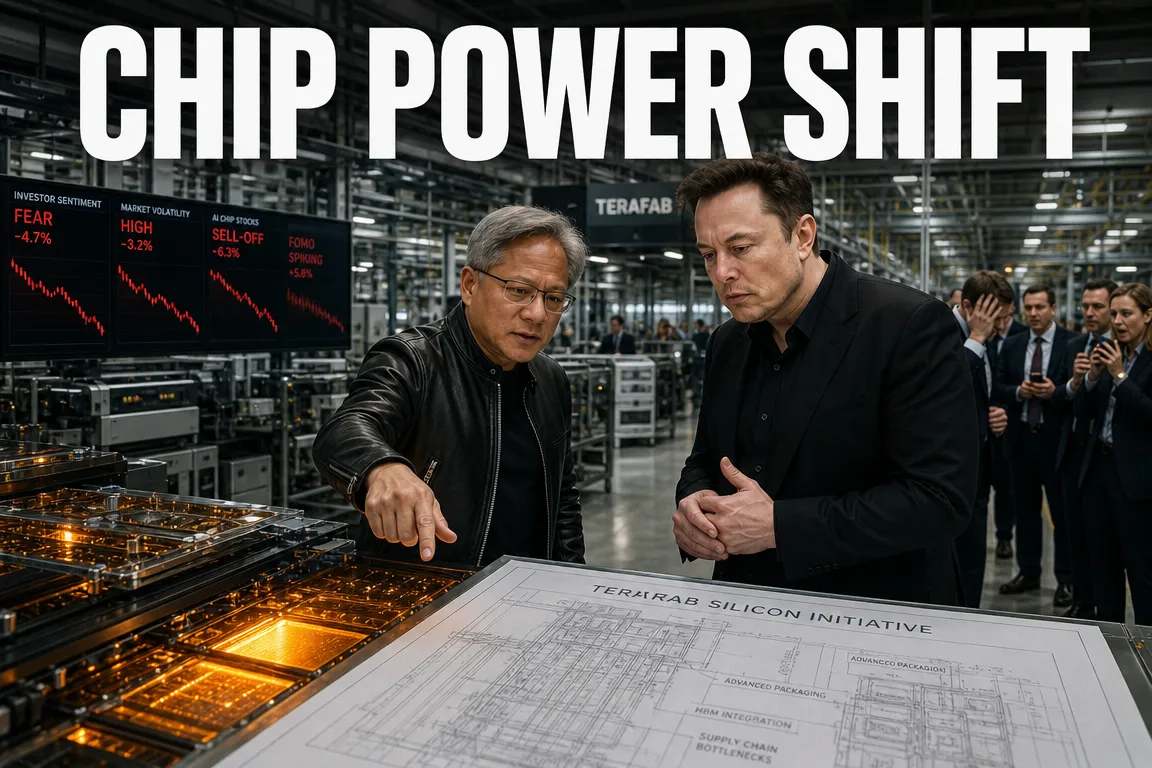
● Nvidia Exodus Rumor – Musk Chip Factory Gamble
Jensen Huang to Join Musk’s “Terafab”? The Economics of AI Semiconductor Manufacturing Matter More Than Departure Speculation
The central issue is not Jensen Huang’s potential departure, but which semiconductor manufacturing activities Elon Musk intends to bring in-house.
This report examines the premise that Huang has left Nvidia, the distinction between chip design and fab operations, potential investment implications for Tesla, and bottlenecks across the AI semiconductor supply chain.
Verification status: The supplied source contains no official announcement or original interview. Regulatory filings, market prices, and webpages were not independently checked in real time.
Huang’s alleged departure from Nvidia and potential move to a Musk-led venture, Terafab’s business scope, attributed remarks, and quoted share prices are therefore treated as unverified.
1. Fact Check: The Claim That Jensen Huang Has Left Nvidia Requires Verification
The supplied video text refers to “Jensen Huang, who left Nvidia” before asking whether he might join Musk’s chip factory venture.
A question-based headline does not establish the factual accuracy of its underlying departure claim.
- Departure from Nvidia: Not verifiable from the supplied material.
- Joining a Musk-led venture: No supporting hiring announcement, contract, or confirmation of formal negotiations is provided.
- Terafab’s business scope: The source uses this name for a proposed factory project. Its operating entity, location, process technology, capacity, and financing structure require verification.
- The description “extremely difficult”: The source attributes this remark to Huang, but the original interview and context have not been verified.
A leadership change at a major global semiconductor company should be verified through official company announcements, investor relations materials, and applicable regulatory filings.
The available evidence supports further verification of the premise, not a conclusion that Huang is likely to join the venture.
2. A Critical Distinction: Chip Design and Fab Operations Are Different Businesses
Regardless of leadership speculation, the distinction between designing chips and operating semiconductor factories is fundamental.
① Nvidia’s Core Capabilities: Integrated Chip, Software, and Systems Design
Nvidia operates primarily under a fabless model, relying on external manufacturing partners rather than running leading-edge wafer fabrication facilities.
Foundries such as TSMC provide core manufacturing capabilities, while Nvidia focuses on GPU design, software, networking, and system-level optimization.
Describing Nvidia as merely a producer of chip blueprints would understate its role.
High-performance AI chips require design decisions that account for manufacturing processes, packaging, and memory interfaces, making close collaboration with manufacturing partners essential.
However, manufacturing expertise differs from directly developing processes and assuming responsibility for high-volume production.
② A Fab’s Core Capability: Consistent Production at Scale
Buildings and equipment alone do not establish a competitive leading-edge semiconductor operation.
- Process integration: Lithography, etching, deposition, cleaning, and numerous other steps must function as a coordinated production flow.
- Yield management: The proportion of functional chips must improve and remain stable.
- Equipment operations: Tool variation, maintenance, and downtime require continuous management.
- Quality and reliability: Products must meet customer performance and long-term operating requirements.
- Production economics: Sufficient utilization is needed to spread substantial fixed costs across output.
The source’s statement that the project involves “more than building a factory” is consistent with these manufacturing requirements.
However, without the original recording or transcript, the statement should not be presented as a verified Huang quotation.
③ “33 Years of Experience” Does Not Mean 33 Years of Fab Operations
Measured from Nvidia’s founding in 1993, approximately 33 years had elapsed by 2026.
Corporate leadership tenure does not equate to direct experience operating leading-edge semiconductor manufacturing processes.
Conversely, the absence of an internally operated fab does not imply a lack of manufacturing knowledge or collaboration experience.
Executive leadership, chip design, manufacturing collaboration, and direct production management should be assessed separately.
3. A Potential Role for Huang: Business Leadership Rather Than Fab Operations
No evidence establishes that Huang will join the venture, although the suitability of potential roles can be assessed conditionally.
A large-scale AI semiconductor business requires capabilities beyond factory operations.
- Product strategy: Identify the AI workloads the chips should target.
- Hardware-software integration: Translate chip performance into application-level performance.
- Supply chain strategy: Secure wafer, memory, packaging, and testing capacity.
- Business model: Determine whether products will serve internal demand or external customers.
- Ecosystem development: Establish development tools, libraries, and technical support.
From this perspective, directing an AI computing business would align more closely with Huang’s established experience than managing fabrication processes.
Role suitability, however, is not evidence of an appointment.
4. Musk’s Semiconductor Plans: Three Distinct Business Models
The term “chip factory” provides insufficient information to assess investment requirements or execution prospects.
The business model depends on whether the venture will design chips, secure production capacity, or develop manufacturing processes itself.
Scenario A. Internal Chip Design With Outsourced Foundry Production
The company develops proprietary AI chips while contracting production to an established manufacturer.
This reduces factory construction and process development requirements, but design staffing, software development, and validation remain significant costs.
Access to advanced process technology and packaging capacity remains a supply chain constraint.
Scenario B. Dedicated Capacity Through Manufacturing Partnerships
Long-term purchase agreements, advance payments, or joint investments secure production capacity.
This can reduce execution demands relative to fully internal manufacturing, but purchase commitments and upfront funding may become burdensome if demand falls short.
Contract terms and the reliability of capacity allocations matter more than factory ownership alone.
Scenario C. Internal Development of Advanced Manufacturing Capabilities
This model offers the greatest manufacturing independence but also the highest technological, capital, and staffing barriers.
Equipment installation must be followed by process stabilization, yield improvement, and qualification for internal products or external customers.
Equating proprietary chip development with ownership and operation of a leading-edge fab can materially distort investment risk assessments.
5. An Additional Constraint: A Fab Does Not Complete the AI Semiconductor Supply Chain
Leadership-focused coverage can obscure the fact that AI performance depends on more than a single chip or factory.
The following supply chain and economic factors are essential to evaluating the project.
① Memory and Packaging Bottlenecks Persist Beyond Wafer Fabrication
High-performance data center AI accelerators depend on high-bandwidth memory, or HBM, advanced packaging, substrates, and testing capabilities in addition to compute chips.
Automotive inference chips and other applications may use different memory architectures and cost structures.
The target application must therefore be established before assessing capacity needs. Additional wafer capacity alone does not resolve all supply constraints.
② Internal Demand Must Support Adequate Fab Utilization
High utilization helps reduce the fixed cost per unit in semiconductor manufacturing.
However, chips for Tesla, AI services, robotics, and data centers cannot automatically be assumed to fit efficiently within the same production line.
Products may differ in process requirements, performance, reliability, and production volumes.
The relevant question is not aggregate demand across Musk-related companies, but the volume of stable demand compatible with the specific manufacturing process.
③ A Musk-Led Project Is Not Necessarily a Tesla Asset
Musk’s involvement does not establish that Tesla will bear all investment costs or receive all resulting earnings.
The operating entity, ownership structure, funding obligations, and purchase agreements determine the economic impact on Tesla shareholders.
Transactions among related companies also require scrutiny of pricing and conflict-of-interest safeguards.
Investors should establish who provides the capital, who owns the assets, and who receives the profits.
④ Proprietary Chip Value Depends on Total Cost per Unit of Useful Compute
A proprietary chip may outperform existing products on specific workloads while still delivering weaker overall economics if development and software migration costs are high.
Comparisons should include chip prices, power, cooling, networking, utilization, and development timelines within a total-cost-of-ownership framework.
AI competition increasingly encompasses the cost and reliability of operating real services, rather than peak performance alone.
6. Tesla Shares and the Economic Outlook: Cash Flow Before Expectations
The source quotes “Tesla at $390.22, down 1.82% from the previous session, at the November 13 U.S. close.”
The year, pricing source, and price basis have not been verified, so the figure should not be treated as a confirmed latest closing price.
Even if accurate, the price movement cannot be attributed to Terafab or Huang-related speculation on the available evidence.
Conditions That Could Support the Share Price
- Developing chips suited to actual demand that reduce costs relative to external procurement.
- Securing reliable supply that removes constraints on product launches or AI service expansion.
- Building durable technological differentiation while controlling investment requirements.
Conditions That Could Weigh on the Share Price
- Capital expenditure increasing faster than operating cash flow.
- Production delays or low yields postponing expected cost savings.
- Weaker-than-expected demand reducing utilization and investment returns.
- Excessive diversion of capital and management resources from existing businesses.
Interest rates and financing costs are also material to the broader economic assessment.
Projects with substantial upfront expenditure and long payback periods are particularly sensitive to changes in the cost of capital.
Rising AI investment may support growth expectations in U.S. equities without necessarily increasing shareholder value at each participating company.
The central investment question is when capital expenditure will generate returns, and at what level, rather than the scale of the facilities alone.
7. Official Disclosure Checklist
- Leadership: Verify any announcement regarding Huang’s position through Huang and Nvidia.
- Operating entity: Identify the legal entity pursuing Terafab and its ownership structure.
- Manufacturing scope: Determine which activities will be internal: chip design, wafer fabrication, packaging, or testing.
- Products: Establish whether the chips target data center training, inference, vehicles, or robotics.
- Financing: Review total investment, annual expenditure, financing arrangements, and purchase obligations.
- Execution: Distinguish construction milestones from volume production and revenue generation.
- Economics: Assess target yields, output, utilization, and cost competitiveness against external procurement.
Until these disclosures are available, prominent leadership involvement alone provides little basis for predicting commercial success.
The decisive issue is who can reliably manufacture the required chips, at what cost—not whether Huang joins the venture.
< Summary >
- The supplied source does not verify Huang’s departure from Nvidia or his participation in a Musk-led venture.
- Chip design, manufacturing collaboration, and fab operations are interconnected but distinct capabilities.
- Terafab’s investment implications depend on its operating entity and manufacturing scope.
- Key variables include yield, utilization, memory, packaging, software, and total cost of ownership.
- For Tesla shareholders, investment obligations and the allocation of profits matter more than prominent names.
- The source’s share price and attributed remarks require independent verification.
[Related Articles…]
*Source: [ 오늘의 테슬라 뉴스 ]
– 젠슨황, 머스크 칩 공장 맡을까? 처음엔 “극도로 어렵다”던 그 사람
● FOMO Trap, Panic Selling, Investor Meltdown
Why Investors Buy After Prices Rise and Sell After They Fall: Investment Psychology and Long-Term Investing Principles
If extensive investment research does not translate into satisfactory returns, review capital allocation and trading behavior before seeking more information.
Drawing on a discussion between journalist Kim Won-jang and Professor Kim Kwang-seok, this report examines momentum-driven buying, panic selling, the conditions for long-term S&P 500 ETF investing, the financial flexibility of wealthy investors, and risks associated with the AI investment boom.
It also examines the conditions omitted from claims that long holding periods guarantee profits, fear creates buying opportunities, or investors must outperform institutions to generate returns.
1. Core Message: Retail Investors Face More Than an Information Disadvantage
Kim Won-jang’s central argument concerns investor behavior rather than stock price targets or market-bottom forecasts.
Investment outcomes depend substantially on behavior under uncertainty and pressure, not merely on access to information.
- Rising markets: Investors increase exposure after hearing about gains achieved by others.
- Falling markets: Investors cancel planned purchases or sell because they fear further losses, despite lower prices.
- Market recoveries: Investors reenter at higher prices after selling during a decline.
- Recurring outcome: Investors’ realized returns may fall below the returns of the assets they hold.
These behaviors do not characterize every retail investor.
Trend-following can be a systematic strategy when supported by defined entry, exit, and risk-management rules.
The problem is changing investment principles in response to others’ gains or personal anxiety rather than executing a consistent strategy.
2. Why Investors Buy High and Sell Low: Five Behavioral Biases
① FOMO: Concern About Missing Gains Can Override Investment Objectives
Fear of missing out, or FOMO, reflects concern about missing opportunities available to others.
Reports of substantial gains in stocks or property can shift attention from personal objectives to relative performance.
Even steady asset growth may appear inadequate when others report doubling their money over a short period.
The investment objective then shifts from achieving financial goals to matching others’ returns.
② Herding: Widespread Participation Is Mistaken for Safety
Popular investments can appear well researched and validated.
However, broad participation does not establish fair valuation or low downside risk.
If expectations are already excessive, favorable news may not produce further price appreciation.
③ Loss Aversion and the Disposition Effect: Avoiding Losses Can Impair Decisions
Reluctance to realize losses can lead investors to retain deteriorating businesses, while extreme fear can trigger unplanned liquidation.
Conversely, investors may sell profitable holdings prematurely to avoid losing unrealized gains.
Loss aversion can therefore produce both delayed selling and abrupt exits, depending on circumstances.
④ Overconfidence: Bull-Market Gains Are Attributed Entirely to Skill
Broad market advances can generate profits even without rigorous analysis.
Attributing those gains solely to forecasting ability can encourage simultaneous increases in capital commitments and leverage.
The principal risk of early success is the greater exposure investors may subsequently assume.
⑤ Confirmation Bias: Investors Seek Supportive Forecasts Rather Than Critical Analysis
Investors may favor bullish commentary on their holdings while dismissing opposing views without examining the evidence.
Information gathering then reinforces existing decisions rather than testing their validity.
Before purchasing, documenting “What evidence would invalidate this investment thesis?” can help reduce confirmation bias.
3. Why Can Equity Markets and the Real Economy Move in Different Directions?
The discussion distinguishes capital-market expectations from changes in actual economic activity.
This distinction does not mean that equities respond only to sentiment while the economy responds only to data.
Equity prices incorporate expectations for future earnings, interest rates, and risk, while economic indicators often report activity that has already occurred.
| Category | Factors Equity Markets Price In Early | Evidence in the Real Economy |
|---|---|---|
| Tariff policy | Announcements, negotiation prospects, expected earnings changes | Import costs, selling prices, trade volumes, corporate margins |
| Interest-rate policy | Expected rate paths, discount rates, financing expectations | Lending rates, interest burdens, consumption, capital expenditure |
| AI investment expansion | Market potential and future corporate growth expectations | Realized revenue, cash flow, investment returns, productivity gains |
Equities can recover while economic indicators remain weak, and share prices can fall following strong earnings announcements.
In the latter case, results may have fallen short of expectations already embedded in prices, despite remaining strong in absolute terms.
Economic outlooks should therefore be assessed against what markets have already priced in, not simply whether conditions are improving or deteriorating.
Policy announcements can also alter business and household expectations before implementation, affecting investment and consumption immediately.
4. Long-Term Investing: Conditions That Must Be Examined
① A Long Holding Period Does Not Necessarily Constitute Sound Long-Term Investing
The discussion repeatedly emphasizes the benefits of long-term investing.
However, holding an individual company for an extended period does not guarantee capital recovery or positive returns.
Declining competitiveness or financial deterioration can cause lasting impairment of corporate value.
Even high-quality businesses can deliver disappointing returns for extended periods if purchased at excessive valuations.
② Diversified Indices Differ from Individual Stocks
S&P 500 ETFs provide exposure to multiple companies, with index constituents changing through additions and removals.
This reduces the risk of exposing an entire portfolio to the failure of a single business.
However, a U.S. large-cap equity index does not provide balanced exposure across all countries, industries, and asset classes.
Rising weights in the largest constituents can increase exposure to particular companies or sectors.
③ A Five-Year Holding Period Does Not Guarantee Safety
Even diversified portfolios can experience losses over multiple years, depending on the investment and valuation dates.
Results also vary with dividend inclusion, inflation adjustments, and measurement in Korean won.
Long-term investing does not eliminate risk; it provides greater capacity to withstand short-term volatility while holding suitable assets.
④ Annualized Returns Are Not Fixed Annual Interest Payments
Historical long-term average returns can conceal substantial year-to-year variation.
Retirement accounts do not generate returns independently; outcomes depend on underlying investments and costs.
U.S. 401(k) plans and Korean Individual Retirement Pension accounts operate under different frameworks, and neither guarantees returns on equity investments.
5. Lessons and Numerical Pitfalls in S&P 500 Staged-Investment Examples
The discussion compares investors purchasing at market highs, market lows, and regular intervals.
The central message is straightforward.
Maintaining an affordable, sustainable investment process matters more than attempting to identify perfect entry points.
However, the discussion combines an assumption of investing $5,000 annually for 10 years with a stated final portfolio value of approximately $17,500–$19,000.
Annual contributions of $5,000 would total $50,000, so the quoted final values do not, by themselves, support a claim of long-term growth.
The figures require verification to determine whether lump-sum and recurring-investment assumptions were mixed or whether transcription errors occurred.
Investment Simulation Checklist
- Confirm the investment start and end dates.
- Distinguish lump-sum investment from monthly or annual contributions.
- Check whether dividend reinvestment, fees, taxes, and exchange rates are included.
- Determine whether interest earned on uninvested cash is incorporated.
- Verify consistency among total contributions, final portfolio value, and return calculations.
The practical benefit of staged investing is not guaranteed performance but reduced entry-timing pressure and impulsive decision-making.
For existing lump sums, delayed deployment can create opportunity costs in rising markets. Conversely, staged deployment may perform better if markets fall shortly after investment begins.
Regular investing from salary should be distinguished from gradually deploying cash already available for investment.
6. Are Unsold Properties and Informal Sentiment Signals Reliable Indicators of Market Bottoms?
The discussion cites apartment developments that initially struggled to sell but subsequently achieved high prices.
These examples show that current popularity and future investment performance do not necessarily align.
However, unsold inventory alone does not establish undervaluation.
Location, offering price, nearby supply, financing costs, demand, and policy changes must also be considered.
Focusing Only on Successful Cases Creates Survivorship Bias
Examining only developments that later appreciated substantially can make past investment opportunities appear obvious.
Other locations or property types purchased during the same period may have remained weak for years.
Contemporaneous lending restrictions and funding constraints also determine whether apparently attractive opportunities were executable.
Speculative Enthusiasm Is a Warning Signal, Not a Precise Exit Indicator
The discussion references surging account openings and the prevalence of investment conversations in everyday life.
Such observations may indicate rising risk appetite.
However, participation by particular occupations or age groups provides weak evidence for identifying market peaks.
Buying solely because others are buying is risky, but assuming widespread participation guarantees an imminent crash is also unjustified.
Sentiment indicators should be assessed alongside valuations, earnings expectations, margin borrowing, and liquidity.
7. Luck Versus Skill: Evaluate Repeatable Processes, Not Returns Alone
One or two strong outcomes during a bull market do not establish investment skill.
Likewise, short-term losses do not necessarily invalidate a sound strategy.
Performance should be evaluated together with the risks assumed to achieve it.
| Evaluation Question | Key Considerations |
|---|---|
| Did the strategy outperform the market? | Use a benchmark appropriate to the assets and risk profile. |
| How much risk was assumed? | Review concentration, leverage, maximum drawdown, and volatility. |
| Are returns net of costs? | Include fees, taxes, currency-conversion costs, and borrowing interest. |
| Did the approach remain consistent across market conditions? | Assess behavior during rising, falling, and sideways markets. |
| Can the process be repeated? | Determine whether investment rationales and trading rules were defined in advance. |
The discussion treats investment skill as broader than identifying attractive stocks.
It also includes diversification, cost control, evaluation of advice, and adherence to investment plans.
However, the contribution of any individual’s financial circumstances or advisers to long-term performance cannot be established without supporting evidence.
8. A Critical Advantage of Wealthy Investors: Financial Capacity to Withstand Drawdowns
The discussion highlights the time advantage available to investors with substantial capital.
Reducing this argument to the proposition that wealth automatically generates more wealth overlooks the underlying mechanism.
The key advantage is the ability to maintain living standards and avoid forced selling when asset prices decline.
① Long-Term Investing Begins with Cash Flow, Not Resolve
Investors who commit funds needed for living expenses or debt repayments may be unable to maintain positions, even when long-term prospects remain favorable.
Emergency reserves and stable income provide greater flexibility during market declines.
Reserve requirements should reflect employment stability, dependents, insurance coverage, and debt obligations.
② Psychological Risk Tolerance Differs from Financial Risk Capacity
Believing that a 30% decline is tolerable differs from being financially able to avoid withdrawals during that decline.
A market downturn may coincide with unemployment or lower business income.
For example, semiconductor employees with portfolios concentrated in semiconductor stocks face correlated risks to both income and investments.
Effective wealth management evaluates occupation, income, debt, and investments together.
③ Higher Interest Rates Affect Households Differently
Households with substantial deposits may receive more interest income, while those with floating-rate debt may face higher repayment burdens.
Aggregate household deposits exceeding aggregate borrowing does not establish that most households benefit from higher rates.
The distribution of deposits and debt, together with the timing of interest-rate adjustments, must be examined.
④ Monetary Expansion Does Not Lift Every Asset
Greater liquidity can influence asset prices but does not guarantee appreciation in a particular property or stock.
Outcomes depend on interest rates, supply, demographics, earnings, and initial valuations.
Even when nominal prices rise, returns after inflation, taxes, and maintenance costs may remain low or negative.
9. Must Investors Beat Institutions to Make Money? Equity Investing Is Not Strictly Zero-Sum
The discussion emphasizes that retail investors trade in the same markets as large pools of capital.
Differences in information access, trading infrastructure, research resources, and financing are material.
However, retail investors do not have to capture institutions’ losses to earn positive equity returns.
Corporate earnings, dividends, and productive investment can create value shared by multiple shareholders.
Competition for returns above the market average is inherently relative.
Frequent trading costs make sustained outperformance more difficult.
However, participating in aggregate market growth differs from trying to outperform counterparties through short-term trading.
Retail investors can reduce competitive disadvantages through low costs and appropriate diversification rather than superior next-day price forecasts.
Institutions also have different objectives and constraints, so institutional selling does not automatically signal deteriorating fundamentals.
10. Implications for AI Investing: An Attractive Industry Is Not Necessarily an Attractive Investment at Any Price
The same behavioral risks apply to sectors with strong growth expectations, including AI and semiconductors.
Recognizing AI’s growth potential does not establish that every AI-related stock is attractive at its current valuation.
Investment returns can disappoint even as an industry expands if share prices already imply stronger growth.
Four Areas to Assess in AI Investments
- Revenue evidence: Determine whether AI demand is producing contracts and realized revenue rather than remaining a forecast or promotional claim.
- Cash flow: Assess whether operations generate cash after capital expenditure and operating costs.
- Competition and concentration: Examine customer dependence, competitors’ capacity expansion, and technological substitution risks.
- Embedded expectations: Estimate the scale and duration of growth required to justify the current valuation.
Multiple ETFs Can Still Produce Concentrated Exposure
S&P 500, Nasdaq-100, and AI thematic ETFs may hold many of the same major constituents despite different product labels.
Diversification should be measured by underlying company, sector, and country weights rather than the number of funds.
AI Is Better Used to Review Investment Judgments
Rather than requesting share-price predictions, investors can use AI to summarize filings, compare results, and develop alternative scenarios.
A useful request is: “Challenge this investment thesis and identify the figures and primary sources requiring verification.”
AI can provide outdated information or inaccurate figures, so material claims should be checked against regulatory filings and official statistics.
Requesting only supportive answers can reinforce rather than reduce confirmation bias.
11. Practical Principles for Reducing Emotion-Driven Investing
① Separate Funds by Purpose and Investment Horizon
Distinguish living expenses, emergency reserves, near-term spending requirements, and long-term investment capital.
Investing funds with fixed withdrawal dates in volatile assets can create forced-sale risk during downturns.
② Document the Investment Plan Before Buying
- What is the rationale for purchasing this asset?
- What supports the expected return at the current price?
- What is the maximum intended portfolio allocation?
- What developments would invalidate the investment thesis?
- How will price declines be distinguished from deterioration in business value?
③ Establish Contribution and Rebalancing Rules in Advance
A long-term diversified strategy can incorporate a defined contribution schedule and target allocations.
Scheduled reviews or allocation-deviation thresholds can reduce sentiment-driven trading.
Rebalancing must account for taxes and transaction costs and does not always improve returns.
④ Apply a Deliberation Period to Unplanned Purchases
When others’ reported gains or sharp price increases prompt an unexpected purchase, document the rationale and allow time for review before placing the order.
This is particularly relevant to unplanned purchases and increases in investment commitments.
It does not justify delaying actions required by established risk-management rules.
⑤ Do Not Increase Risk Solely to Recover Losses
Switching from large-cap stocks to leveraged ETFs or highly volatile securities because returns appear insufficient materially changes portfolio risk.
Many leveraged ETFs target a multiple of daily returns, so their long-term performance is not a simple multiple of the underlying index’s cumulative return.
Return paths and costs affect outcomes; these products should not be treated as equivalent to conventional index ETFs intended for long-term exposure.
⑥ Incorporate Selling into the Plan
Long-term investing does not mean never selling.
Deteriorating competitiveness, excessive concentration, approaching spending requirements, or changes in asset allocation can justify reviewing a position.
Selling because prices have fallen differs from selling because the investment thesis has changed.
12. Fact-Checking Priorities When Assessing the Discussion
Useful behavioral insights do not automatically validate accompanying figures or statistical claims.
The following issues should be assessed separately from the discussion’s broader lessons.
- Post-midterm election market performance: Historical average patterns do not guarantee gains in a particular year.
- JOMO: The term describes comfort with missing opportunities and is not a validated market-bottom indicator.
- Individual stock prices and quarterly results: Some figures may contain unit, timing, or transcription errors and require verification against company disclosures.
- Property prices and policies: Accurate comparisons require consistent floor-area definitions, contract dates, transaction types, and policy implementation dates.
- Lottery retailers: Higher ticket sales can produce more winners without increasing the probability that any individual ticket wins.
- Lottery number selection: Less popular combinations may affect the likelihood of sharing a prize but do not increase the probability of winning.
- Probability analogies: Explanations based on independent trials cannot be applied directly to equity markets.
The discussion’s time analogy should be interpreted within similar limits.
Chronos and kairos are concepts of Greek origin, used here to contrast elapsed time with decisive moments.
Applied to investing, the analogy favors securing a sustainable investment horizon over identifying a perfect entry point.
It does not remove the need to assess asset quality, valuation, and costs throughout that horizon.
Additional Analysis: Implications Beyond Investment Psychology
First, systems that reduce dependence on emotional discipline are more robust than resolve alone.
Staged purchases, exposure limits, emergency reserves, automatic contributions, and review schedules do not eliminate emotions.
They help maintain consistent behavior when emotions fluctuate.
Second, the capacity to invest during market stress depends on liquidity and income.
Encouragement to buy during downturns is insufficient.
Financial stability is necessary to evaluate opportunities without compromising essential spending.
Third, unsupported contrarianism is another form of crowd-dependent decision-making.
Selling solely because others are buying, or buying solely because others are fearful, still relies on others’ behavior.
Contrarian investing requires analysis of value, price, and financial condition.
Fourth, success should be measured against financial objectives rather than others’ returns.
For retirement planning, the relevant question is whether required funds are being accumulated at an acceptable level of risk, not whether returns exceed those of peers.
Using exceptional gains achieved by others as the benchmark can encourage repeated increases in risk limits.
The most immediately controllable improvements are capital allocation and trading behavior, not next-day price forecasting.
Economic analysis and behavioral discipline are complementary.
The objective is to translate both into practical, sustainable investment rules.
< Summary >
- Investment psychology: FOMO, loss aversion, overconfidence, and confirmation bias can undermine disciplined execution.
- Market interpretation: Equity prices reflect future expectations and interest rates as well as current earnings.
- Long-term investing: Extended holding periods do not guarantee profits; diversification, valuation discipline, and cost control remain essential.
- Staged investing: Spreading purchases can reduce timing pressure but does not consistently maximize returns.
- Wealth management: Emergency reserves, income stability, and debt management support the capacity to hold investments through downturns.
- AI investing: Distinguish industry growth from investment attractiveness and examine earnings, cash flow, and overlapping holdings.
- Execution: Define investment rationales, allocation limits, and exit conditions in advance to reduce reliance on emotion.
[Related Articles…]
*Source: [ 경제 읽어주는 남자(김광석TV) ]
– [풀버전] 주가 오를 땐 사고 떨어지면 도망친다…개인투자자가 계속 지는 이유 | 경읽남과 토론합시다 | 김원장 기자