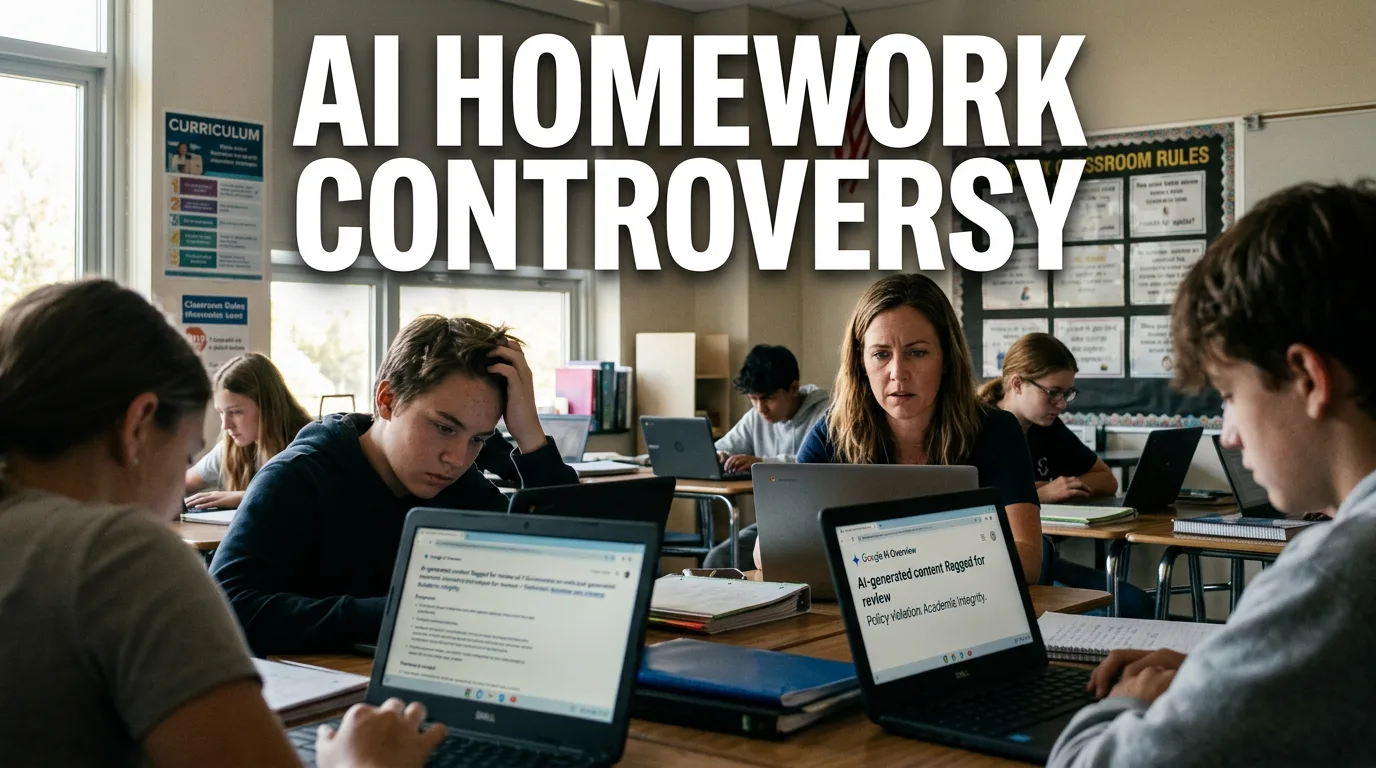
● Google AI Overviews Turn School Search Into Homework
The Moment the Google Search Box on School Chromebooks Became an AI Tutor: Why Google AI Overviews and AI Mode Clash with Education
The core point of this issue is not simply that “students use AI to do homework.”
The most important point is that by attaching AI Overviews and AI Mode to the educational infrastructure Google has installed in schools—Chromebooks, Google Classroom, and Google Search—a school environment is being created that is difficult to control.
From a student’s perspective, simply typing a math problem or essay topic into the search box produces an answer, while schools are caught in a dilemma: they need search, but want to prevent AI-generated answers.
This issue extends beyond education and connects to artificial intelligence, edtech, digital transformation, Big Tech regulation, and global economic outlooks.
1. The Beginning of the Issue: The Google Search Box Students Used Every Day Became an AI Homework Tool
A controversy is growing in U.S. schools over student accounts provided by Google.
The reason is AI Overviews and AI Mode integrated into Google Search.
In the past, when students entered a question into Google’s search box, they had to look through a list of websites and find the information themselves.
But now, an AI-generated summary appears at the top of the search results first.
And when AI Mode is added, students can continue follow-up questions inside the search box without opening a separate Gemini app.
In other words, Google Search has effectively become a structure that works like an AI chatbot.
- Students enter homework questions into the search box.
- AI Overviews summarize the core point.
- If they move into AI Mode, they can ask follow-up questions conversationally.
- They can quickly receive math solutions, research assignments, and essay drafts.
This feature is extremely convenient for ordinary users.
That is because they can quickly grasp the core point without reading multiple long documents.
But for students who still need training in reading materials and making judgments, it becomes a completely different problem.
2. Real Student Cases: AI Made Homework Faster, but Test Scores Fell
According to a Wall Street Journal report, Richard Scott, a middle school student in Pennsylvania, began entering math problems into the Google search box on the laptop provided by his school.
He discovered that the search box worked like an AI chat tool that produced answers.
He was able to finish assignments much faster and also used AI in other subjects.
- Research assignment on the names of fossil parts.
- Essay writing on Edgar Allan Poe’s poetry.
- Math problem solving.
- Research and summary assignments.
The problem became clear in year-end exams.
Scott failed some final exams and said that because he could not use AI during tests, it was hard to think through the problems.
AI helped him complete assignments, but he did not get enough practice solving problems on his own.
Another student, Sophia Chatzigiann, had a similar experience.
She reportedly saw her grades decline after relying on Google Search’s AI summaries and AI Mode on a school computer.
The biggest temptation she pointed to was accessibility.
That was because the search box she always used while studying had turned into a tool that immediately gave answers.
3. Why Google Became the Center of the Problem: Because It Is Already Deeply Embedded in Schools
The reason this controversy grew is that Google is not just a search company; it has become a core provider of school education infrastructure.
In U.S. public schools, it is common to provide students with laptops or tablets.
Currently, about 88% of U.S. public schools are known to provide students with learning devices.
The device with the largest share in this market is Google Chromebooks.
Schools provide students with Google accounts along with Chromebooks.
Students use those accounts to access Google Classroom.
Teachers post class materials and assignments in Classroom, and students check and submit assignments there.
Documents are written in Google Docs, while materials are stored and shared through Google Drive.
- Chromebooks: Enable affordable device distribution to many students.
- Google Classroom: Easily handles assignment distribution, submission, and review.
- Google Docs: Optimized for collaborative document writing.
- Google Drive: Convenient for storing and sharing class materials.
- Admin Console: Allows school IT staff to manage multiple devices at once.
After COVID-19 expanded remote learning, these tools became even more deeply embedded in schools.
Google Classroom is currently said to have more than 150 million users worldwide.
There are also more than 50 million students and teachers using Chromebooks.
In short, Google has secured a powerful platform position in the edtech market.
4. Google AI Expansion Timeline: How Did Gemini Reach Student Accounts?
Google has gradually expanded AI features in educational accounts.
Features that were initially aimed at university students gradually expanded to middle school students, high school students, and even elementary school students.
- May 2024: Gemini app launched for educational accounts, but available mainly to university students aged 18 and older.
- November 2024: Expanded eligibility to ages 13 and up.
- 2025: Expanded further toward all ages, including elementary school students.
- 2026: Gemini features integrated into Google Classroom, placing an AI learning entry point next to students’ assignment screens.
Especially important was the addition of AI entry points inside Google Classroom, such as “Learn with Gemini.”
Students no longer needed to copy assignment titles, instructions, and class materials separately to explain them to AI.
That is because AI could already help while understanding the context of the assignment.
This structure is extremely powerful as a learning support tool.
Students can ask for explanations of concepts they do not understand.
They can also have their own answers checked.
But at the same time, the risk of becoming a tool that rapidly generates submission-ready answers has also grown.
5. Pushback from Schools and Parents: They Want Search, but Want to Block AI Answer Generation
As Google AI features moved deeply into assignment screens and search boxes, resistance from schools and parent groups intensified.
New York City introduced a policy that delays the use of generative AI by students through the 8th grade, equivalent to middle school year 2.
Parent groups and U.S. senators also pressured Google.
They demanded that AI features such as Gemini be blocked on school-issued devices.
In response, Google said it would keep Gemini and Classroom AI features turned off by default in K–12 student accounts.
They would only be enabled if a school administrator agrees.
But a bigger problem remained.
That is Google Search.
Google Search already integrates AI Overviews and AI Mode.
According to Google, it is difficult to turn off only the AI features in Search.
In other words, if schools want to block AI completely, they would need to block Google Search itself.
That is an unworkable condition for schools.
That is because internet search is a core skill for classes and assignments these days.
Curriculum evaluation standards also include the ability to gather information effectively using search terms and to assess the reliability and accuracy of sources.
Schools want something simple.
They want search to remain available, but AI features that generate answers to be restricted.
However, Google is closer to the position that returning to the old Google Search is difficult.
6. The Core Conflict: Does AI Help Learning, or Replace the Learning Process?
AI itself is not the problem.
Being able to easily receive explanations for concepts students do not understand, or having their own answers reviewed, clearly helps learning.
If artificial intelligence is used well, the age of personalized learning, or AI tutors, can arrive much faster.
But the core point of this controversy is that AI has gone beyond helping students’ thought processes and now creates the answers they will submit.
The U.S. nonprofit Common Sense Media conducted tests asking Google AI Mode to do homework.
As a result, it said that all 180 tested assignments were answered with completed submissions in a form that could be turned in directly.
Rather than encouraging students to try first, it provided the answer first and, if desired, explained the solution process afterward.
From a student’s perspective, this is a very strong temptation.
If there is an assignment due soon and a complete answer appears just by typing a question into the search box, it is hard not to click.
In the end, assignment completion time may decrease, but thinking skills and problem-solving practice can also decline.
7. The Real Reason Google Cannot Give Up AI Search: Advertising Revenue and Search Dominance
The reason Google cannot easily separate AI features from Search is not only a technical issue.
The bigger reason is that the competitive structure of the search market is changing.
According to OpenAI, the volume of search-like questions processed by ChatGPT is said to be about 20% of Google Search.
That means people are now entering into AI chat windows like ChatGPT the questions they used to type into Google Search.
From Google’s perspective, where a question begins is directly tied to revenue.
If users stay within Google Search, they can be connected to various services such as advertising, shopping, maps, YouTube, and cloud.
Conversely, if the starting point for questions moves to ChatGPT or another AI service, Google’s search ad base could weaken.
That is why simply making the Gemini app better is not enough for Google.
To prevent users from moving to ChatGPT, Google must provide AI answers within its existing Search product.
AI Overviews and AI Mode are the core of that strategy.
Ultimately, the demands of schools and Google’s platform strategy are colliding head-on.
Schools want to restrict AI.
Google needs to place AI deeper inside Search.
This conflict is likely to become an important point to watch when looking at Big Tech regulation and the digital education market in global economic outlooks going forward.
8. The Most Important Point That Other News Does Not Cover Well: The Problem Is Not “Whether AI Is Used,” but the “Inseparable Platform Structure”
Many articles and videos focus on the scene of students using AI to do homework.
But the more important essence is that schools are losing their ability to choose.
Schools introduced search as an educational tool.
They adopted Google Classroom for document writing and assignment management.
They chose Chromebooks for affordable device distribution.
But over time, AI began to be automatically attached to the center of all these tools.
In other words, the tools schools originally purchased were search and class management tools, but what students actually face is an AI answer engine.
That leads to the key question.
- Do schools have the right to choose search and AI separately?
- Should AI answer generation be disabled by default in student accounts?
- Should educational platform contracts clearly define standards for adding AI features?
- After Big Tech controls education infrastructure and changes features, how far can schools refuse?
This issue is not simply a matter of learning ethics.
It is a problem intertwined all at once with platform dependency, data control, public education infrastructure, and AI governance.
It could also affect edtech companies, AI semiconductor demand, cloud infrastructure, and the educational software market.
9. Why This Matters to Korean Schools and Parents Too
The debate over Google Chromebooks in U.S. schools is not unrelated to Korea.
Schools in Korea are also rapidly promoting digital textbooks, tablet-based classes, cloud-based assignment submissions, and AI tutor adoption.
Digital transformation is already a major trend in education.
The issue is that operational principles matter more than device distribution.
Completely blocking AI is not realistic.
But leaving an environment where complete answers are immediately provided through the search box is also dangerous.
At minimum, the Korean education field needs the following standards.
- Separate assignments where AI use is allowed from those where it is prohibited: A standard is needed that allows concept explanations but restricts final answer generation.
- Separate search from generative AI functions: In student accounts, AI summaries, AI Mode, and answer generation should be controlled step by step.
- Change assignment evaluation methods: Do not evaluate only the final product; also assess the thought process and draft-writing process.
- Make AI usage records transparent: A system is needed to show at which stage a student used AI.
- Strengthen teacher training: Teachers should not only think about whether to ban or allow AI, but also learn how to incorporate it into lesson design.
10. The Economic Perspective on Google’s Choice: The Education Market Is a Future Customer Acquisition Strategy
The reason Google focuses on the school market is not just to sell Chromebooks.
If students become familiar from an early age with Google accounts, Google Docs, Google Drive, and Google Search, they are more likely to remain in the Google ecosystem as adults.
This is a long-term platform lock-in strategy.
The edtech market matters more for securing future customers than for short-term revenue.
If students become used to AI search and AI document writing, they are likely to prefer the same tools in future work environments as well.
That could lead to revenue from enterprise cloud, productivity tools, and AI subscription services.
Therefore, this controversy is both about educational ethics and about Big Tech’s long-term revenue model.
This is also why Google cannot easily separate AI search in schools.
When search dominance is being challenged, Google cannot afford to lose user habits.
11. Key Points to Watch Going Forward
- Whether Google will allow AI Overviews and AI Mode to be separately disabled in student search is the key issue.
- Whether U.S. education authorities and Congress will regulate Big Tech education platforms needs to be watched.
- Whether school contracts will clearly include AI feature additions and data usage clauses may become increasingly important.
- Whether assignments using AI and assessments that must be done without AI will be separated is the practical change point in education.
- The AI search competition among ChatGPT, Google Gemini, and Microsoft Copilot is likely to become even more intense.
In the end, this issue is not a simple debate about “students should not use AI.”
It is a signal that the definition of search is changing, the way learning works is changing, and Big Tech’s economic strategy is entering public education.
< Summary >
As AI Overviews and AI Mode are integrated into Google Search, the search box on school Chromebooks is effectively functioning like an AI homework tool.
U.S. students are using AI for math problems, research assignments, and essay writing, and some students have even experienced lower test scores.
Schools and parents are asking to keep search while limiting AI answer generation, but Google says it is difficult to separate only AI features from Search.
The reason Google is pushing AI search is connected to competition with ChatGPT, defending search ad revenue, and maintaining long-term platform dominance.
The most important essence is not whether AI is used, but the platform structure that prevents schools from choosing search and AI separately.
[Related Articles…]
- How AI Search Is Reshaping Google and ChatGPT’s Future
- The New Investment Trend in the EdTech Market and Digital Classrooms
*Source: [ 티타임즈TV ]
– 학교 노트북에도 ‘딸깍’ 가능하게 한 구글