● Hedge-Fund Liquidation Shock
The Real Cause of the Crash in AI Infrastructure Semiconductors: GPU Rental Prices Are Nearly Doubled Instead
The most important point in this downturn is not “whether AI demand has weakened,” but “whether the leverage piled into AI-related stocks is being forcibly unwound.”
On the surface, it looks like an AI bubble is bursting because AI semiconductors, memory semiconductors, and cloud infrastructure stocks are all collapsing at the same time.
But in reality, GPU rental prices have risen by nearly 2x over the past year, and there are reports that most of NVIDIA’s 2027 GPU supply is already sold out.
In other words, stock prices are plunging while demand for AI computing is becoming even stronger, creating a bizarre situation happening at the same time.
In this article, we will organize the causes of the collapse in AI-related stocks, the chain liquidation of hedge funds, the surge in short selling, rising GPU rental prices, bottlenecks in data center investment, how this differs from the dot-com bubble, and the key indicators to watch going forward.
1. Current Market Situation: AI-related Stocks Are Crashing, While Indexes Are Holding Up Better Than Expected
The recent drawdown in AI infrastructure and semiconductor names has gone beyond a normal correction.
Some AI-related stocks have fallen more than 30% from their highs, and among cloud infrastructure names, there have even been cases of declines nearing 70%.
- Some AI infrastructure stocks: about 30~70% collapse from highs
- Memory semiconductor names such as Micron and SanDisk: about a 30% correction
- Philadelphia Semiconductor Index: about a 25% drop
- S&P 500: about 3% below its high
- Nasdaq: about 7% below its high
What stands out here is that while individual AI semiconductor stocks have fallen sharply, the major U.S. equity indexes have shown relatively strong resilience.
This once again confirms why long-term investors emphasize index investing.
Investors concentrated in specific sectors or individual names can suffer large losses, but broad indexes like the S&P 500 or Nasdaq absorb shocks much more smoothly.
In particular, AI semiconductor stocks had already risen excessively this year.
The high-beta momentum index, meaning a basket of volatile AI-related stocks, had at one point risen nearly 70% from the start of the year.
Some names such as SanDisk had risen by several hundred percent from the start of the year before correcting.
Therefore, this plunge is more accurately seen not simply as “AI is over,” but as the unwinding of excessive positioning in names that had risen too far, too fast.
2. The Direct Cause of the Crash: The More Frightening “Chain Liquidation of Hedge Funds” Than an AI Bubble
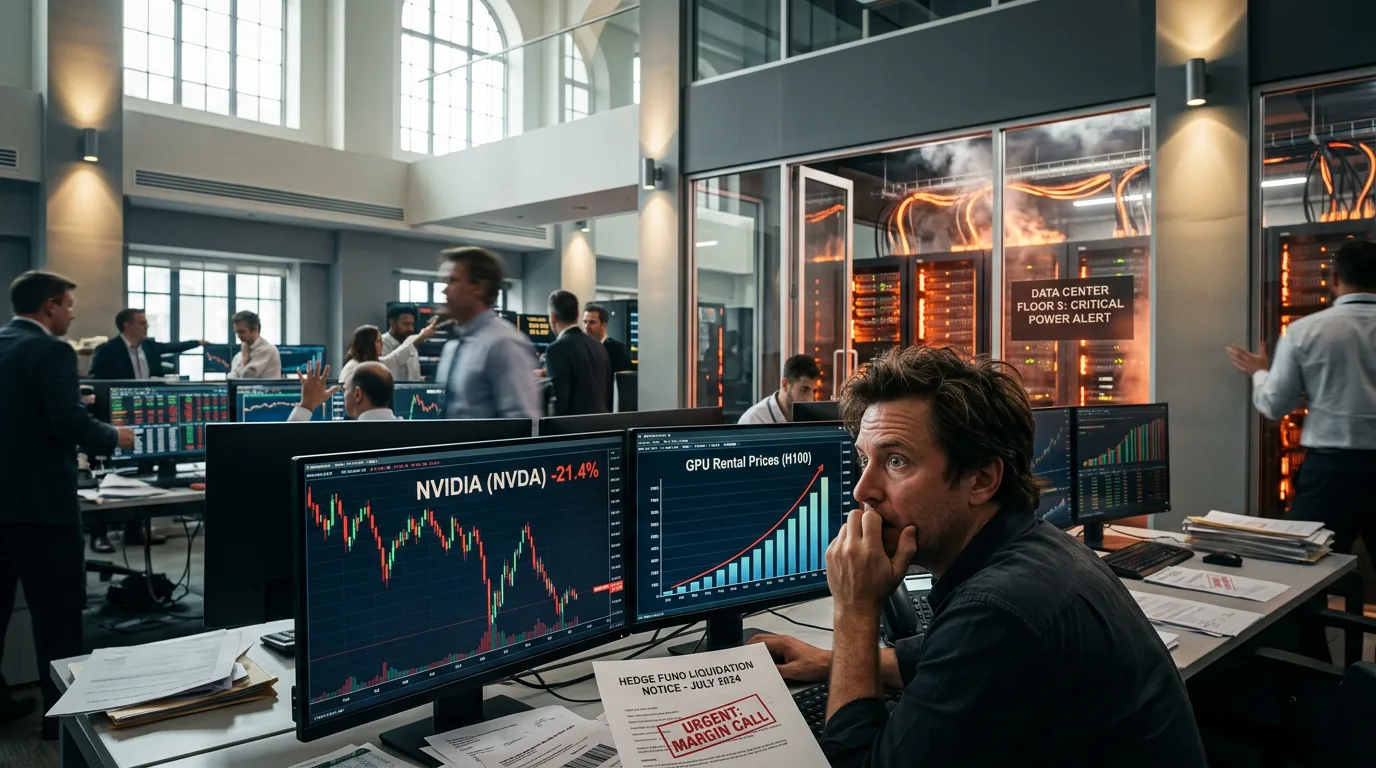
The main cause of this decline is being described as the possibility of chain liquidation among hedge funds.
According to Goldman Sachs prime brokerage data, the scale of tech stock selling reportedly expanded to an extreme level.
In particular, Goldman Sachs’ AI-related basket and VIP Trading Index fell sharply, and losses occurred simultaneously across the hedge fund universe.
- Multi-strategy hedge funds: funds that use multiple strategies at the same time
- Quant funds: funds that trade using mathematical models, algorithms, and AI
- Fundamental long-biased funds: funds that invest based on earnings and growth while also hedging part of the risk
In markets, if one strategy suffers losses, another strategy often helps provide defense.
But this time, all three types of funds reportedly recorded losses of more than 1% at the same time.
There are even comments that this kind of simultaneous loss is the first since 2020.
The problem is that hedge funds often hold similar stocks and use similar leverage.
When one fund takes losses, a margin call is triggered.
When a margin call hits, the fund has to sell its holdings.
If that stock falls, the neighboring fund also suffers losses.
Then that fund also receives a margin call and sells again.
When this process repeats, stock prices mechanically collapse regardless of earnings or demand.
This is the most realistic explanation for the recent plunge in AI semiconductor stocks.
3. Surge in Short Selling: On Wall Street, Weak Links Get Attacked Harder
When stock prices plunge, market participants do not simply sit back and watch.
Especially on Wall Street, if a specific fund or sector is seen as wavering, capital that attacks that weakness more aggressively tends to pile in.
The current short-selling pressure on AI-related stocks is being described as approaching very high levels by five-year standards.
Short leverage ratios are also showing a sharp upward trend.
In simple terms, this means that once people see “AI-related stocks are falling,” money is flowing in to bet on additional downside.
In that case, stock prices can fall faster and deeper than the companies’ actual value.
So if you interpret this drop only as fundamental damage, you may miss something important.
Right now, AI bubble debate, weakening liquidity, hedge fund liquidation, and short-selling pressure are all colliding at once.
4. Is It Really an AI Bubble: Stock Prices and Industry Reality Must Be Viewed Separately
When stock prices fall, the market immediately starts saying, “It was an AI bubble.”
But if you compare now with two weeks ago when the market hit its peak, the AI technology itself has not suddenly deteriorated.
Claude’s performance has not suddenly declined.
GPT users have not suddenly been cut in half.
Companies have not suddenly stopped adopting AI.
The long-term supply agreements signed by memory semiconductor companies have not disappeared just because stock prices fell.
The stock market moves in the short term based on sentiment and liquidity.
But in the long run, it has converged toward corporate earnings and cash flow.
Looking at the past 100 years of the U.S. stock market, companies whose earnings increase have often seen their stock prices rise over time.
Of course, for investors who bought at the top, this is an extremely painful period.
But the growth potential of the AI industry itself and the short-term correction in AI-related stock prices must be distinguished.
5. The Most Important Core Point: GPU Rental Prices Are Actually Rising Nearly 2x
The most important data point in this market is not stock prices, but GPU rental prices.
AI semiconductor stocks are plunging, but the actual price of AI computing resources is rising instead.
According to the original text, a significant portion of NVIDIA’s next-generation GPU supply has already been sold through 2027, and inquiries are reportedly even coming in for 2028 supply.
It is also mentioned that GPU rental prices have risen to nearly 2x over the past year.
This includes not only the latest Vera Rubin and Blackwell, but also the Hopper generation and even the older A100.
Even though the A100 is an old GPU, its rental price has recently been seen rebounding.
This is a very important signal.
If AI demand were weakening, GPU rental prices should be falling first.
But in reality, GPU leasing prices are rising even though data centers keep being built.
This means that demand for AI inference computing is increasing faster than supply.
6. The Nebius and CoreWeave Cases: Even in the Same AI Infrastructure Space, Contract Structure Determines Success or Failure
When evaluating AI infrastructure companies, you cannot just look at how many GPUs they have.
You also need to look at contract structure, debt levels, data center utilization, customer mix, and whether power has been secured.
CoreWeave was regarded as one of the leaders in the AI infrastructure market.
But the burden of early long-term low-price contracts signed to secure major customers like Microsoft and OpenAI is now weighing on the company.
At the time, it was a strategy to secure anchor customers, but looking back now, with GPU rental prices surging, it amounts to promising long-term supply at low prices.
As a result, profitability comes under pressure, debt burdens increase, and the stock price is negatively affected.
By contrast, Nebius is described as having a relatively lighter debt burden and a strategy centered more on short-term contracts for part of its supply.
In particular, if it locks in 2027 supply through short-term contracts, it can benefit more directly from rising GPU rental prices.
In the AI infrastructure business, “how much you own” matters far less than “at what price, for how long, and to whom you leased it.”
7. The Economics of a 1GW Data Center: Why the GPU Leasing Business Appears Extremely Profitable
The original text notes that building a 1GW-scale data center based on NVIDIA Vera Rubin could require roughly $50 billion in capital expenditure.
But if this facility is leased out, annual revenue could also reach roughly $50 billion.
Of course, not all of that revenue is profit.
Electricity costs, depreciation, operating expenses, and interest expenses all need to be subtracted.
Even so, some estimates suggest that annual profits below $20 billion are possible.
The exact figure depends on contract pricing, power costs, GPU depreciation, and financing costs.
But the overall direction is clear.
At present, the AI computing resource leasing business is showing extremely high profitability in a period where demand exceeds supply.
This is why investment in AI data centers continues.
8. How It Differs from the Dot-Com Bubble: The Bigger Issue Now Is “Physical Bottlenecks,” Not “Duplicate Orders”
Recently, many have compared AI infrastructure investment to the fiber-optic investment wave during the 2000 dot-com bubble.
Citadel’s Ken Griffin is said to have suggested that AI may be a bubble.
On the other hand, the Blackstone CEO argued that AI is not a bubble.
During the dot-com bubble, telecom companies laid fiber-optic cables first by taking on debt in anticipation of future internet demand.
The problem was that companies A, B, C, and D all calculated the same demand multiple times.
Massive oversupply occurred as infrastructure was installed at 5x or 10x the actual demand.
But the current AI data center market is structurally different.
- Securing power is difficult.
- Waiting times for grid connections are long.
- Local permitting procedures are complex.
- Financing on the order of tens of billions of dollars is required.
- GPU supply itself is limited.
- Cooling, land, and power contracts are all bottlenecks.
In other words, this is not a structure where overbuilding happens easily just because someone wants to.
Right now, it is closer to a phase where demand exists but supply cannot keep up because of power, GPU, and site constraints.
TSMC is also said to have checked actual data center sites and mentioned in its earnings call that there is real demand from clients for AI investment.
This makes it hard to dismiss AI infrastructure investment as merely fictitious orders.
9. The Next Stage of AI Demand: From Enterprise Agents to Personal Agents, and Then to Physical AI
Current AI demand is expanding beyond simple chatbot usage into enterprise AI agents.
Companies are attaching AI to customer support, coding, document analysis, accounting, legal work, and sales automation.
On top of that, personal AI agents may also spread rapidly.
Meta’s personal AI services, smart glasses, on-device AI, and more advanced voice assistants are representative trends.
And the next stage is physical AI.
Physical AI refers to AI that moves in the real world, such as robots, autonomous driving, manufacturing automation, and logistics automation.
Once we move into this stage, the computing resources required could become much larger than today.
That is because video, robotics, simulation, and autonomous driving models require far more computation than text-generation AI.
Therefore, if you judge AI demand only by current ChatGPT usage, you may miss the full picture.
10. From a Valuation Perspective: If It Were Truly a Bubble, Would PERs Be This Low?
One part often missed in the AI bubble debate is valuation.
The original text notes that Broadcom and NVIDIA’s price-to-earnings ratios have fallen to around 15x, while memory semiconductor companies are showing very low PERs around 3x.
Of course, this figure can be interpreted differently depending on whether it is based on forward earnings estimates or temporary cycle earnings.
But in a classic bubble phase, companies with little or no revenue or earnings usually receive valuation multiples of dozens or even hundreds of times.
Today’s leading AI semiconductor names are generating real revenue, real earnings, and real cash flow.
Memory semiconductors also have room for earnings improvement based on HBM demand, server DRAM prices, and long-term supply agreements.
Therefore, it is difficult to interpret the current correction in AI semiconductors the same way as the collapse of the dot-com bubble.
11. Still, Be Careful: Even If AI Grows, Not Every Stock Will Rise
Just because the AI industry is growing does not mean every AI-related stock will survive.
The most important lesson from this selloff is the difference in financial structure and contract structure.
Companies with heavy debt can be shaken by interest rates and refinancing pressure even if GPU demand is strong.
Companies with many long-term low-price contracts may see limited profitability even if market prices rise.
Data center companies that fail to secure power may not be able to run properly even if they obtain GPUs.
Companies whose customers are concentrated in just one or two big tech firms face significant contract-change risk.
Therefore, when looking at future AI infrastructure investment, you should not simply believe the label “AI beneficiary.”
- Is the debt ratio high?
- Is the contract price fixed?
- Has power been secured?
- Is the GPU procurement schedule confirmed?
- Are customers diversified?
- Is data center utilization actually rising?
- Can cash flow cover interest expenses?
These items are likely to become the criteria that separate winners and losers among AI infrastructure companies going forward.
12. The Most Important Point Rarely Mentioned in Other News
Most news headlines focus on “AI-related stock crash,” “AI bubble concerns,” and “semiconductor correction.”
But the real core point is not AI demand, but the price of AI computing resources.
Stock prices can swing sharply in the short term due to market sentiment and leverage.
By contrast, GPU rental prices are closer to the spot price of AI infrastructure that real companies are paying to use.
The fact that stock prices are falling while GPU rental prices are rising suggests that the market may be reflecting a collapse in financial positioning rather than a collapse in industrial demand.
If you do not understand this difference, you may misread the current downturn.
AI demand has not disappeared just because AI semiconductor stocks have fallen.
On the contrary, GPU rental fees, data center power requests, long-term supply contracts, and big tech CAPEX still indicate that demand for AI computing remains strong.
Therefore, the key indicators investors should watch going forward are not just stock charts.
- Trends in GPU rental prices
- Reservation status for NVIDIA next-generation GPU supply
- Long-term supply contracts for HBM and server DRAM
- Big tech data center CAPEX plans
- Grid connection waiting lists
- Debt maturity structures of AI infrastructure companies
- Short interest and hedge fund deleveraging trends
If these indicators do not weaken, then this decline is more likely a positioning adjustment than an industry collapse.
13. Investor Takeaway: This Is a Time for Distinction, Not Just Fear
The current market is definitely difficult.
In particular, investors who bought AI semiconductors, memory semiconductors, or data center infrastructure names near the top may be facing large losses.
But this is exactly when you need to distinguish three things.
- First, stock price declines and weakening industry demand are not the same.
- Second, even within AI infrastructure companies, risk differs depending on financial structure.
- Third, forced liquidation selling and long-term fundamental damage are not the same.
This correction is difficult to explain with the simple phrase “the AI bubble has burst.”
Rather, it is more convincing to see it as a process in which excessive leverage piled into AI-related stocks, and that positioning is being unwound all at once through hedge fund liquidations and short-selling pressure.
That said, this does not mean all stocks should be held without question.
Companies with excessive debt, companies whose profitability is constrained by long-term low-price contracts, and companies with uncertain power supply may continue to face pressure.
On the other hand, companies with strong real demand, favorable contract structures, and healthy cash flow may be reassessed after the correction.
< Summary >
The sharp drop in AI-related stocks is more likely the result of overlapping hedge fund liquidations, surging short selling, and leverage reduction than a collapse in AI demand.
The S&P 500 and Nasdaq are holding up relatively well, but individual AI semiconductor and data center infrastructure names have fallen sharply.
The important point is that while stock prices are plunging, GPU rental prices have actually risen by nearly 2x over the past year.
There are reports that NVIDIA’s next-generation GPU supply for 2027 is already mostly sold out, and inquiries for 2028 supply are also continuing.
Unlike the dot-com bubble, current AI data center investment is constrained by physical bottlenecks such as power, permitting, GPU supply, and financing, so it is hard to view it as simple oversupply.
Going forward, investors need to look not only at AI semiconductor stock prices, but also at GPU rental rates, data center power demand, HBM long-term contracts, big tech CAPEX, and the debt structures of AI infrastructure companies.
This downturn is more likely a period of financial position cleanup than the end of the AI industry.
[Related Articles…]
- AI Semiconductor Cycle and Memory Market Outlook
- Data Center Power Demand and AI Infrastructure Investment Trends
*Source: [ 월텍남 – 월스트리트 테크남 ]
– AI인프라 반도체 대학살극의 원인….”GPU렌탈 가격은 2배 상승 중”