● Tesla Starts Selling Driverless Cybercab
Tesla Begins Personal Sales of the Steering-Wheel-Free Cybercab… The Autonomous Vehicle Market Has Moved to the Next Stage
There are exactly five key takeaways.
First, Tesla has officially opened personal sales of the Cybercab, which has no steering wheel or pedals.
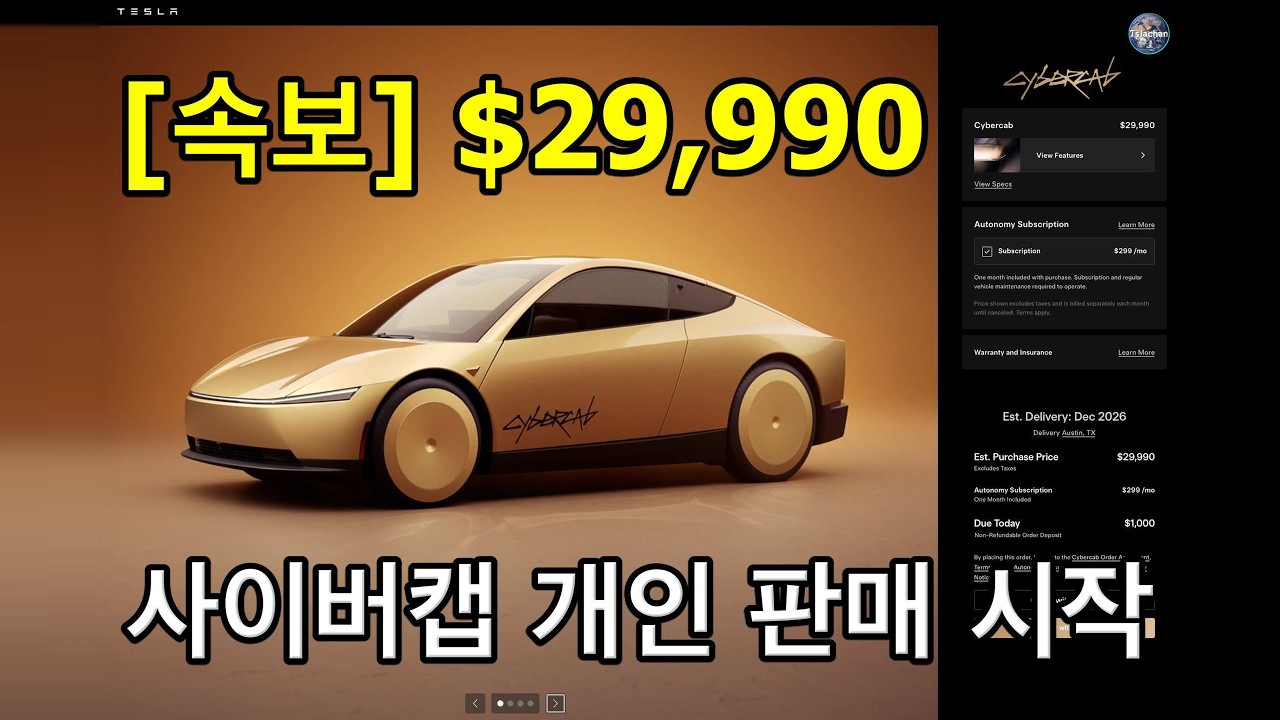
Second, the price is set at $29,990, and the $299-per-month Autonomy subscription is effectively attached.
Third, deliveries are scheduled for December 2026, with the first delivery area being Austin, Texas.
Fourth, there is still no possibility confirmed for a Korean launch, and road certification and safety regulations are the biggest variables.
Fifth, this announcement should be seen as a signal that will change the direction of the electric vehicle industry, robotaxis, AI autonomous driving, and the future mobility market.
News Summary: Tesla Has Moved the Era of “Driverless Personal Vehicles” Into Actual Sales
Tesla has officially announced that it will sell the Cybercab to individual customers.
The reason this announcement is even more shocking is that this vehicle truly has no steering wheel, accelerator pedal, or brake pedal.
In other words, what matters is that this is not a “futuristic concept car that may appear someday,” but an actual product with orders and delivery schedules in place.
Until now, autonomous vehicles have mostly been discussed in the context of test operations, robotaxi pilots, or limited service use.
But this time, as the format has shifted to direct purchase by individuals, it has become the first signal that AI-based autonomous driving is moving into consumer products.
1. What Has Changed With Tesla Cybercab Personal Sales?
Tesla has sent Cybercab reservation-opening invitation emails to select customers.
The emails include expressions such as early access and limited release, showing that this is a limited sale centered on initial supply.
The order screen displays the phrase “Order your own Cybercab,” and the vehicle purchase has moved into the actual contract stage.
The most important point is that this car is not structured to be driven like a regular automobile.
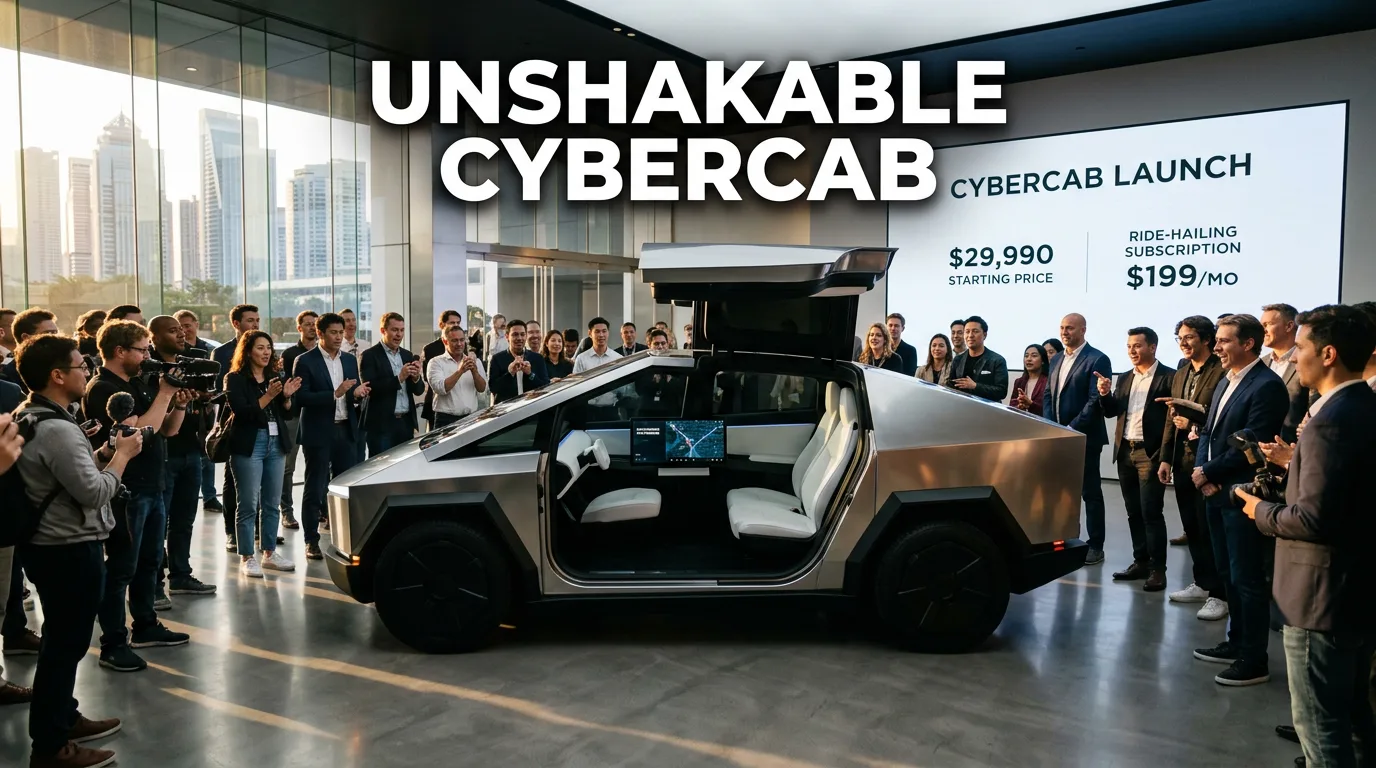
Inside, there are only two seats and a large touchscreen, with no place for a steering wheel.
This is not simply a design change.
It means that electric vehicles, autonomous vehicles, and robotaxis are merging into one trend in the electric vehicle market.
Vehicles are now shifting from “machines driven by people” to “platforms in which AI takes responsibility for mobility.”
2. The Price Is $29,990… But the Real Perceived Cost Is Higher
The official vehicle price is $29,990.
It appears to be a price deliberately set below $30,000 psychologically, aiming for both a mass-market image and accessibility.
However, the actual purchase cost does not end there.
The Autonomy subscription costs $299 per month, and although the first month is included, monthly costs apply afterward.
In addition, a non-refundable deposit of $1,000 is required when placing an order.
In other words, on the surface, it is a “vehicle in the $30,000 range,” but in reality, it is closer to an AI subscription-based mobility service structure.
The reason this is important is that the revenue model of the automobile industry is shifting from vehicle sales to recurring subscriptions.
In the future, autonomous driving software, subscription fees, and service operating costs may become bigger variables than the vehicle price itself.
3. Delivery Is Scheduled for December 2026… Tesla Is Pushing Its Year-End Target
The expected delivery timing is December 2026.
The first delivery location has been presented as Austin, Texas.
Considering that neither the price nor the order schedule had been disclosed at the previous earnings announcement, Tesla has moved into the sales stage in just a few weeks.
This can be interpreted as a move by Tesla to somehow keep its year-end delivery promise.
However, the important question here is whether mass production is truly possible.
Autonomous driving is not simply a matter of building a car; software stability, local regulations, insurance systems, and accident liability structures must all be aligned.
Therefore, this announcement is both a manufacturing event and a regulatory test.
4. Is Sales in Korea Possible? For Now, It Is Still Close to Impossible
To state the conclusion first, Tesla has not officially announced a launch in Korea.
The current sales target is limited to selected invited customers in Austin, United States.
The biggest reason sales in Korea would be difficult is safety standards.
To register as a regular vehicle on Korean roads, it must meet safety standards and have a structure that allows a person to drive directly.
However, because the Cybercab was designed from the beginning as a vehicle without a steering wheel, it is highly likely to conflict with the existing vehicle certification system.
In other words, entering Korea may require a separate certification process or regulatory exception.
This is not an issue that can be resolved simply by saying, “It is an American car, so it can enter under the FTA.”
The core issue is safety certification rather than tariffs.
That said, the possibility is not completely closed.
If Tesla later introduces a version with a steering wheel and pedals, or a modified model that complies with Korean regulations, the situation could change.
In that case, there may be room to use the existing pathway through which American-made electric vehicles enter the Korean market.
In other words, the key to entering the Korean market is not the FTA, but whether the vehicle form can be adapted to Korean regulations.
5. The Real Reason This Announcement Matters: Tesla Is Moving From an “Automobile Company” to an “AI Mobility Platform Company”
Many news reports only discuss the price, delivery timing, and whether it will be sold in Korea.
But what matters more is the change in Tesla’s business structure.
This Cybercab is not simply a new car.
It is a product that combines AI-driven mobility services, subscription-based software, data-based operations, and robotaxi infrastructure all at once.
This means that Tesla’s future revenue could come more from services than from vehicle sales.
The following three points are especially important.
First, the performance of autonomous driving AI will determine product competitiveness.
Second, software updates and subscription models will determine profitability more than the vehicle itself.
Third, if robotaxis and personal sales operate simultaneously, the mobility market itself could be reorganized.
6. Points to Watch From a Global Economic Perspective
This announcement does not end as news about just one company, Tesla.
It must also be viewed together with global economic trends and the flow of the Fourth Industrial Revolution.
The first point is the restructuring of the electric vehicle industry.
In the electric vehicle market, it is now difficult to differentiate through battery price competition alone.
Going forward, AI autonomous driving, user experience, and data-learning capabilities will become key competitive strengths.
The second point is the spread of the subscription economy.
Automobiles are also shifting into a structure in which users pay a monthly subscription fee after purchase.
This trend is connected to software, cloud, and AI service industries as a whole.
The third point is that the boundary between manufacturing and services is becoming blurred.
Tesla is becoming a company that sells cars and, at the same time, sells AI services.
This change is a factor that could lead global stock markets to reassess technology stock valuations.
7. The Most Important Point That Other News Reports Often Miss
The most important but surprisingly under-discussed point is that this announcement signals the opening of the “legal era of autonomous driving.”
The fact that a vehicle without a steering wheel has appeared on the personal sales list means that regulations must now catch up with reality faster than technology itself.
In other words, autonomous vehicles are no longer just about performance competition.
Road laws, insurance systems, accident liability, and operating permit frameworks in each country must change at the same time.
Another point is that the operating structure matters more than the price.
For a vehicle that is not driven by a human, the key question is “who is responsible?”
If an accident occurs, the more important question becomes whether responsibility lies with the driver, the manufacturer, or the software.
If this issue is not resolved, commercialization in a conservative regulatory environment like Korea will inevitably be delayed.
Finally, this announcement is a declaration that robotaxis are no longer a future forecast, but have entered the execution stage.
Tesla has now changed the message from “someday” to “we will sell it now.”
Summary: Checkpoints to Watch Going Forward
From now on, the following four points should continue to be monitored.
First, how far the geofenced area within Austin extends.
Second, whether the actual delivery schedule remains set for December 2026.
Third, whether additional plans for overseas launches, including Korea, are announced.
Fourth, whether a separate regulatory-compliant variant appears instead of the steering-wheel-free model.
Depending on these four factors, the Cybercab could become either a simple experiment or the benchmark for the global autonomous driving market.
< Summary >
Tesla has begun personal sales of the Cybercab, which has no steering wheel or pedals.
The price is $29,990, and the Autonomy subscription costs $299 per month.
The first delivery is scheduled for December 2026, with the location being Austin, United States.
There is still no Korean launch, and safety certification and regulations are the biggest variables.
This announcement should be seen as a turning point for AI autonomous driving and the robotaxi market beyond electric vehicles.
[Related Articles…]
Robotaxi Market Trends Reshaping the Future of Mobility
Autonomous Driving Competition and the 2026 Global Industry Shift
*Source: 테찬 Tslachan