● AI Memory Bottleneck War
The Real Meaning of Musk’s “Memory Bottleneck”: The AI semiconductor war is shifting from GPUs to a battle over memory, power, and cloud cash flow
The most important point in this issue is not simply “Elon Musk is building a semiconductor plant.”
The core point is that the bottleneck in the AI industry is rapidly moving from GPUs to memory semiconductors, power infrastructure, data center investment, and cloud infrastructure monetization.
In the original text, the focus is on Musk pushing ahead with his own semiconductor plant, called “Terafab,” and saying that memory will become AI’s biggest bottleneck over the next 10 years.
However, what matters here is that some figures, SpaceX’s listing, earnings announcements, and the scale of Terafab are claims that need to be officially verified.
So rather than following the original text exactly, this article will organize the issue from the perspective of the global economic outlook and the AI semiconductor industry, focusing on why this claim matters to the market.
1. Key News Summary: What Musk is targeting is not a semiconductor plant, but an AI infrastructure empire
The core claim in the original text is that Musk is pushing forward with a massive in-house semiconductor production facility, the so-called “Terafab,” near Houston, Texas.
The facility is described as being much larger than Tesla’s existing Gigafactories, and as a giant AI infrastructure hub connecting semiconductor production, data centers, autonomous driving, Optimus robots, and xAI model training.
What matters here is not the “size of the factory,” but “why Musk wants to build it himself.”
According to the original text, Musk believes that external foundries and memory supply chains alone cannot meet the AI computing demand he wants.
In other words, to connect Tesla’s autonomous driving, Optimus robots, xAI’s Grok, and SpaceX’s communications and space infrastructure, simply buying GPUs is not enough.
This signals that the AI semiconductor market is shifting from a simple chip competition to a vertically integrated competition to control the entire supply chain.
2. The Most Important Sentence: “Memory will be the key bottleneck over the next 10 years”
The most important sentence in the original text is Musk’s statement that “memory will be the next core bottleneck over the next 10 years.”
In the early stages of the AI investment cycle, NVIDIA GPUs were the main bottleneck.
But the situation is changing now.
Training and inferencing large-scale AI models requires not only GPUs, but also HBM, DRAM, NAND, networking equipment, power, cooling, and data center land.
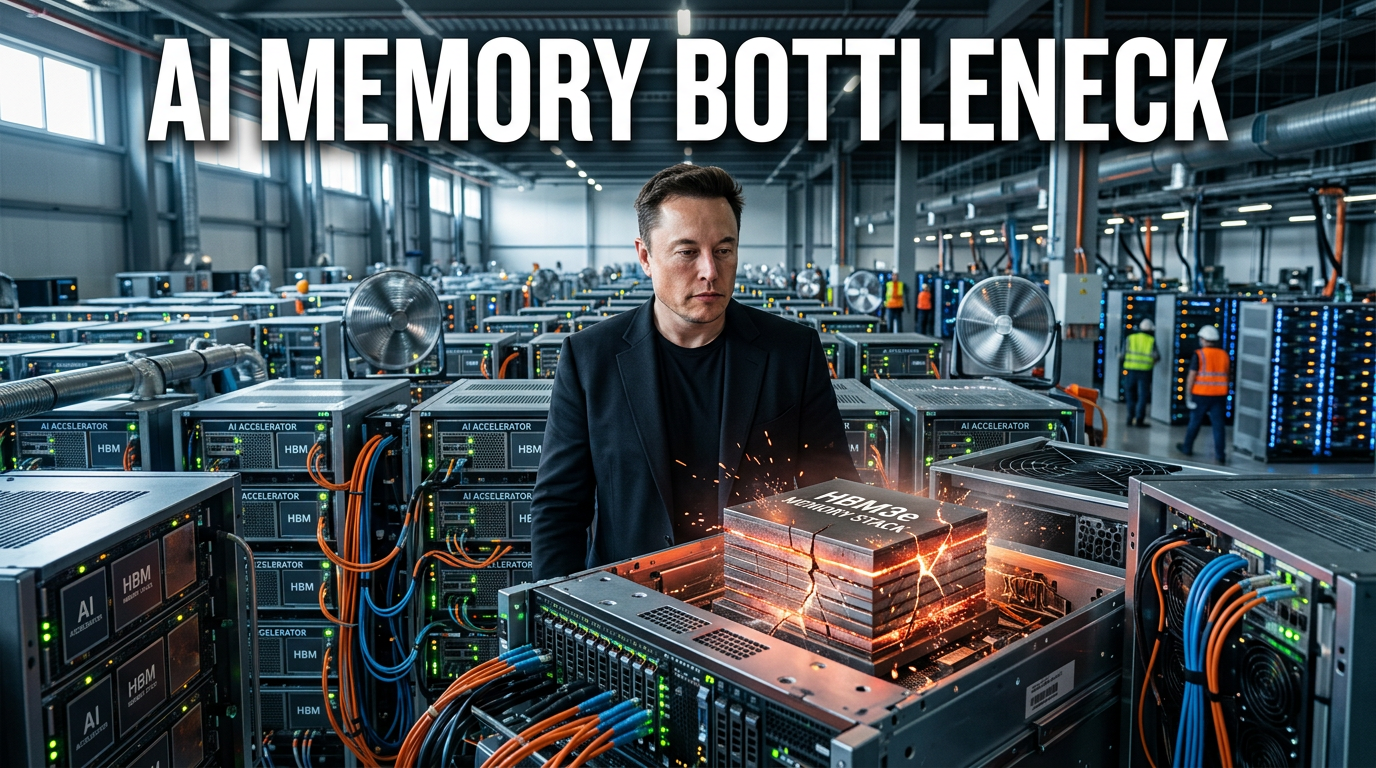
In particular, HBM is the core memory attached to GPUs that determines AI computing speed.
No matter how good a GPU is, if it cannot be fed data quickly, computing efficiency drops.
That is why the AI semiconductor bottleneck is moving from “GPU shortages” to “high-bandwidth memory shortages.”
This is the background behind the rising strategic value of memory semiconductor companies such as SK hynix, Samsung Electronics, and Micron.
From the global economic outlook perspective, rising memory prices can lead to higher data center costs, cloud service price adjustments, and increased cost pressure on AI startups.
3. Why would Musk want to make semiconductors himself?
Musk’s strategy always looks similar.
If the supply chain becomes a bottleneck, he moves in directly.
Just as Tesla vertically integrated batteries, charging networks, software, and vehicle production, in the AI era he may move toward directly controlling semiconductors and even data centers.
The original text explains that even the production capacity of TSMC, the world’s largest foundry, can only meet part of the semiconductor demand Musk needs.
This figure requires official verification, but the overall direction is still quite convincing.
Major AI tech companies are already developing their own chips.
Google uses TPU, Amazon is scaling Trainium and Inferentia, and Microsoft and Meta are also speeding up their own AI chip development.
From Musk’s perspective, it is difficult to rely only on NVIDIA to support Tesla, xAI, SpaceX, Starlink, and Optimus.
But there is an important difference here.
According to the original text, Musk is said to prefer NVIDIA’s Blackwell and Vera Rubin lineup over Google TPU or AWS in-house chips.
If that is true, Musk’s strategy is closer to “use NVIDIA for GPUs in the near term, but seize control of the long-term bottlenecks in memory and infrastructure.”
4. The Real Meaning of Terafab: More than a semiconductor plant, it is an “AI data center economic zone”
In the original text, Terafab is described as being 10 times the size of an existing Gigafactory.
It is even compared to a massive artificial structure on the scale of the Pentagon or Apple Park.
These scale descriptions may be exaggerated, but the market should focus on something else.
If Musk really pushes ahead with a massive semiconductor and data center complex, it would not be just a manufacturing facility.
It would likely become an AI infrastructure platform combining AI model training, inference services, robot data processing, autonomous driving data analysis, and cloud rental business.
In other words, what Musk wants is not merely a Samsung-style model of making money by selling semiconductors.
It is a structure that produces computing power, uses it internally, rents out excess capacity to others, and uses that cash flow to build even larger AI infrastructure.
This is similar to the direction taken by Amazon AWS, Microsoft Azure, and Google Cloud.
The difference in Musk’s case is that physical AI is layered on top of it.
Autonomous vehicles, robots, satellite communications, space infrastructure, AI models, and cloud infrastructure can all be tied together into one ecosystem.
5. Claims related to SpaceX must be separated carefully
In the original text, there is content saying that SpaceX recently went public, and that revenue and operating profit exceeded expectations in an earnings release, but the stock price fell.
However, by generally known standards, SpaceX is not a publicly listed company, and it does not disclose quarterly earnings like a regular listed firm.
Therefore, it is safer to view this as either a private investor materials reference or a hypothetical analysis scenario rather than an official earnings announcement from a listed company.
In particular, a figure like “$350 billion in AI investment in 2027” could have an enormous impact on the market, so it needs official filings or reliable source verification.
That said, whether the claim is true or not, the direction aligns with current big tech capital expenditure trends.
Microsoft, Amazon, Google, and Meta are all sharply increasing their AI data center investments.
The AI infrastructure race has already become the center of the global capital expenditure cycle.
So investors should look not at “how much Musk actually spends,” but at “how far the competition in AI data center investment expands.”
6. Why the reported 6GW purchase plan for NVIDIA Vera Rubin matters
The original text says Musk aims to build future data centers based on NVIDIA Vera Rubin and secure computing infrastructure of 6GW or more.
6GW is a massive power scale that goes far beyond ordinary corporate data center investment.
At that scale, it is not just a matter of buying GPUs.
It also requires grid connections, substations, cooling facilities, land acquisition, memory supply, network switches, optical modules, and security infrastructure.
The most underestimated part of AI data center investment is power.
GPUs can be ordered with money, but power infrastructure cannot be created overnight.
Power permitting, transmission expansion, cooling water access, and community negotiations all take time.
That is why the winners in the AI industry are likely to be determined not just by who has the best model, but by who secures connected computing power the fastest.
7. Why has GPU leasing become a “gold mine”?
An interesting part of the original text is the claim that Musk is leasing GPU computing power to outside companies at a high price.
Right now, AI startups and big tech companies are desperately racing to secure large-scale GPU clusters.
Training AI models requires thousands to tens of thousands of GPUs, and newer models require even more compute.
But the supply of the latest GPU clusters with connected power is limited.
In such an environment, companies that own GPUs can operate a cloud-like leasing business.
The original text describes Musk as using only part of the total computing power for his own model training, and selling the rest to external customers.
This strategy is extremely attractive in practical terms.
AI infrastructure capex is large, but when demand is strong, GPU rental rates can stay high and shorten the payback period.
Of course, “recouping investment in one year” is a somewhat aggressive claim.
But if there is a payback window within two to three years, AI data centers become a very powerful cash-generating business for big tech.
8. What Musk really wants to do: cloud business, not rockets
The core interpretation of the original text is fairly clear.
What Musk may most urgently want to do right now is not space business itself, but AI cloud infrastructure business.
SpaceX rockets are a means of building space infrastructure over the long term.
Starlink is a global communications network.
Tesla is a machine that produces physical AI data.
Optimus is an AI robot that moves in the real world.
xAI is an AI model.
To connect all of these, a massive computing infrastructure is ultimately needed.
And that infrastructure can be used not only for training its own AI models, but also sold to outside companies.
In the end, the structure Musk is targeting is an integrated platform of “AI model + data center + cloud + robots + autonomous driving + satellite communications.”
If this becomes reality, it could become a new type of AI cloud company competing with Amazon, Microsoft, and Google.
9. The most important point that other news does not emphasize enough
Most news stories only say things like “Musk is building a semiconductor plant,” “he is buying NVIDIA GPUs,” or “AI investment is increasing.”
But the truly important point is that the profit structure of the AI industry is changing.
First, AI models themselves are likely to enter a period of price competition.
As Claude, GPT, Grok, Gemini, and Chinese models compete on performance, API prices could decline over the long term.
Second, computing infrastructure could become even scarcer.
That is because the latest GPUs, HBM, power, and data center land are limited.
Third, the companies that make money may ultimately not be only those that build the best models, but also those that own the infrastructure capable of running AI.
Fourth, memory semiconductors may emerge as the area with the strongest pricing power in this infrastructure value chain.
Fifth, AI cloud infrastructure could create a new global capex cycle in the future economy.
In other words, this issue should be seen not as Elon Musk’s personal eccentricity, but as a signal that the means of production in the AI era are shifting toward data centers and memory semiconductors.
10. Industry Impact Summary
NVIDIA remains at the center of the AI computing market.
If Musk actually adopts the Vera Rubin lineup on a large scale, NVIDIA’s long-term demand visibility could become even stronger.
However, NVIDIA’s biggest risk is the trend of customers simultaneously building their own chips and their own infrastructure.
Memory semiconductor companies are the top candidates to benefit from the shift in AI bottlenecks.
As HBM supply tightens, the bargaining power of SK hynix, Samsung Electronics, and Micron may strengthen.
In particular, memory for AI servers has higher profitability than standard PC or mobile memory, so the earnings leverage is large.
Foundry companies are likely to continue to revolve around TSMC.
That said, increased semiconductor manufacturing in the United States, geopolitical risks, and big tech’s attempts at in-house production remain long-term variables.
Power and infrastructure companies are the hidden beneficiaries of expanded AI data center investment.
This connects to transformers, power equipment, cooling systems, grid infrastructure, and even nuclear, gas, and renewable energy infrastructure.
Cloud companies now need to balance AI investment burdens with monetization speed.
If AI data center investment grows too quickly, depreciation burden rises; if demand is sufficient, long-term cash flow strengthens.
11. Investor Checkpoints
First, investors should watch whether AI semiconductor demand expands from GPUs to HBM and memory as a whole.
Second, they should check whether big tech’s data center investment growth rate is excessively faster than revenue growth.
Third, they should see whether the value gap between data centers that can secure power and those that cannot is widening.
Fourth, they should track whether GPU rental prices remain at peak levels or fall as supply increases.
Fifth, they should confirm whether the relative value of infrastructure companies rises as AI model price competition intensifies.
Sixth, Terafab, space data centers, and SpaceX investment plans related to Musk must be carefully distinguished from official materials and unofficial rumors.
Especially in cases like this original text, where the numbers are very large, it is necessary to check official announcements, regulatory filings, and highly reliable media reports before making investment decisions.
12. Conclusion: The next round of the AI war is memory and power
If we summarize this issue in one line, the bottleneck in the AI industry can no longer be explained by GPUs alone.
As AI models grow larger, memory semiconductors, power, data centers, networking, and cooling infrastructure all become bottlenecks.
Whether or not Musk actually pushes ahead with Terafab, the direction he described as a “memory bottleneck” is extremely important.
Looking ahead in the global economic outlook, AI data center investment is likely to become not just a technology story, but a key variable that moves capex, power demand, the semiconductor cycle, and cloud profitability.
Ultimately, the winners of the AI era may not be the companies with the smartest models, but the companies with the infrastructure to run those models more cheaply and more quickly.
So what we need to watch now is not only “who built the best AI model,” but also “who secured the memory and the power.”
< Summary >
The claims related to Musk’s Terafab require some official verification, but the core message is clear.
The bottleneck in the AI industry is moving from GPUs to memory semiconductors, power, and data center infrastructure.
NVIDIA remains central, but the importance of memory companies supplying HBM and DRAM is growing even more.
AI data centers are becoming a core capex area for big tech and the foundation of cloud monetization.
What Musk is targeting is likely not a simple semiconductor plant, but a vast AI infrastructure ecosystem tying together AI models, cloud, robots, autonomous driving, and satellite communications.
Investors should care more about memory supply, power access, data center investment, and changes in GPU rental profitability than about the Terafab rumor itself.
[Related Articles…]
AI Semiconductor Bottlenecks and the Outlook for the Memory Supercycle
Global Data Center Investment and Cloud Infrastructure Competition
*Source: [ 월텍남 – 월스트리트 테크남 ]
– 머스크 “메모리가 가장 병목이���”..내가 직접 테라팹에서 만들겠다