● Musk Empire Shockwave, Tesla Surges, SpaceX Dominates AI, Starlink Threatens Telecoms
Tesla’s 1 trillion KRW solar factory announcement is less important than the fact that SpaceX appears set to absorb 75% of the AI infrastructure capacity
The key issue in this event is not simply whether Tesla’s stock has recovered to $328.
The real point is that Tesla is moving ahead with a solar cell factory in Texas valued at roughly 10 trillion KRW, while the larger share of the associated AI semiconductor project appears to be allocated to SpaceX.
This is unfolding alongside weaker U.S. employment data, growing expectations for Fed rate cuts, Starlink’s entry into the telecom market, and renewed speculation about a Tesla-SpaceX merger.
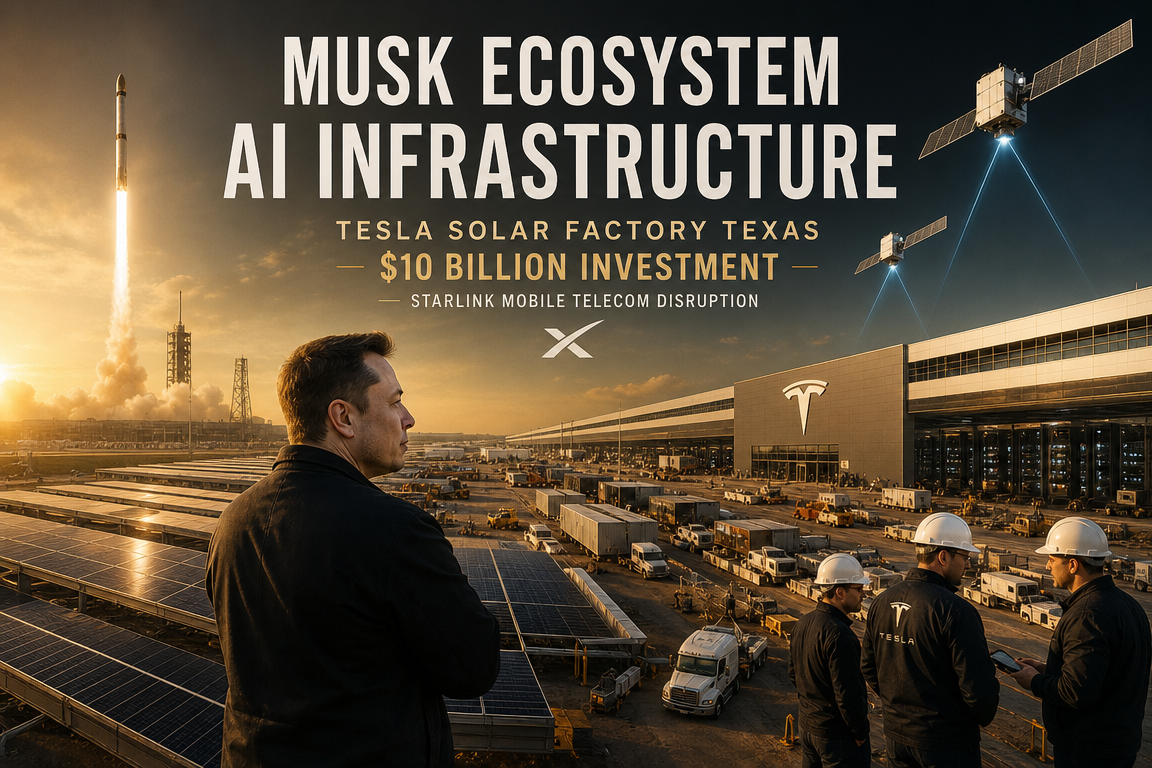
On the surface, this appears to be an investment in Tesla Energy. In practice, it is becoming a broader Musk ecosystem linking Tesla, SpaceX, Starlink, Optimus, AI semiconductors, and energy infrastructure.
1. Market backdrop: Tesla’s stock gain is supported by rate-cut expectations
In the source material, Tesla rose 2.83% to $328.58.
The SpaceX-related asset price cited in the source increased more than 15% to $133.11.
However, SpaceX is not a listed company on Nasdaq.
Accordingly, any SpaceX price move should be treated separately as a private-market transaction, derivative-linked product, or a price quoted on an alternative trading venue.
U.S. July employment data came in materially weaker than expected.
The market had expected payroll growth of 85,000, but the actual figure was a decline of 23,000.
June payrolls were also revised sharply lower, from a gain of 57,000 to 20,000.
The unemployment rate eased from 4.2% to 4.1%, but the overall message was that the U.S. labor market is clearly cooling.
Normally, weaker employment data can increase recession concerns and pressure equities.
In this case, the market response was different.
Investors interpreted the slowdown as strengthening the case for Fed rate cuts.
After the release, the U.S. 10-year Treasury yield declined and the dollar index weakened.
This supported risk appetite and created a favorable backdrop for Tesla and other growth stocks tied to AI.
2. Tesla’s 10 trillion KRW solar plant: a vertically integrated manufacturing facility, not a simple assembly line
Tesla reportedly filed plans for a solar cell manufacturing plant in Fort Bend County, Texas, with a project value of $10.1 billion.
That amounts to more than 10 trillion KRW.
The internal project name is said to be “Crystal Sun.”
The site is described as being about 40 minutes by car from Houston.
The schedule reportedly targets construction this year, completion in 2028, and commercial operations in the first quarter of 2029.
The facility is said to create around 9,000 jobs.
This scale suggests a project with implications for Texas manufacturing and the energy supply chain, rather than a secondary production site.
The equipment listed in the filing indicates a broader scope.
It includes wafer manufacturing equipment, ingot manufacturing equipment, coating systems, metallization lines, printing lines, cell testing equipment, and a clean room.
In other words, this is not a facility that merely assembles finished panels.
It resembles a vertically integrated model that processes materials from input to finished solar cell production inside one plant.
Although solar cells may appear simpler than EVs, the manufacturing process has a number of similarities to semiconductor production.
Silicon wafers must be coated with thin films, circuits formed, and electrical efficiency controlled.
A clean room is required because even a single particle of dust can reduce performance.
Tesla’s pursuit of this factory signals an effort to make energy a manufacturing-based business, not just a sales-driven one.
3. Tesla Energy’s real direction: moving from an EV company toward an energy infrastructure company
Tesla has already been recognized as a growth company in the EV market.
However, recent quarterly trends suggest that Tesla Energy may be growing faster than the automotive business in certain periods.
Megapack, Powerwall, solar products, and battery storage are emerging as the next growth drivers.
This solar cell factory could reshape Tesla Energy’s cost structure.
Increasing internal production rather than sourcing panels externally could reduce supply chain risk.
U.S.-based production could also improve access to policy support, lower logistics costs, and strengthen supply stability.
Tesla is also emphasizing expanded battery recycling.
It said its U.S. battery recycling facilities recover more than 90% of key materials such as nickel and cobalt.
Used battery packs are sent to dedicated facilities in Nevada and Texas, disassembled, and the recovered materials are reintroduced into the battery supply chain.
Last year, the two facilities reportedly recycled about 14,000 tons of battery materials.
That was described as equivalent to the battery content of roughly 9,000 Model Y rear-wheel-drive vehicles.
Tesla has stated a long-term target of raising recycled battery output to a level comparable with North American lithium mining by 2030.
This matters because the battery supply chain is ultimately exposed to raw material pricing and sourcing stability.
If lithium, nickel, and cobalt prices fluctuate, both EV profitability and energy storage costs are affected.
Higher recycling penetration could help Tesla absorb some of that input-price volatility.
Over the long term, this may also support operating margin resilience.
4. The larger issue is the Terra project: a joint Tesla-SpaceX AI semiconductor factory
The most complex and important part of the report is the Terra project.
In the source, it is described as a large-scale AI semiconductor factory jointly developed by Tesla and SpaceX.
Elon Musk is said to have stated that the facility could deliver more than 1 TW of annual AI compute capacity once completed.
The key point is that this is not a standard semiconductor plant.
It appears to be an AI-computing infrastructure base that could support Optimus robots, AI satellites, autonomous driving, data centers, and Starlink.
For Tesla, it would secure computing resources for Optimus and robotaxi development.
For SpaceX, it could become a core infrastructure layer for AI-enabled orbital satellite networks.
A particularly notable detail in the source is the allocation of AI compute output.
Elon Musk reportedly indicated that roughly 25% would be used for Tesla Optimus and 75% for AI orbital satellites.
If accurate, that would suggest SpaceX may benefit more than Tesla from a facility jointly built by the two companies.
That said, 25% is still a meaningful share.
But given that Optimus is viewed as a core driver of Tesla’s future valuation, allocating only one-quarter of total compute capacity raises questions for Tesla shareholders.
The issue is not yet clear because the cost-sharing structure has not been disclosed.
5. AI semiconductor bottlenecks: an attempt to bypass ASML-style constraints
The Terra project video reportedly showed a circular structure, which led to various technical interpretations.
Some users asked whether it could be related to a free-electron laser lithography tool or an accelerator-based facility.
According to the source, Elon Musk gave a brief response with a positive tone.
One of the major bottlenecks in leading-edge semiconductor production is lithography equipment.
ASML’s EUV tools in particular remain the dominant solution, but global supply is limited.
Annual production is estimated at only 60 to 80 units, making it difficult to meet surging AI chip demand.
If Musk is attempting to develop a method that bypasses the ASML-centered bottleneck, this would represent more than a factory investment; it would be an effort to challenge the existing semiconductor manufacturing paradigm.
However, this has not been confirmed through an official technical announcement by Tesla or SpaceX.
For investors, the relevant distinction is between innovation potential and execution risk.
6. Terra project cost structure: the most important issue remains undisclosed
The source cites a first-phase Terra investment of $16.8 billion.
Initial estimates ranged from $20 billion to $25 billion, and at one point the target was described as a $55 billion SpaceX-only investment.
Even the currently cited first-phase amount is substantial.
The problem is that the cost-sharing structure has not been disclosed.
The compute allocation appears to favor Tesla at 25% and SpaceX at 75%, but it is unclear how the capital burden is divided.
That is the issue other coverage tends to underemphasize.
For Tesla shareholders, the key question is straightforward.
If Tesla bears 50% of the cost but receives only 25% of the benefit, is that acceptable?
Conversely, if Tesla bears only 25% of the cost, the arrangement may be more defensible.
At present, the lack of disclosure could create a governance discount in Tesla’s valuation over time.
7. Why build a solar factory while the Terra project is powered by natural gas?
At first glance, the strategy appears inconsistent.
Tesla is building a 10 trillion KRW solar cell factory in Texas.
At the same time, the Terra project in Texas reportedly plans to rely on its own natural gas power generation rather than the local grid.
SpaceX is said to plan $2.8 billion in gas turbine spending over the next three years.
The source also says the company acquired a natural gas generation specialist.
xAI’s Memphis data center is also described as using natural gas.
This should not be viewed only as a contradiction between clean energy and fossil fuel use.
The solar factory is a manufacturing facility for energy products.
By contrast, a semiconductor or AI compute facility requires highly stable, 24-hour baseload power.
Solar power alone cannot reliably support that type of load because output depends on time of day and weather conditions.
In that sense, Tesla’s solar factory is aimed at strengthening the energy product supply chain, while Terra’s gas-fired power is aimed at securing baseload power for AI semiconductor production.
The energy strategies differ because the underlying use cases differ.
8. Tesla-SpaceX merger speculation is now treated as a market scenario
Market participants increasingly discuss a possible Tesla-SpaceX merger.
According to the source, RBC argued that a merger could be strategically rational given the extent to which the two companies are already linked through projects such as Terra.
During Tesla’s earnings call, a Wells Fargo analyst also directly asked Elon Musk about merger potential.
Musk said Tesla and SpaceX already collaborate extensively.
He added that such a matter could not be announced on the spot and would require the proper process.
The important point is that he did not directly reject the possibility.
Gene Munster reportedly placed the probability as high as 90%.
Dan Ives of Wedbush was also cited as seeing a high likelihood of a merger within a year.
These are analyst views, however, not an official announcement.
The Wall Street Journal was cited as reporting that Tesla had considered separating its China business.
Some interpreted that as preparatory work ahead of a potential merger.
Musk, however, reportedly denied the report.
9. Combined investment scale of about $49.3 billion: the Musk ecosystem is absorbing substantial capital
If the investment figures cited in the source are combined, the total is substantial.
Tesla solar cell factory: $10.1 billion.
Terra first phase: $16.8 billion.
Gas turbine spending: $2.8 billion.
SpaceX spectrum acquisition costs: $19.6 billion.
The total comes to roughly $49.3 billion.
That is a large amount even for a single company, and it is being deployed across a structure that links Tesla, SpaceX, Starlink, and xAI.
This is no longer a conventional new-business expansion. It resembles an AI infrastructure race.
For investors, the key question is not whether the vision is compelling.
The question is who is funding it, who captures the economic returns, and which shareholders bear the greatest risk.
Tesla shareholders in particular should monitor whether Tesla’s cash flow is being used to support expansion across the broader Musk ecosystem.
10. Starlink mobile: if successful, SpaceX becomes a telecom company as well as a launch company
SpaceX’s main revenue source is no longer limited to rocket launches.
Starlink has become a major contributor to SpaceX’s business.
In the source, quarterly revenue of $7.8 billion was said to be driven substantially by Starlink, with 12 million subscribers.
SpaceX also reportedly formalized plans for Starlink mobile, which would deliver cellular service directly from satellites.
The source suggests satellite launches next year and service launch around late 2027.
SpaceX reportedly believes it could attract a significant share of customers from AT&T, Verizon, and T-Mobile.
This announcement reportedly weighed on telecom equities.
However, incumbent carriers argue that the threat is overstated.
The CEO of T-Mobile reportedly said he does not see what consumer problem the satellite carrier is trying to solve.
Technically, significant gaps remain.
The source says Starlink’s terrestrial spectrum is only about 5 MHz.
That compares with roughly 1,000 MHz held by major telecom carriers, a substantial difference.
As a result, some analysts remain skeptical that Starlink can compete directly with incumbents over the next five years.
Price may still be the key variable.
If Starlink mobile is priced well below conventional mobile plans, the market dynamic could change.
It may not fully replace premium urban wireless networks, but it could become a strong alternative in rural areas, maritime and aviation use cases, lower-income markets, and emergency communications.
In that case, SpaceX could be revalued as a global communications infrastructure company rather than only a rocket company.
11. Key checkpoints for Tesla shareholders at $328
First, Tesla’s 10 trillion KRW solar plant is a positive long-term development.
It supports energy business vertical integration, battery supply chain stability, and potential cost reductions for Megapack and Powerwall.
Second, the Terra project combines high upside with high uncertainty.
The vision of linking AI semiconductors, Optimus, autonomous driving, and satellite networks is attractive.
However, if cost-sharing and compute allocation remain unclear, the project may create governance concerns for Tesla shareholders.
Third, Tesla-SpaceX merger speculation can no longer be dismissed.
The two companies are becoming increasingly connected through projects, power infrastructure, AI computing, and satellite networks.
Even if a merger occurs, the key issue is whether the terms are favorable to Tesla shareholders or to SpaceX shareholders.
Fourth, Starlink mobile could be a major catalyst for the merger narrative.
If Starlink succeeds in entering telecom markets, SpaceX’s cash flow and valuation profile could change materially.
If technical limits become more visible, market expectations could be revised downward.
Fifth, expectations for U.S. rate cuts may support Tesla in the short term.
But rate-cut expectations alone do not explain the economics of large-scale capital investment.
In the long run, Tesla’s stock will depend on EV market share, energy growth, AI chip access, Optimus commercialization, and robotaxi execution.
12. The most important point other coverage often misses
The core of this story is not simply that Tesla is building a solar factory.
The real issue is whether Tesla becomes a funding anchor for a broader Musk ecosystem that spans AI infrastructure, energy manufacturing, battery recycling, semiconductor production, and satellite communications.
Tesla’s $10 billion investment in energy manufacturing is understandable.
But if 75% of Terra’s AI compute capacity is directed toward SpaceX’s orbital satellite network, Tesla shareholders should ask how far their company’s capital is being used beyond Tesla itself.
The merger discussion follows the same logic.
A combined Tesla-SpaceX structure could enlarge the strategic vision.
However, a larger vision does not automatically benefit Tesla’s current shareholders.
The merger ratio, asset valuation, debt structure, cash flow, regulatory risk, and the treatment of the China business all matter.
Two issues now stand out.
First, whether the Terra project’s cost-sharing structure is disclosed transparently.
Second, whether Starlink mobile can materially challenge the telecom industry’s revenue model.
Until those two points are clarified, the appropriate view is that the market is in a phase of both expectation and risk.
< Summary >
Tesla is pursuing a solar cell factory in Texas valued at about $10.1 billion.
The project is structured as a vertically integrated manufacturing facility with wafer, ingot, coating, testing, and clean-room capabilities.
This is positive for Tesla Energy and battery supply chain stability.
However, the more important issue is the Terra AI semiconductor project jointly linked to Tesla and SpaceX.
In the source, 25% of the AI compute capacity is said to be allocated to Tesla Optimus and 75% to SpaceX’s AI orbital satellite network.
Because the cost-sharing structure has not been disclosed, this remains a key risk for Tesla shareholders.
If Starlink mobile succeeds, SpaceX could be revalued as a global communications infrastructure company rather than only a launch provider.
Tesla-SpaceX merger speculation is gaining traction, but the implications for shareholder value depend on the terms.
The main checkpoints ahead are disclosure of Terra’s cost structure and the commercial competitiveness of Starlink mobile.
[Related Articles…]
- Tesla AI Semiconductor Investment and Stock Outlook
- How Starlink Satellite Communications Could Reshape Global Telecom
*Source: [ 오늘의 테슬라 뉴스 ]
– 테슬라가 10조 쓰는 날 정작 스페이스X가 다 가져간다? — 힘 받는 합병론까지, $328 테슬라 주주는?
● Global Power Struggle, AI Drone War, Supply Chain Shock
The Real Nature of the U.S.-China Strategic Rivalry: De-Globalization, AI Drone Warfare, and Supply Chain Restructuring Are Reshaping the Korean Economy
The core issue is not simply whether the United States or China is stronger.
The current shift reflects a broader realignment in which U.S.-China strategic rivalry, protectionism, supply chain restructuring, erosion of dollar dominance, and rising power demand from AI data centers are converging.
The Russia-Ukraine war and conflicts in the Middle East should also be viewed as geopolitical shocks emerging from the breakdown of globalization.
For Korea, the more important question is not whether it aligns with the United States or China, but which industries will remain competitive and which supply chains will lose relevance as globalization weakens.
1. Has Globalization Failed? Korea Was a Winner, but There Is No Guarantee in the Next Era
Over the past 30 years, Korea has been one of the major beneficiaries of globalization.
After China joined the WTO, global trade expanded rapidly, and Korea benefited from China’s strong growth, generating large trade surpluses.
In practical terms, Korean manufacturing benefited from China’s growth engine and expanded alongside it.
However, globalization also created clear losers.
U.S. manufacturing workers lost jobs as factories moved offshore.
Countries such as Malaysia and Indonesia, which once appeared to be catching up with Korea, also failed to escape the middle-income trap.
Globalization was not a system that distributed benefits evenly.
The issue now is that globalization is gradually ending.
Korea was a winner in the globalization era, but it is not yet certain whether it can remain a winner in the post-globalization era.
Korean firms that once transferred technology and built plants in China now face direct competition from Chinese companies.
In some sectors, Chinese firms are moving faster, at lower cost, and with greater flexibility.
2. The Paradox of Globalization: War Undermines Globalization, Yet War Still Depends on It
The Russia-Ukraine war appears to be a clear example of the end of globalization.
Yet the reality on the battlefield shows a different paradox.
Analyses indicate that a significant share of drone components used by both Ukraine and Russia are made in China.
In other words, war disrupts globalization, but global supply chains remain necessary to conduct war.
The side that secures more Chinese-made components gains an advantage on the battlefield.
This is one of the key contradictions in the current global economy.
Even as de-globalization advances, core components, raw materials, semiconductors, batteries, drones, and AI equipment still depend on global supply networks.
From this perspective, supply chain restructuring is not merely about shifting factories to the United States or reducing dependence on China.
It has become a national survival strategy that links war, security, industrial policy, trade, and finance.
3. AI Drone Warfare: Lower Costs Make War Easier
One of the most important themes is AI-enabled drone warfare.
In the past, war required large-scale deployment of personnel and equipment, imposing heavy political and human costs on leaders.
With drones and AI, the entry barrier to conflict is falling.
Attacks can be conducted remotely, and low-cost drones can damage high-value assets.
This shift may contribute to the normalization of war.
If political leaders face lower human-cost constraints, military action may become easier to initiate.
Drone technology originally evolved for civilian uses such as imaging, logistics, and industrial inspection, but it is now becoming a central military tool.
As with dynamite, which began as an industrial technology before becoming a military one, AI and drones are following a similar path.
This is a critical downside that must be considered when assessing AI trends.
AI is both a productivity-enhancing technology and one that is reshaping military power.
4. AI Data Centers and the Power Constraint: The Era of Energy Competition, Not Just Green Transition
AI expansion is creating another structural contradiction.
While the world has discussed carbon neutrality and clean energy, competition in AI data centers is driving substantial electricity demand.
As generative AI, cloud computing, semiconductors, and supercomputing infrastructure expand, electricity is becoming a strategic resource.
A data center is not merely a building.
It is core infrastructure for maintaining AI leadership.
The United States, China, Korea, Japan, and Europe are all expanding AI data center capacity, but power supply remains the key constraint.
The question of where electricity comes from, who builds the transmission network, and who bears the cost is becoming a major policy issue.
The United States, with its long-established power infrastructure dating back to the 19th century, faces the challenge of integrating massive AI data centers into an existing regulatory framework.
China, by contrast, can mobilize state-led power grid expansion and data center construction more quickly.
This difference may affect the pace of future AI competition.
Korea is not immune to this issue.
Semiconductor clusters, AI data centers, battery plants, and advanced manufacturing all require reliable power.
Going forward, securing the power grid may become a more important industrial policy priority than simply attracting companies.
5. Trump and the 1930s: America First Is Not About One Individual
President Trump’s America First slogan did not appear in isolation.
It closely resembles the U.S. isolationism of the 1930s.
At the time, the United States focused on domestic economic recovery after the Great Depression and was reluctant to intervene in European conflicts.
Charles Lindbergh also promoted the America First slogan.
The same question is being asked in the United States today.
Why should the U.S. continue to act as the global policeman?
Why should it protect sea lanes, bear the cost of defending allies, and maintain the global financial system?
From a Trump-style perspective, the underlying view is that the rest of the world has taken advantage of the United States for decades.
The key point is that this trend is unlikely to end even after Trump leaves office.
The Biden administration used subsidies and legislation to promote U.S.-centered supply chains, while the Trump administration pursued the same objective through tariffs and pressure.
The methods differ, but the direction is the same.
The objective is to revive U.S. manufacturing and restructure the semiconductor and AI value chain around the United States.
Protectionism should therefore be understood not as a temporary event, but as a structural shift in U.S. strategy.
Korean companies should not assume that conditions will return to the previous order once Trump is gone.
6. The Essence of the U.S.-China Rivalry: The United States Wants to Contain China, and China Wants to Avoid Being Contained
The U.S.-China rivalry should not be viewed simply as a clash between G1 and G2.
The United States sees China as a strategic challenger.
China, in contrast, presents itself not as a country seeking to replace the United States as a hegemon, but as one that does not want its growth path constrained.
In practice, however, China is already pressuring the United States and the West through manufacturing, raw materials, rare earths, batteries, solar panels, electric vehicles, and drones.
China’s manufacturing competitiveness is reshaping industrial ecosystems in the West.
Germany’s auto industry is a clear example.
When a major automaker such as Volkswagen weakens, many smaller suppliers are affected as well.
China also has structural weaknesses.
It can sell large volumes of goods, but it remains unclear whether it can offer the values and lifestyle that others want to follow.
The United States still retains soft power through democracy, freedom, culture, platforms, finance, and technology standards.
China is strong in markets and manufacturing, but it remains unclear whether it is willing to bear the costs required of a true hegemon.
For example, when Chinese firms and nationals are attacked in Africa, it is still uncertain whether China is prepared to deploy military power to maintain order in the same way the United States might.
A hegemon is not defined by GDP alone; it must also be willing to bear costs and sustain order.
7. Dollar Dominance Is More Likely to Erode Than Collapse Abruptly
Dollar dominance is unlikely to disappear overnight.
However, it can erode gradually.
Russia’s exclusion from SWIFT and sanctions on Iran have made many countries more aware of the risks embedded in the dollar-based system.
As the United States increasingly uses the dollar and financial infrastructure as strategic tools, other countries are seeking alternatives.
This includes China, Russia, India, and BRICS members increasing gold holdings and reducing reliance on the dollar.
The likely path is not a sudden collapse through mass selling of U.S. Treasuries, but gradual substitution and diversification.
This shift is highly significant for the global economy.
If dollar dominance weakens, it will affect U.S. fiscal management, interest rates, exchange rates, commodity pricing, and capital flows into emerging markets.
Korea, with its high exposure to exports and open financial markets, must closely monitor this trend.
8. The Middle East War: A Ceasefire May Be a Temporary Pause Rather Than Peace
The discussion of the Middle East conflict emphasized a cautious interpretation of the current ceasefire or negotiation phase.
The key point is that it may represent a temporary pause rather than a true end to the conflict.
The United States must consider energy prices, strategic petroleum reserves, electoral cycles, and military inventory constraints.
Iran also needs time to rebuild air defenses and military readiness.
Israel’s position is more complex.
Analysts noted that the Netanyahu government and hardline factions may have limited incentives to end the war.
Israeli domestic politics, the Greater Israel concept, the Hezbollah and Iran issues, and pressure from U.S. neoconservative circles all interact.
The conflict should therefore be viewed through three possible scenarios:
first, a ceasefire or long-term truce within 2026;
second, an unstable peace with repeated localized clashes;
third, a return to full-scale war.
Economic forecasts must account for the fact that each scenario implies different paths for oil prices, logistics costs, inflation, and interest rates.
9. The Russia-Ukraine War: Sustaining the War Matters More Than Frontline Gains
The Russia-Ukraine war is less about which city is captured and more about which side can sustain the conflict longer.
The discussion criticized Western media for failing to provide a balanced view of the war.
News about Ukraine’s drone attacks on Russian energy facilities is common, but it does not fully explain the broader structure of the conflict.
Russia is assessed to hold advantages in artillery, missiles, air defense, and industrial production.
Ukraine remains heavily dependent on Western support, and donor fatigue is rising among supporting countries.
Russia, meanwhile, appears to view the war not only as a conflict with Ukraine, but also as part of a longer confrontation with NATO.
The key point is that the war is unlikely to end easily through negotiation.
The gap between the terms acceptable to Russia, Ukraine, and the West remains too large.
For Korea, the war continues to affect energy prices, grain prices, defense demand, European growth, and exchange rate volatility.
10. The Atlas of Borders: Borders Are Both the Product of Peace and the Cause of War
The accompanying book, The Atlas of Invisible Borders, argues that borders are not merely lines on a map.
Borders are the result of war, the condition for peace, and at times the trigger for the next conflict.
Artificially drawn borders may initially appear unnatural.
However, over time, they can provide stability.
Conversely, natural borders such as rivers and mountain ranges can become sources of dispute as climate and geography change.
Israel is cited as a case in which borders remain unresolved among UN member states.
If borders are not clearly fixed, war cannot be considered fully over.
The same applies to Ukraine.
Although its borders were defined after the collapse of the Soviet Union in 1991, Russia never fully accepted them, and the result was war.
This perspective also applies to the Korean Peninsula.
The armistice line, the Northern Limit Line in the West Sea, Dokdo, and Ieodo remain geopolitical risks.
For Korea, economic forecasting requires not only interest rates and exchange rates, but also geographic awareness.
11. The Sea as a New Border: Hormuz, Malacca, and the South China Sea Are Shaping the Economy
In the past, borders were primarily a land issue.
Today, the sea has become a new frontier.
Following the United Nations Convention on the Law of the Sea, territorial waters, exclusive economic zones, seabed resources, and maritime routes have become central to interstate conflict.
The South China Sea is a major example.
China is seeking to expand its influence through the nine-dash line claim, while Vietnam, the Philippines, and Malaysia are strongly opposing it.
The Strait of Hormuz is a key route for global oil flows, and the Strait of Malacca is a lifeline for Asian manufacturing.
If these maritime chokepoints are disrupted, Korea will experience immediate pressure.
Korea depends heavily on imported energy and on sea transport for most of its exports.
Accordingly, conflict in the Middle East, tensions in the South China Sea, and risks in the Taiwan Strait all represent direct threats to the Korean economy.
12. The Most Important Point Often Missed in Mainstream Coverage
Much of the coverage of U.S.-China tensions focuses on tariffs, semiconductors, and summit diplomacy.
The more important issue is that the United States no longer wants to manage the global order at no cost.
This is not simply a foreign policy shift; it is a question of who will pay the operating costs of the global economic system.
For decades, Korea benefited from the U.S.-led order by relying on free trade, secure sea lanes, dollar settlement, technology standards, and the security umbrella.
In effect, it was closer to a discounted subscriber than a paying customer in the U.S.-centered global system.
Going forward, the United States is likely to demand greater contributions from allies.
Defense spending, investment pressure, tariff negotiations, semiconductor plant relocation, energy purchases, and cooperation in shipbuilding all fit within this trend.
Another important point is China’s growth model.
Rather than imitating the American model of hegemony, China is reshaping the global economy through manufacturing strength and market scale.
In electric vehicles, solar panels, batteries, rare earths, drones, and industrial robots, China is pressuring competitors through price and speed.
This is a quieter but more tangible form of industrial power than military hegemony.
Korea’s main challenge is here.
The United States is pressuring Korea for investment, while China is eroding the market position of Korean industries.
Korean firms are increasingly exposed to pressure from both sides.
13. Key Strategic Responses for the Korean Economy
First, Korea should reduce dependence on China, but abandoning the Chinese market entirely would be risky.
China remains the world’s largest manufacturing ecosystem and a major consumer market.
The appropriate approach is diversification, not substitution.
Second, U.S. investment pressure is likely to continue over the long term.
Semiconductors, batteries, shipbuilding, defense, and AI infrastructure companies will need to balance U.S. localization with retention of core technology in Korea.
Third, power infrastructure will become central to industrial competitiveness.
AI data centers, semiconductor fabs, battery plants, and EV production all require stable electricity.
Korea should redesign its power grid, nuclear policy, renewable strategy, LNG supply, and transmission infrastructure as part of industrial policy.
Fourth, defense and AI technologies can become new growth engines.
However, they should not be viewed only as export industries.
AI drones, autonomous weapons, cyber warfare, satellites, and air defense systems also require careful management of ethical and security risks.
Fifth, geopolitical scenarios must be incorporated into economic forecasting.
Oil prices, exchange rates, interest rates, exports, and logistics costs can no longer be explained solely by central bank policy.
The Strait of Hormuz, the Taiwan Strait, the Russia-Ukraine war, the South China Sea, and U.S.-China tariff negotiations are all relevant variables.
< Summary >
Globalization has not completely ended, but the era in which the world broadly embraced free trade has clearly passed.
The United States is building a more domestically centered supply chain through protectionism and America First policies.
China is reshaping the industrial order through manufacturing power, rare earths, electric vehicles, drones, and solar panels.
AI drone warfare is lowering the cost of conflict, while AI data centers are intensifying power shortages and competition for energy resources.
Dollar dominance is more likely to erode gradually than collapse abruptly.
The Russia-Ukraine war and the Middle East conflict are unlikely to end quickly, and both continue to affect Korea through oil prices, exchange rates, exports, defense demand, and semiconductor risk.
Korea must move beyond choosing between the United States and China and instead build a survival strategy that incorporates power infrastructure, supply chains, technological sovereignty, maritime logistics, and geopolitical risk.
[Related Articles…]
- Semiconductors and the Restructuring of the U.S.-China Supply Chain
- AI Data Centers and the Global Power Constraint
*Source: [ 경제 읽어주는 남자(김광석TV) ]
– [모아보기] 미국은 이미 중국을 이기기 어렵다? 미중 패권전쟁의 진짜 본질 | 경읽남과 토론합시다 | 최준영x진재일