● Tesla-SpaceX, Merger Bombshell, Before December
Barclays’ Tesla-SpaceX merger thesis: the key issue is not a “before December” announcement, but the terms Tesla shareholders would receive
The three points that matter most in this issue are:
First, Barclays said a Tesla-SpaceX merger announcement could come “before December.”
Second, the Tesla Roadster unveiling is reportedly taking place at a SpaceX rocket test site, which could serve as the first public demonstration of the two companies’ technical integration.
Third, SpaceX’s Starlink and Starshield are operating as strategic infrastructure in the war in Ukraine.
At first glance, this appears to be a story about Tesla stock, the Roadster, and merger speculation. In practice, it links U.S. interest rates, inflation, AI data centers, satellite internet, and defense infrastructure in a single framework.
1. Market backdrop: Tesla weakness was driven more by rates and inflation than by company-specific news
In the source material, Tesla closed at $367.16, down 2.15%.
SpaceX private-market stock was cited at $152.16, also indicating weakness.
U.S. equities sold off broadly, led by technology.
The S&P 500 fell 1.05%, the Nasdaq declined 1.88%, and the Dow Jones Industrial Average slipped 0.09%.
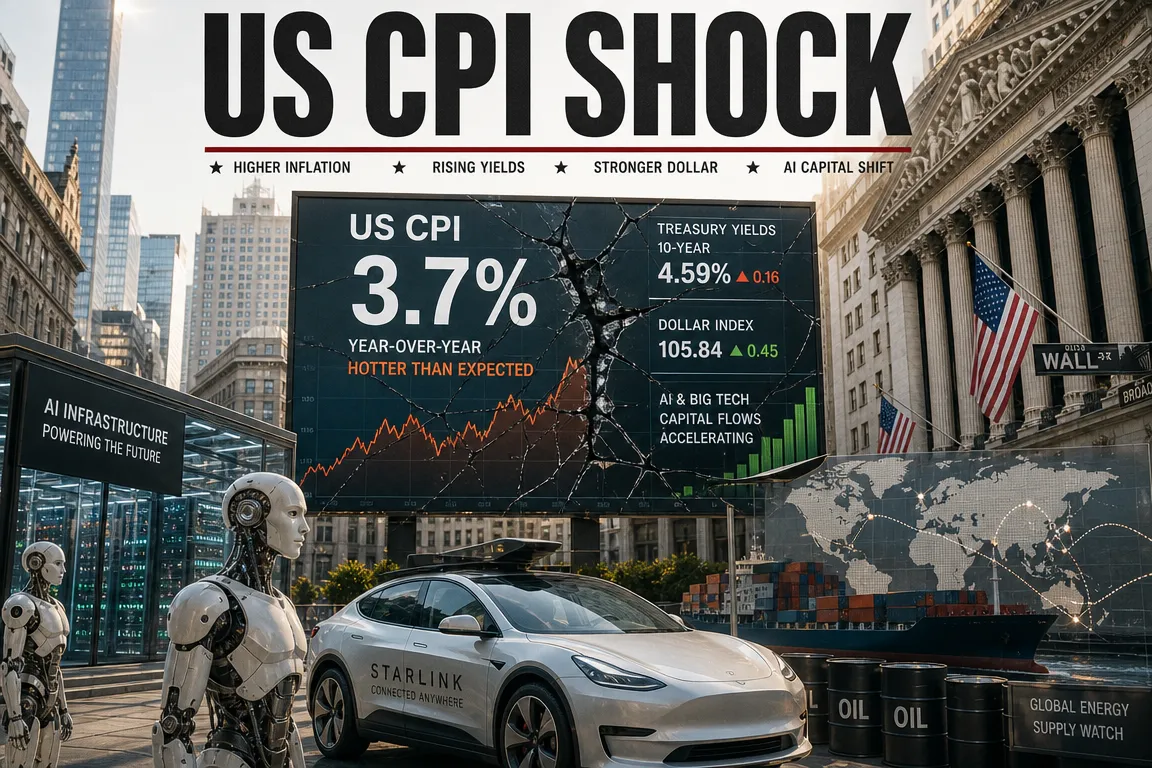
The main driver was the September Consumer Price Index.
Headline CPI rose 3.7% year over year, above the 3.6% consensus estimate.
That was also above August’s 3.4%, reviving concerns about inflation reacceleration.
Core CPI, excluding food and energy, came in at 2.6%, also above expectations.
The largest contributor was gasoline.
Gasoline prices rose 9.1% in one month and accounted for more than half of the overall increase.
Higher fuel prices raise consumer pressure and reduce expectations for rate cuts.
They also increase the likelihood of tighter monetary policy.
Before the inflation data, the market had priced roughly a 20% probability of a rate hike. After the release, that probability nearly doubled, according to the source.
This matters directly for Tesla.
Higher interest rates increase auto financing costs and weigh on electric vehicle demand.
Tesla, as a long-duration growth stock, is also sensitive to higher discount rates.
2. AI investment enthusiasm is showing signs of strain: data-center stocks sold off sharply
Another notable development was the sharp decline in AI data-center-related names.
Companies leasing Nvidia chips and operating data centers came under pressure, with CoreWeave reported down 15.5%.
The source attributed part of the move to Gartner’s view that 80% of such companies may fail to survive through 2030.
This is important for the broader market.
Investors have treated AI infrastructure spending as a growth engine with automatic monetization.
That view is shifting toward scrutiny of whether capital expenditures are translating into revenue.
This also has indirect implications for Tesla.
Tesla’s investment case includes autonomy, FSD, Optimus, AI chips, and robotaxi initiatives.
As the market becomes more selective on AI spending, Tesla will need to demonstrate monetization rather than rely on narrative value alone.
3. Middle East risk and oil prices: what looks like a Tesla story is also a macro story
The source also mentioned that a Singapore-flagged container vessel near the Strait of Hormuz was struck by an unidentified object, caught fire, and sank.
All 21 crew members were safe, but more than 20 vessels had reportedly been attacked this month.
Traffic through the Strait of Hormuz was said to be down about 40% from prewar levels.
For Tesla investors, this matters.
Higher oil prices can support the long-term case for electric vehicles.
At the same time, they intensify inflation and raise pressure on U.S. rates.
In other words, higher oil prices may support the product narrative for EVs while weighing on Tesla’s valuation.
4. Barclays’ Tesla-SpaceX merger view: announcement could come before December
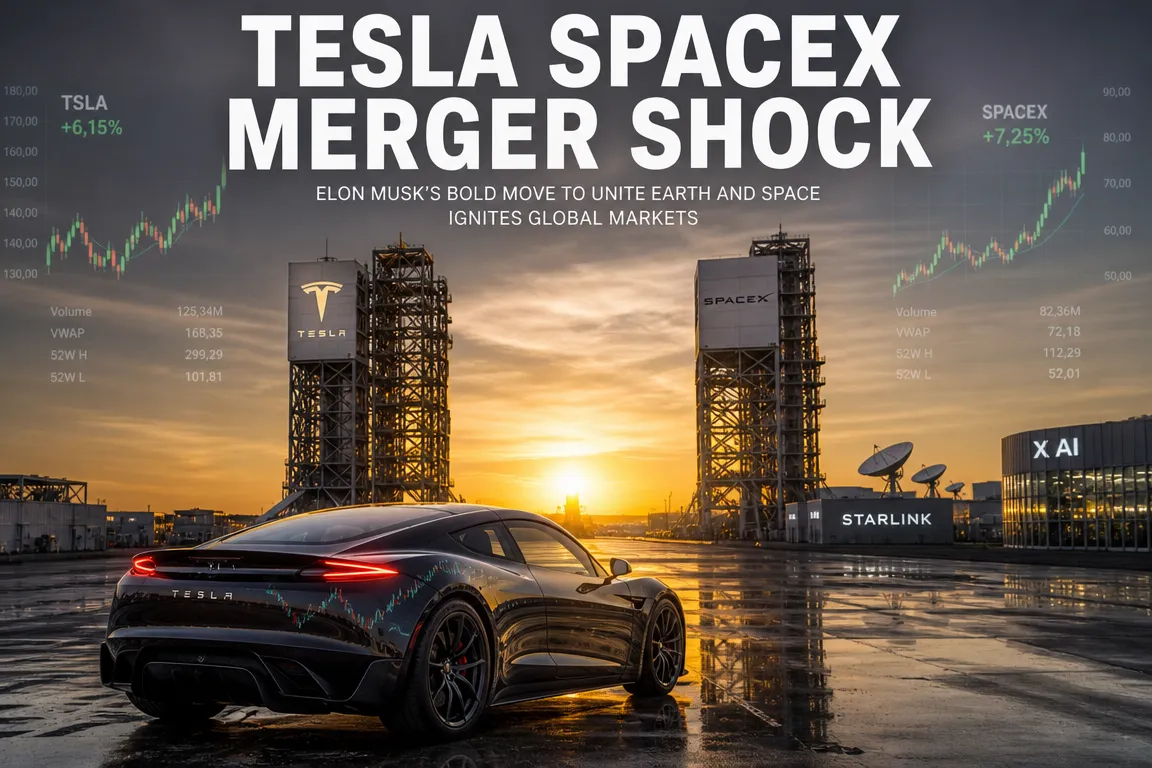
The most significant headline was Barclays’ view that a Tesla-SpaceX merger announcement could come before December.
According to the source, this was reported through Bloomberg and appeared after the U.S. market close, so it was not the direct driver of that day’s Tesla decline.
The merger speculation itself is not entirely new.
The source says Bloomberg reported in January that SpaceX was considering a merger with Tesla.
During Tesla’s July earnings call, Elon Musk did not directly dismiss the question.
The source also cites Wedbush’s Dan Ives as assigning an 80% probability of a merger sometime next year.
The difference this time is that a major bank mentioned a timing window “before December.”
The market’s interpretation is tied to Tesla’s shareholder meeting schedule.
Under Texas law, the annual meeting must be held within 13 months. If last year’s meeting was on November 6, this year’s effective deadline would be early December.
A merger would require shareholder approval.
That means a formal announcement would need to come before the matter could be placed on the meeting agenda.
However, one key point remains.
Neither Tesla nor SpaceX has made an official announcement.
There is no confirmed merger agreement, negotiation disclosure, or filing.
Barclays’ view is an analyst call, not an official company plan.
5. Why the Roadster unveiling is tied to the merger thesis
The Tesla Roadster unveiling may be more than a product event.
The source says it is being held at SpaceX’s rocket test site in Waco, Texas.
That would make it a symbolic demonstration of a Tesla vehicle being unveiled at a SpaceX facility.
The key feature is the SpaceX package.
The package reportedly uses compressed gas thrusters integrated into the vehicle.
That concept is linked to rocket attitude-control systems.
Elon Musk has said the setup could allow the car to accelerate from standstill to 97 km/h in less than one second.
When the Roadster was first shown in 2017, Tesla said 0-60 mph acceleration would take 1.9 seconds.
With the SpaceX package, the figure would roughly be cut in half.
The source says The Information reported that the vehicle may briefly lift off the ground during the demonstration.
Electrek reported that the test vehicle could move remotely without a driver.
The outdoor venue also has regulatory context.
The event was originally scheduled for October 1, but delayed by strong winds for about two weeks.
The source says the FAA imposed a flight restriction of about 3 km above the test site during the initial schedule.
Musk said attendees would need to see the event in person to believe it was not AI-generated footage.
In another interview, he said excitement is guaranteed, but success is not.
6. The key question on the Roadster is not whether it flies
Many investors may focus on whether the Roadster actually lifts off the ground.
From an investment perspective, the more relevant issues are:
- Final price: The base price was previously cited at $200,000, or about 270 million won.
- Final specifications: The estimated range of about 1,000 km and whether the SpaceX package is included.
- Production timeline: First shown in 2017, promised for production in 2020, and now discussed as potentially launching in 2027 or 2028.
The reservation terms are also material.
According to the source, buyers paid a $5,000 card deposit and had to wire an additional $45,000 within ten days.
Electrek noted that reservation holders waiting since 2017 care less about a stunt and more about whether the car will actually be delivered.
The Roadster will not change Tesla’s total sales volume or near-term earnings materially.
It is a premium, limited-volume symbol model.
Still, it matters because it is the first major public demonstration of a product jointly associated with Tesla and SpaceX.
That is why the merger rumor is drawing heightened attention ahead of the unveiling.
7. SpaceX’s real value: not just a rocket company, but a switch controlling war and communications
SpaceX should not be viewed only as a rocket-launch company.
The more important issue in the source is the role of Starlink and Starshield in Ukraine.
Ukrainian forces have used Starlink receivers on drones for satellite-guided control.
The source says this has helped inflict significant damage on Russian forces.
For military use, the system is referred to as Starshield.
Recently, some Ukrainian units have claimed that drone speeds above 160 km/h caused signal loss.
Some units said the signal dropped at even lower speeds.
The source says there was no advance notice.
It is not confirmed whether this was a policy decision or a technical limitation.
However, Ukrainian officials reportedly suspect U.S. pressure, especially in connection with demands to stop attacks on Russian refineries.
Musk distinguished between Starlink and Starshield.
He said Starshield is owned and controlled by the U.S. government, and that speed or usage restrictions are determined by the military and ultimately the president.
By contrast, Starlink is SpaceX’s commercial service and cannot be used for offensive military operations.
In simple terms, if SpaceX built the vehicle, Starshield is like a government-owned patrol car.
The manufacturer is SpaceX, but the government decides whether to use it, how fast it can go, and where it is deployed.
8. Why the U.S. government depends on SpaceX
One important number in the source is that SpaceX handled 11 of 12 U.S. national-security satellite launches last year.
This implies SpaceX has become difficult to replace within America’s space-launch infrastructure.
The Starshield contract value was cited at about $6 billion.
Ukraine and Europe are discussing alternatives to Starlink, but no comparable satellite network exists at the same scale.
That is why a single signal disruption can trigger direct responses from top officials.
Another important point is SpaceX’s revenue mix.
Musk reportedly said about 90% of SpaceX revenue comes from commercial operations, while government revenue is less than 5%.
In other words, most revenue comes from consumer Starlink users, but strategic influence is concentrated in defense applications.
That gap is central to SpaceX’s valuation.
9. The $50 trillion SpaceX projection: attractive, but not to be taken at face value
Investor Ron Baron said SpaceX could grow from roughly $2 trillion today to $20 trillion to $50 trillion over the next decade, according to the source.
It also said Starlink alone could be worth $14 trillion to $15 trillion, and that space-based data centers could be worth several times that amount.
Musk responded to the post with an affirmation.
This matters to Tesla shareholders for a simple reason.
If Tesla and SpaceX were to merge, Tesla holders could indirectly gain exposure not only to EVs, autonomy, and robotics, but also to Starlink and space-data-center growth.
If AI data-center demand continues to collide with land, power, and cooling constraints on Earth, the space-data-center concept could become a long-dated investment theme.
However, the numbers should be treated cautiously.
Baron is a long-standing bull on Tesla and SpaceX.
The source also says SpaceX is trading at about 110 times last year’s revenue of $18.7 billion.
That suggests much of the future growth may already be reflected in the valuation.
10. Tesla shareholders would not receive SpaceX for free
One common misconception is that a Tesla-SpaceX merger would automatically give Tesla shareholders free SpaceX shares.
That is not necessarily how it would work.
If Tesla were to acquire SpaceX through a stock-for-stock transaction, Tesla shareholders would retain Tesla shares while SpaceX shareholders could receive newly issued Tesla shares.
In that case, Tesla holders would own a larger combined company, but their ownership percentage would be diluted.
If a new combined entity were created, both shareholder groups could receive shares in the new company according to a negotiated ratio.
The source notes that, using a simple comparison, Tesla at $367.16 and SpaceX at $152.16 implies Tesla is worth 2.41 SpaceX shares.
By that logic, 100 Tesla shares would correspond to the value of 241 SpaceX shares.
RBC was cited as saying Tesla shareholders could demand a 25% to 30% premium.
At a 25% premium, 100 shares would translate to about 300 shares, and at 30%, to about 314 shares.
That is only a simplified price comparison.
A real merger would need to reflect valuation, premium, voting rights, debt, taxes, regulatory approval, and shareholder consent.
For Tesla shareholders, the key question is not whether a merger happens, but what exchange ratio and premium are offered.
11. The biggest conflict: Elon Musk sits on both sides of the table
If a merger proceeds, the most sensitive issue will be conflict of interest.
According to the source, Musk owns about 20% of Tesla and holds roughly 85% of the voting power at SpaceX.
That means the same person has significant influence on both the seller and the buyer side.
In such a structure, merger terms are likely to face scrutiny over which side benefits more.
That is why formal process matters.
The first signal would be whether Tesla’s board forms an independent special committee.
It would also matter whether an investment bank issues a fairness opinion.
SEC filings, shareholder-meeting materials, and voting timelines would also need to be reviewed.
Musk’s comment during the July earnings call that any merger discussion would need to follow formal procedures is consistent with that framework.
Formal procedure effectively means an independent committee and fairness review.
12. The hidden major variable is China and the Shanghai Gigafactory
While many headlines focus on merger probability, the larger variable may be China.
Tesla’s Shanghai Gigafactory is not simply an overseas plant.
It can produce more than 950,000 Model 3 and Model Y vehicles annually.
It is a strategic manufacturing hub tied to nearly half of Tesla’s quarterly deliveries.
Shanghai is also central to Tesla exports to Asia and Europe.
If Tesla had to spin off or restructure its China business to enable a merger, that would not be a simple equity adjustment.
It would require redesigning Tesla’s manufacturing structure.
The source says the Wall Street Journal reported in July that Tesla had explored a China business spin-off or sale to open the path for a merger.
Musk and Tesla China denied that report as false.
Still, the Barclays-related coverage said regulatory approvals from China and other jurisdictions would be the main obstacle.
For Tesla shareholders, the key questions are:
First, whether Tesla explicitly says it will keep the Shanghai factory intact.
Second, whether it signals any willingness to change the business structure to enable a merger.
13. A real merger process could take much longer than expected
Barclays referred to a possible merger announcement, not a completed merger.
Those are very different things.
If a merger is announced, both companies are likely to form independent committees.
Investment banks would review whether the exchange ratio is fair.
Filings would be submitted to the SEC.
Shareholder meetings and votes would follow.
Approvals from multiple regulators would also be needed.
Tesla’s 2016 acquisition of SolarCity took about four months from announcement to completion, even though foreign regulatory complexity was limited.
A Tesla-SpaceX merger would be far more complex.
It would involve EVs, autonomy, rockets, satellite communications, defense contracts, and China’s manufacturing base.
14. The hidden core issue: this is not just Tesla expansion, but a restructuring of U.S. strategic infrastructure
The first hidden point is that the issue is less about Tesla’s stock price and more about the integration of U.S. strategic infrastructure.
Tesla has EVs, batteries, autonomy, robots, and AI manufacturing capability.
SpaceX has rockets, satellite internet, Starlink, Starshield, and space infrastructure.
If the two companies combine, the entity could be reclassified not simply as a mobility company, but as an energy, AI, communications, and defense infrastructure platform.
The second hidden point is the link between AI data centers and space data centers.
Land-based AI data centers are increasingly constrained by power, cooling, land, and regulation.
Space-based data centers are being discussed as a long-term solution.
It remains a distant concept, but lower launch costs could make it more plausible over time.
The third hidden point is that SpaceX’s government revenue may be small, but its strategic influence is outsized.
Most revenue comes from commercial operations, but Starshield can determine operational capability in wartime.
Such a company is valued differently from a typical consumer business.
Network effects, strategic control, and irreplaceability may matter more than the income statement.
The fourth hidden point is that the first signal for Tesla shareholders is not the stock chart but board-level disclosure.
Any announcement of an independent committee would signal that the merger story has moved beyond rumor.
The annual meeting date and agenda would also be critical.
Any mention of the Shanghai business would indicate that regulatory risk has become central.
15. What Tesla shareholders should monitor now
- Tesla shareholder meeting schedule: Whether the annual meeting is held before early December and whether an agenda is disclosed.
- Independent committee formation: The first formal step toward addressing Musk’s conflict-of-interest concerns.
- Merger ratio and premium: The most direct economic terms for Tesla shareholders.
- China regulatory issues and the Shanghai factory: One of the main obstacles in any approval process.
- Roadster unveiling details: Final price, specifications, and production timing.
- Starlink and Starshield policy: A window into SpaceX’s strategic value and political risk.
- AI data-center sentiment: A gauge for whether the space-data-center thesis is a long-term growth theme or speculative excess.
< Summary >
Barclays said a Tesla-SpaceX merger announcement could come before December.
The key issue is not whether a merger occurs, but what exchange ratio and premium Tesla shareholders would receive.
The Roadster unveiling may serve as a symbolic demonstration of Tesla-SpaceX technical integration.
SpaceX should be viewed not only as a rocket company, but as a strategic platform for Starlink, Starshield, satellite communications, and defense infrastructure.
The main variables are Elon Musk’s conflict of interest, Tesla’s independent committee process, China regulation, and the Shanghai Gigafactory.
Tesla shareholders should focus first on meeting dates, board disclosures, merger terms, and any statements related to China.
[Related Articles…]
*Source: [ 오늘의 테슬라 뉴스 ]
– 월가 “테슬라·스페이스X 12월 전 합병 발표 가능” — 스페이스X 50조 달러 전망까지, $367 테슬라 주주는?
● CPI Shock, CoreWeave Crash, Anthropic Slowdown
Three Headwinds Tempering Expectations for KOSPI 6,000: U.S. CPI, CoreWeave Bond Decline, and Anthropic Growth Slowing
The key issue in today’s market is not simply that equities sold off.
The stronger-than-expected U.S. CPI print weakened rate-cut expectations, while a sharp decline in CoreWeave’s corporate bonds highlighted credit risk in the AI infrastructure sector.
In addition, Anthropic’s slower third-quarter revenue growth reignited questions about whether AI can generate sufficient economic returns.
As a result, this correction should be viewed as a composite risk factor affecting the KOSPI outlook, U.S. CPI, rate-cut expectations, the AI bubble debate, and semiconductor equities simultaneously.
1. First Headwind: U.S. CPI Pressures the Market Again
The first factor weighing on markets was the U.S. inflation reading.
When U.S. CPI comes in above expectations, investors immediately focus on interest rates.
Sticky inflation implies that the Federal Reserve is unlikely to accelerate rate cuts.
A retreat in rate-cut expectations typically increases pressure on equities.
- Persistently elevated inflation increases the burden on the Fed’s policy stance.
- The timing of rate cuts may be pushed back.
- Higher U.S. Treasury yields pressure growth-stock valuations.
- A stronger dollar can trigger foreign capital outflows from emerging markets.
- Ultimately, export-oriented markets such as the KOSPI are directly affected.
The KOSPI is particularly exposed because it has been priced for upside in semiconductors, secondary batteries, and AI infrastructure.
In such an environment, higher rates increase the discount rate applied to future growth expectations, creating valuation pressure.
2. Second Headwind: CoreWeave Sell-Off Highlights Bond Risk, Not Just Equity Volatility
The second shock came from CoreWeave, an AI cloud infrastructure company.
CoreWeave is a leading provider of AI cloud services built on Nvidia GPUs and is seen as a symbol of the AI investment cycle.
However, the market’s focus was not on the equity decline alone.
The key issue was the sharp deterioration in CoreWeave’s corporate bond prices.
Equity markets can support valuations through expectations.
The bond market is different.
Bond investors are primarily concerned with whether a company can service its debt.
- The decline in CoreWeave bonds indicates rising concerns over default risk.
- Large-scale GPU investment and data center expansion are placing significant funding demands on AI infrastructure companies.
- In a high-rate environment, higher borrowing costs increase pressure on cash flow.
- If AI demand does not translate into revenue quickly enough, financial risk can widen.
The significance of this development is that the weakest link in the AI sector may lie in credit markets rather than equities.
For the AI theme to remain intact, companies must demonstrate not only revenue growth but also sustainable access to capital.
3. Third Headwind: Anthropic Q3 Results Raise Concerns About Slowing Growth
The third factor was Anthropic’s third-quarter revenue-related figures.
Anthropic operates Claude, a major competitor to ChatGPT, and has been closely watched as a leading AI company.
The market had been expecting continued exponential growth.
What unsettled investors was the slowdown in revenue growth.
According to the source data, Anthropic’s quarter-over-quarter revenue growth slowed from 145% to 46%.
While 46% remains exceptionally strong by conventional corporate standards, the issue was the gap versus expectations.
- AI companies are already valued on the assumption of very high growth.
- When growth slows, investors begin revising future revenue estimates downward.
- Positive free cash flow in the third quarter was a constructive factor.
- However, the market was more sensitive to whether growth momentum had peaked.
In effect, the Anthropic data increased questions about the pace of monetization in AI services.
Usage may be rising, but the market remains unconvinced that such usage is being converted into sufficient revenue and profit.
4. Why This Matters for the KOSPI
Although these developments appear to be U.S.-based, their impact on the KOSPI is material.
Korean equities are highly sensitive to the global AI investment cycle and semiconductor conditions.
- Expanded AI data center investment supports demand for HBM, memory chips, and server components.
- Samsung Electronics and SK Hynix, two core KOSPI constituents, are closely tied to global AI infrastructure spending.
- If concerns about AI investment sustainability rise, the valuation premium on semiconductor equities may narrow.
- Higher U.S. rates also weigh on foreign investor flows.
- As a result, the KOSPI outlook may become more conservative.
In other words, this was not merely a domestic market decline.
It reflected simultaneous pressure from U.S. inflation, global rates, AI credit risk, and semiconductor demand expectations.
5. The Core Question Market Participants Are Asking: Can AI Generate Profits?
The central issue is not whether AI is an important technology.
That is already broadly accepted by the market.
The real question is whether AI can generate returns greater than the capital invested.
The AI industry currently requires substantial upfront spending.
Companies must acquire GPUs, build data centers, secure power supply, and operate cloud infrastructure.
However, it remains unclear whether AI subscriptions and API usage fees are sufficient to cover these costs.
- AI infrastructure companies face heavy capital expenditure requirements.
- AI model companies bear significant training and inference costs.
- AI cloud companies face leverage and long-term contract risk.
- Large-cap technology firms can absorb these costs, but smaller AI companies are more sensitive to funding conditions.
CoreWeave and Anthropic together point to the same conclusion.
AI sector growth does not mean every AI company is profitable.
6. The Key Point Often Missed Elsewhere: The Weak Link in the AI Rally May Be Debt, Not Revenue
The most important point in this market move is that the bond market reacted first.
Equity investors favor growth narratives.
Bond investors focus on balance sheet fundamentals.
They look first at interest expense, maturity schedules, cash flow, collateral value, and financial stability.
Even if AI revenues grow, the market will view the sector as risky if debt burdens rise faster.
This problem is more pronounced in a high-rate environment.
- AI infrastructure firms borrow against GPUs.
- GPU prices and demand must remain stable for collateral values to hold.
- If customer contracts weaken, forward cash flow assumptions also weaken.
- Bond price declines increase future financing costs.
- Equity valuations then come under pressure as well.
This is a more immediate concern than the general AI bubble debate.
AI can be a transformative technology while still leaving some companies with fragile financial structures.
7. Key Indicators to Watch Next
For now, markets are likely entering a period in which more variables must be confirmed before stability returns.
The following indicators will be important:
- U.S. CPI and PCE inflation: The pace of disinflation will determine rate-cut expectations.
- U.S. Treasury yields: If the 10-year yield rises again, growth stocks and AI-related names will face renewed pressure.
- CoreWeave bond performance: Bond prices and yields may provide a more important signal than the equity price.
- Anthropic revenue growth: Investors need to determine whether the slowdown is temporary or structural.
- Big Tech CAPEX plans: Microsoft, Amazon, Google, and Meta remain key drivers of AI investment demand.
- Semiconductor order flows: Demand for HBM and server memory must be confirmed in actual orders.
- Foreign investor flows: The KOSPI remains highly sensitive to foreign buying and selling trends.
8. What Investors Should Focus on Now
This is not a time for panic, but neither is it an obvious dip-buying opportunity.
The more important issue is that stock selection within AI may become increasingly selective.
- Investors should distinguish between companies with stable cash flow and those supported mainly by expectations.
- AI infrastructure companies with high leverage are more exposed to interest-rate conditions.
- For semiconductor stocks, actual orders and pricing trends matter more than short-term volatility.
- The KOSPI must be analyzed together with U.S. rates and dollar trends.
- Rather than saying the AI investment cycle is over, it is more accurate to say the market is moving into a phase of profitability validation.
At this stage, the market is no longer moving on the premise that AI is simply important.
Going forward, the key will be how much AI earns, how much margin it retains, and how much debt it can sustain.
< Summary >
There are three main headwinds behind today’s KOSPI decline.
First, the U.S. CPI report reduced expectations for imminent rate cuts.
Second, the decline in CoreWeave’s bonds highlighted credit risk in AI infrastructure.
Third, slower third-quarter revenue growth at Anthropic raised concerns about AI monetization.
The core issue is not AI technology itself, but whether AI companies can generate profits sufficient to support their investment spending and debt loads.
Going forward, investors should monitor U.S. inflation, Treasury yields, AI company bonds, Big Tech CAPEX, and semiconductor demand together.
[Related Articles…]
*Source: [ 내일은 투자왕 – 김단테 ]
– 코스피 6000도 깨버린 3가지 이유 #코스피 #코어위브 #앤트로픽